Whose story is this? This question must be the beginning of a new pedagogy of education in history, and remain central to the project of its study. True education in the discipline of history asks Socratic questions and teaches methods of research, analysis, interpretation, and the publishing and presentation of insights and discoveries to be interrogated in open debate in a public forum; education in general teaches us to interrogate and test claims of truth.
Among his many lies and crimes in the subversion of our democracy, Our Clown of Terror, Traitor Trump, proclaimed a triumph of propaganda in authorizing an official state version of historical truth, whose purpose is to institutionalize the Mayflower Puritan/Pilgrim mythos as a competing narrative of national origins to the 1619 hypothesis. We must disavow and ignore the authorization of identity and government disinformation facets of this anniversary and instead make the public debate and interrogation of competing narratives itself the heart of our national story and curriculum.
Myths of colonialism, fictive inventions of national origin, and the roots of fascisms of blood, faith, and soil combine viciously in our triumphalist narratives of the Puritans as founders of America. Though the Mayflower Compact was signed November 21 1620, its celebrations have been historically promoted through our schools as a year round ongoing campaign and glorification of the Conquest and the idea that American identity is founded in the Puritans as an iconography of racial and religious superiority. This I cannot abide, so say I in paraphrase of the hero in the film Inglorious Basterds; can you abide it?
As we learn from John Cage in music, Harold Pinter in theatre, and Piet Mondrian in art, it is the blank spaces which define and order meaning; and in history it is the silenced and erased voices to which we must listen most carefully, for here the emptiness speaks to us of secret power and of the key functions and relationships which authority must conceal to maintain its hegemony over us.
Always pay attention to the man behind the curtain.
We must ask ourselves as we raise our children to become citizens and as we ourselves continue to learn throughout our lives, Whose story is this?
The Idea of Thanksgiving and American Identity, a reading list
Legacies of America’s Founding Fascist State: Slavery
The 1619 Project: A New Origin Story, by Nikole Hannah-Jones
History, memory, identity, the stories we tell about ourselves and those told about us by others including those who would enslave us, who are and can become and who decides; all of this is a ground of struggle against systems of oppression, falsification, commodification, and dehumanization, and often a shifting ground, constructed of relative truths as a Rashomon Gate of human being, meaning, and value.
Brazil’s embrace of a national holiday on the date of the great slave revolt leader Zumbi’s death in glorious battle at the hands of colonialist forces is a case study of what I term the Narrative Theory of Identity, in which self construal is a form of revolution and the primary defining act of becoming human.
Celebrate with us the great warrior, King, and figure of liberation Zumbi and his defiance unto death of those who would enslave us, and the free republic of Palmares he led in anticolonialst revolution and a century long war of independence against vast forces of imperial conquest and dominion and systems of white supremacist oppression and terror, whoever he may have been and whatever rebel kingdom he championed, for all that truly matters is that he holds an imaginal space we each of us may step into and become, no matter the wretchedness of our initial conditions.
That a man lived and was real who refused to submit is enough for us to remember and dream into being, for each of us may become that man who we dream.
As written by Tiago Rogero in The Guardian, in an article entitled Brazil celebrates Black Consciousness Day as national holiday for first time: Legacy of African Brazilians honored on 329th anniversary of resistance leader Zumbi’s death by Portuguese forces; “During the more than 350 years during which slavery was legal in Brazil, harsh conditions prompted a string of uprisings, often resulting in the establishment of quilombos – independent communities formed by escaped Africans who were formerly enslaved, and their descendants.
None were more prominent than the one known as Palmares, where, in the 17th century, as many as 11,000 people lived in a string of communities across parts of the north-eastern states of Alagoas and Pernambuco.
But the roughly 100-year history of what historians regard as the most significant resistance movement against slavery in Brazil began to unravel on 20 November 1695, when its most famous leader, Zumbi, was captured by Portuguese colonial forces and killed.
Three hundred and twenty-nine years later, the date will for the first time be marked as a national public holiday: Black Consciousness Day, which has been a longstanding demand of Black movements that still face attacks from the far right.
A series of events – including at least 38 in São Paulo alone – will mark the date nationwide, celebrating Zumbi, Palmares and the ongoing fight for racial equality.
“Palmares was the largest quilombo in the Americas, both in terms of its longevity and population,” said Danilo Luiz Marques, a historian and professor at the Federal University of Alagoas.
Some researchers have described Palmares – whose first records date back to 1590 – as the earliest form of a republic to emerge on Brazilian soil. Marques, however, argues that it was a Bantu kingdom, reflecting the central-African language family to which most Africans brought to Brazil belonged.
Black movements in Brazil have celebrated the names of Zumbi and Palmares since the early 20th century at the earliest, but it was only in 1971 that 20 November became a key date.
Activists had sought a date to contrast with another historically associated with Black people: 13 May, the day slavery was abolished in 1888.
Rather than celebrating Black individuals, however, 13 May had traditionally been used to exalt the white princess who signed the abolition decree: Isabel, then the regent of the Brazilian empire.
“The princess was glorified as if she had granted a favour to the enslaved people; as if she were a heroine,” said Deivison Campos, a historian and professor at the Pontifical Catholic University of Rio Grande do Sul.
“The Palmares group sought to counter this narrative, proposing 20 November as a way to honour the collective struggle for the inclusion of Black people in Brazilian society,” he said.
Today, 13 May is still celebrated, with Black activists arguing it cannot be ignored since abolition was primarily the result of Black resistance. However, 20 November has become so popular that November is now informally known as Brazil’s Black Consciousness Month.
The law to make Black Consciousness Day Brazil’s 10th national holiday – signed by President Luiz Inácio Lula da Silva in December 2023 – was passed amid significant resistance from conservatives.
During the presidency of far-right leader Jair Bolsonaro, Sérgio Camargo, the then head of the Palmares Foundation – a federal body established in 1988 to promote African-Brazilian culture – harshly criticised the 20 November holiday, labelling it the Day of Black Victimisation, the Day of the Black Mind Enslaved by the Left or the Day of Resentment for the Past.
Some within the far-right even doubt the existence of Palmares or its most famous leader despite extensive historical evidence. “Falsehoods have always been used to attack Black history,” said Marques.
Brazil’s largest television network, Rede Globo, will mark the date with a 50-minute primetime special focusing on the wrongful imprisonment of Black individuals based on photographic identification – a widespread issue in the country.
“In Brazil, Black people continue to be imprisoned, deprived of freedom, a healthy life and the chance to realise their dreams simply because they are Black,” said the special’s creator and presenter, Clayton Nascimento.
“It’s important that 20 November is, for the first time, a public holiday because it allows us to pause and reflect on Brazil’s Black history. We were the ones who built this nation,” he added.”
As written in 2019 by Laurence Blair in The Guardian, in an article entitled History of free African strongholds fires Brazilian resistance to Bolsonaro: Quilombo dos Palmares – founded by Africans who escaped slavery – maintained its independence for 100 years and has become a touchstone for a new generation; “Apalm-fringed ridge rises above the plains of Alagoas in north-east Brazil. Just a few replica thatched huts and a wall of wooden stakes now stand at its summit, but this was once the capital of the Quilombo dos Palmares – a sprawling, powerful nation of Africans who escaped slavery, and their descendants who held out here in the forest for 100 years.
Its population was at least 11,000 – at the time, more than that of Rio de Janeiro – across dozens of villages with elected leaders and a hybrid language and culture.
Palmares allied with indigenous peoples, traded for gunpowder, launched guerrilla raids on coastal sugar plantations to free other captives, and withstood more than 20 assaults before falling to Portuguese cannons in 1695.
“Hundreds threw themselves to their deaths rather than surrender,” said local guide Thais “Dandara” Thaty at the historical site in Serra da Barriga. In her telling, those killed included Dandara – her adoptive namesake – captain of a band of warrior women, whose husband Zumbi is similarly shrouded in myth as a fearless Palmarian commander.
About 5 million enslaved Africans were brought across the Atlantic to Brazil between 1501 and 1888. Many escaped, forming quilombos, or free communities.
Three centuries later, the remarkable saga of Palmares is being seized on once more as a symbol of resistance against Brazil’s rightwing president and the country’s pervasive racism towards its black and mixed-race majority.
A pair of new television and Netflix documentaries, screened in late 2018 and this June, have examined the legacy of Palmares. In March, the victorious carnival parade of Mangueira samba school highlighted Dandara among a lineup of overlooked black and indigenous heroes. Later that month, Brazil’s senate voted to inscribe Dandara in the Book of Heroes in the Pantheon of the Fatherland, a soaring, modernist cenotaph in Brasília.
Angola Janga, a graphic novel charting the rise and fall of Palmares, has won a string of awards. “Many people want an alternative view, to try to escape the one-sided, one-dimensional vision of our history imposed by the Portuguese and Brazilian elite,” said author Marcelo D’Salete, whose painstakingly researched book, including maps and timelines alongside striking monochrome illustrations, has been widely used in classrooms.
“Quilombos in general are very big right now,” said Ana Carolina Lourenço, a sociologist and adviser to one recent documentary on Palmares. Young Afro-Brazilians have even coined a verb, she added – to quilombar – meaning to meet up to debate politics or simply celebrate black music, culture and identity.
This renewed prominence coincides with a sharp rightward turn in Brazilian politics. Jair Bolsonaro has denied that Portuguese slavers set foot in Africa, and vilified the roughly 3,000 quilombos dotted across Brazil today – poor and marginalised Afro-Brazilian communities, often descended from fugitive slaves – branding their residents “not even fit for procreation”.
The president has sought to erode the landholding rights of quilombo communities in favour, critics argue, of the powerful agribusiness sector. Police killings, mainly of Afro-Brazilians, in Rio de Janeiro and São Paulo have also risen sharply in 2019 with Bolsonaro’s encouragement.
Earlier this month, footage of supermarket security guards whipping a bound and gagged black teenager for allegedly shoplifting, prompted reflections on the lasting legacy of slavery.
For centuries, writers portrayed Palmarians merely “as runaway blacks and outlaws who rebelled against the crown”, said the Alagoas historian Geraldo de Majella.
It was only in the mid-20th century that historians began to reconstruct its story via Portuguese archives, often in Marxist terms. Meanwhile, “black militant movements took up the flag of Palmares as a movement of national liberation,” De Majella explained. The largest guerrilla group during the 1964-85 military dictatorship – the Palmares Armed Revolutionary Vanguard – counted former president Dilma Rousseff among its members.
Lula, the former president, simultaneously bolstered recognition of Palmares and the legal rights of present-day quilombos. 20 November – the date the Palmarian leader was killed – was officially adopted as the National Day of Zumbi and Black Consciousness in 2003.
In the same year, public schools were legally required to teach Afro-Brazilian history.
But limited archaeological evidence and the absence of Palmarian sources has encouraged freewheeling interpretations. Today, perhaps drawing on the historical presence of advanced metalworking at the site, some compare Palmares with Wakanda, the hi-tech, Afrofuturist utopia of Marvel’s Black Panther.
But the inclusion of Dandara – whose first written mention occurs in a 1962 novel – in the Pantheon divided opinion. “I absolutely defend creative freedom in the way people look at our history,” said D’Salete. “But we need to take care to differentiate between fact and fiction.”
Fernando Holiday, an Afro-Brazilian YouTuber and conservative activist, has noted that Palmarian society had monarchical elements and also kept captives. “I’m sorry to disappoint leftist and black leaders, but today we’re commemorating a farce,” Holiday said in a video. “Zumbi wasn’t a hero of abolition.”
But Palmares and other examples of revolt and resistance, D’Salete argued, “are important as other ways of understanding our history … so people can imagine and build another kind of society that is very different to one just based on violence and oppression”.
That legacy of violence is apparent in Tiningu, a remote quilombo in Pará state. The community has battled to receive legal recognition, threatened by the ranchers and landowners who have cut down much of the surrounding rainforest. One resident was murdered by a rival soybean farmer on the eve of Bolsonaro’s election. Here, Palmares is not merely history but a source of hope.
“Zumbi was the beginning of everything,” said local teacher Joanice Mata de Oliveira, whose school is daubed with the names of African nations. “He was the one who began our fight.”
As I wrote in my post of January 12 2023, A History of the Revolution in Brazil and Fascist Counter-Revolution: Liberty Versus Tyranny, Lula Versus Bolsonaro; In the wake of the collapse of Bolsonaro’s fascist counter-revolution and coup attempt in Brazil, Lula’s swift reaction in the mass arrests of the treasonous brownshirts who stormed the offices of the government in imitation of Trump’s failed January 6 Insurrection, itself modeled on his idol Hitler’s Beer Hall Putsch, and the stunning nationwide repudiation of Bolsonaro and his failed capture of the state by the victorious peoples of Brazil, has now begun a new phase of struggle with the manhunt for those who fund and organize fascist tyranny, much like that ongoing now in America for two years.
An insidious and far reaching conspiracy against democracy linking the Trump and Bolsonaro crime families and the forces of reaction in America and Brazil begins to emerge, mixing familiar malefactors and Fourth Reich apologists like Steve Bannon and Tucker Carlson with unknown freaks of nature like Luiz Philippe de Orléans e Braganza, who seeks a return to the throne of Brazil through Trump and Bolsonaro as proxies and is now scuttling from beneath his rock like the ravenous and vile crawling thing all aristocrats are beneath their gold paint, conspiracies which widen to engulf whole networks of white supremacist terror, theocratic patriarchal sexual terror, plutocratic and oligarchic theft of public wealth as terminal stage capitalism seeks to free itself from its host political system, and the xenophobic and self-righteous carceral states of force and control which they spawn as instruments of elite wealth, power, and privilege.
Our great enemy is the global Fourth Reich, which transforms itself ceaselessly and adapts to the conditions of whatever nation it targets for subversion and capture, and the interconnections between regimes of fascist tyranny are manifold and subtle. Fascism wears many masks, and like an ambush predator in nature moves among us behind mirages of lies and illusions, rewritten histories and stolen voices, images which capture and distort. Here is a ground of struggle in which we all of us must fight, if we are to seize control of our own identity under falsification and division as imposed conditions of struggle.
As written in the Netflix series Wednesday, episode three Friend Or Woe:
“Principal Weems, bracing Wednesday in her office for sabotaging the celebration of the Pilgrim leader who burned the original Outcasts alive and built the town on their stolen land and graves, a story repeated endlessly in our all too real history; “You’re a trouble magnet.”
Wednesday: “If trouble means standing up to lies, decades of discrimination, centuries of treating outcasts like second-class citizens or worse…”
Principal: “What are you talking about?”
Wednesday: “Jericho. Why does this town even have an Outreach Day?
Don’t you know its real history with outcasts? The actual story of Joseph Crackstone?”
Principal: “I do. To an extent.”
Wednesday: “Then why be complicit in its cover up? Those who forget history are doomed to repeat it.”
Principal: “That’s where you and I differ. Where you see doom, I see opportunity. Maybe this is a chance to rewrite the wrongs, to start a new chapter in the normie-outcast relations.”
Wednesday: “Nothing has changed since Crackstone. They still hate us. Only now they sugarcoat it with platitudes and smiles. If you’re unwilling to fight for truth…”
Principal: “You don’t think I want the truth? Of course I do. But the world isn’t always black and white. There are shades of gray.”
Wednesday: “Maybe for you. But it’s either they write our story or we do. You can’t have it both ways.”
Here is a History of the Revolution in Brazil as I have lived it;
As I wrote in my post of October 30 2022, Victory in Brazil: “We are going to live new times of peace, love and hope” vows Brazil’s New President Lula as He Begins the Restoration of Democracy; We celebrate a Forlorn Hope vindicated and become glorious in the victory of the peoples of Brazil and their champion Lula, with dancing in the streets and running Amok beyond the boundaries of the Forbidden.
A monster and tyrant has been driven from his castle, and this is always cause for celebration. We will always have this moment of triumph, and the hope it holds for our future, regardless of the trials to follow. Whether such hope is a gift or a curse is up to each of us to live and make real; but things are now possible which yesterday were not, and this I call victory.
With the words of Glinda to Oz I congratulate Lula and the peoples of Brazil; ‘We’ve waited a long time for you, Wizard.” And we really need you to be the Wizard we hope you are.
A great work now begins, as like Biden in America, Lula in Brazil leads the Restoration of Democracy in a nation whose systems, structures, institutions, values, and ideals have been damaged by fascist subversion, disruption, and fracture, but whose people emerge from the crucible of their forging unconquered and renewed.
One day we will be a United Humankind and a free society of equals, and Lula like Biden will be remembered for as long as there are human beings as among the founders of a new humanity and civilization, whose vision will shape our being, meaning, and value, inform our choices about how to be human together for millennia, and motivate our discover of the limitless possibilities of becoming human.
Let us each do what we can to make the dream of democracy real.
As I wrote in my post of June 3 2021, Brazilians Seize the Streets to Demand the Resignation of Bolsonaro; The horrific death toll of Bolsonaro’s inept and corrupt handling of the Pandemic, the campaign of ethnic cleansing of indigenous peoples, the plunder of public wealth and natural resources by a plutocratic elite, the vast precariat of a nation poised on the edge of collapse; all these and one thing more have brought the people of Brazil into the streets this week to demand the resignation of the tyrant Bolsonaro; the brutal repression of a kleptocratic fascist regime of force and violence.
The use of force and violence fails at the point of resistance and refusal to submit, and power is a fragile and hollow illusion which may be dispelled by exposure and challenge of authority, for who cannot be controlled is free. Regardless of the death squads and sexual terror, of the enormous military might of the government of Brazil as a host structure of racist elite hegemony, a people who do not recognize the authority of the state and who meet repression with disobedience cannot be subjugated.
Every Brazilian in the streets today who challenge and defy state terror has won their freedom, for they cannot be enslaved by those who would be our masters. So begins the end of tyranny in Brazil; we can help the people of Brazil liberate themselves and establish a true democracy as a free society of equals by shaping our policy to such ends.
The people of Brazil have spoken; how shall we answer them?
As I wrote in my post of March 11 2021, Brazil Reclaims Its Heart: the Return of Lula da Silva, Champion of the People; Lula da Silva, Champion of the People, has had the false corruption charges against him overturned and is now free to challenge Bolsonaro for the Presidency of Brazil once again.
This is a historic example of class war, which pits labor leader da Silva directly against capitalist kingpin Bolsonaro, whose regime creates wealth for elites by the de facto enslavement of Blacks and the precariat and the plunder of resources from indigenous peoples, and whose government is controlled from within by a network of some six thousand military officers who enforce his kleptocracy with brutal repression.
Racism, patriarchy, oligarchic and plutocratic wealth, de facto military rule; Brazil today meets all the criteria of fascist tyranny. I look now to Lula to change the balance of power and restore democracy in Brazil.
Of my connection with Brazil and her peoples, stamped into my soul by the trauma of my near-execution by police while rescuing abandoned street children whom they were bounty hunting for the wealthy aristocratic elite, I have written in my post of July 15 2022, Let Hope Overcome Fear: Lula 2022; Among my personal role models in antifascism and revolution is the fictional character of Harry Tuttle played by Robert de Niro in the film Brazil, whose line “we’re all in this together,” echoes through forty some years of my life and adventures.
Let me place this in context; Brazil was my first solo foreign travel experience, flying to Sao Paulo when I was fourteen, in the summer of 1974, to train with some fellow fencers for the Pan American Games which were planned to be held there, though later the venue was moved to Mexico. I had some newly learned conversational Portuguese, an invitation to stay at the home of a boy my age I knew from the fencing tournament circuit with whom I could discover the local mischief, and visions of beach parties.
So it was that I entered a world of courtly manners and white-gloved servants, gracious and brilliant hosts who were local luminaries and threw a magnificent formal ball to introduce me, and a friend with whom I shared a mad passion for martial and equestrian sports, but also a world of high walls and armed guards.
My first view beyond this illusion came with the sounds of rifle fire from the guards; when I looked from my balcony to see who was attacking the front gate I discovered the guards were firing into a crowd of beggars, mostly children, who had mobbed a truck carrying the weekly food supplies. That day I made my first secret excursion beyond the walls.
What truths are hidden by the walls of our palaces, beyond which it is Forbidden to look? It is easy to believe the lies of authority when one is a member of the elite in whose interest they claim to wield power, and to fail to question one’s own motives and position of privilege. Terrifyingly easy to believe lies when we are the beneficiaries of hierarchies of exclusionary otherness, of wealth and power disparity and inequalities systemically manufactured and weaponized in service to power, and of genocide, slavery, conquest, and imperialism.
Always pay attention to the man behind the curtain. For there is no just authority, and as Dorothy says in the Wizard of Oz, he’s “just an old humbug”, and his lies and illusions, force and control, serve no interests but his own.
Being a naïve American boy, I felt it was my duty to report the incident; but at the police station I had difficulty making myself understood. They thought I was there to place a bet on my guard in an ongoing monthly contest for which police officer bagged the most street children; there was a chalkboard on the station wall for this. This was how the elites of Brazil had chosen to solve the problem of abandoned street children, fully ten per cent of the national population. Another betting game called “the Big One”, was for which policeman kicked the most pregnant girls in the stomach and ranked among the top ten causes of death in Brazil for teenage girls, invariably living within slum zones containing the most impoverished and most Black of citizens; this in a city founded by escaped African slaves as a free republic.
I learned much in the weeks that followed; above all I learned who is responsible for these inequalities; we are, if we do not challenge and defy tyranny and unjust systems.
During the nights of my adventures beyond the walls and actions to help the bands of child beggars and obstruct the police bounty hunts I had a traumatic near death experience, similar to the mock executions of Maurice Blanchot by the Nazis in 1944 as written in The Instant of My Death and Fyodor Dostoevsky by the Czar’s secret police in 1849 as written in The Idiot; fleeing pursuit through a warren of tunnels with an injured child among others and trapped in the open by two police riflemen who took flanking positions and aimed at us while the leader called for surrender beyond the curve of a tunnel. I stood in front of a boy with a twisted leg who could not run while the others scattered and escaped or found hiding places, and refused to stand aside when ordered to do so. This was reflexive and a decision of instinct beneath the level of conscious thought or volition, where the truths our ourselves written in our flesh are forged and revealed. Asked to let someone die to save myself, I simply said no. When thought returned me from this moment of panic or transcendence of myself, I asked how much to let us walk away, whereupon he ordered his men to fire. But there was only one shot instead of a demonstration of crossfire, and that a wide miss; he had time to ask “What?” before falling to the ground.
And then our rescuers revealed themselves, having crept up on the police from behind; the Matadors, who might be described as vigilantes, a criminal gang, a revolutionary group, or all three, founded by Brazil’s notorious vigilante and criminal Pedro Rodrigues Filho, infamous for avenging his mother’s savage murder by killing his father and eating his heart, who had been arrested the previous year after a spectacular series of one hundred or more revenge killings of the most fiendish and monstrous of criminals, powerful men beyond the reach of the law who had perpetrated atrocities on women and children. Into this fearsome brotherhood I was welcomed, with the words; “You are one of us,” and in the streets of Sao Paulo that summer I never again stood alone.
“We can’t save everyone, but we can avenge”; so they described themselves to me, and this definition of solidarity as praxis or the action of values remains with me and shadows my use of the battle cry Never Again! As Shakespeare wrote in The Merchant of Venice, Act III, scene I; “If you wrong us, shall we not avenge?”
From the moment I saw the guards of the aristocratic family with whom I was a guest firing on the crowd of homeless children and beggars swarming the food supply truck at the manor gate, naked and skeletal in starvation, scarred and crippled and misshapen with diseases unknown to any people for whom healthcare and basic nutrition are free and guaranteed preconditions of the universal right to life, desperate for a handful of food which could mean one more day of survival; in that moment I chose my side, and my people are the powerless and the dispossessed, the silenced and the erased; all those whom Frantz Fanon called the Wretched of the Earth.
Join us, for a United Humankind cannot be enslaved, conquered, dehumanized, falsified, or commodified, nor can tyranny stand against liberty when the people refuse to submit.
For we are many, we are watching, and we are the future.
Brazil celebrates Black Consciousness Day as national holiday for first time
Legacy of African Brazilians honored on 329th anniversary of resistance leader Zumbi’s death by Portuguese forces
History of free African strongholds fires Brazilian resistance to Bolsonaro:
Quilombo dos Palmares – founded by Africans who escaped slavery – maintained its independence for 100 years and has become a touchstone for a new generation
20 de novembro de 2024 O Brasil celebra sua herança de resistência negra, revoltas de escravos, repúblicas negras livres e luta de libertação
História, memória, identidade, as histórias que contamos sobre nós mesmos e aquelas contadas sobre nós por outros, incluindo aqueles que nos escravizariam, que são e podem se tornar e que decidem; tudo isso é um terreno de luta contra sistemas de opressão, falsificação, mercantilização e desumanização, e muitas vezes um terreno mutável, construído de verdades relativas como um Portão Rashomon do ser humano, significado e valor.
A adoção pelo Brasil de um feriado nacional na data da morte do grande líder da revolta de escravos Zumbi em uma batalha gloriosa nas mãos das forças colonialistas é um estudo de caso do que chamo de Teoria Narrativa da Identidade, na qual a autoconstrução é uma forma de revolução e o principal ato definidor de se tornar humano.
Celebre conosco o grande guerreiro, rei e figura da libertação Zumbi e seu desafio até a morte daqueles que nos escravizariam, e a república livre de Palmares que ele liderou na revolução anticolonial e uma guerra de independência de um século contra vastas forças de conquista e domínio imperial e sistemas de opressão e terror da supremacia branca, quem quer que ele tenha sido e qualquer reino rebelde que ele defendeu, pois tudo o que realmente importa é que ele detém um espaço imaginário em que cada um de nós pode entrar e se tornar, não importa a miséria de nossas condições iniciais.
Que um homem viveu e foi real que se recusou a se submeter é o suficiente para nos lembrarmos e sonharmos em ser, pois cada um de nós pode se tornar aquele homem que sonhamos
12 de janeiro de 2023 Uma História da Revolução no Brasil e da Contra-Revolução Fascista: Liberdade Versus Tirania, Lula Versus Bolsonaro
Na esteira do colapso da contra-revolução fascista de Bolsonaro e da tentativa de golpe no Brasil, a rápida reação de Lula nas prisões em massa dos camisas marrons traidoras que invadiram os escritórios do governo em imitação da fracassada Insurreição de 6 de janeiro de Trump, ela mesma modelada em seu ídolo O Golpe da Cervejaria de Hitler e o repúdio nacional impressionante a Bolsonaro e sua captura fracassada do estado pelos povos vitoriosos do Brasil, agora começou uma nova fase de luta com a caçada para aqueles que financiam e organizam a tirania fascista, muito parecido com o que está em andamento agora na América por dois anos.
Uma conspiração insidiosa e de longo alcance contra a democracia, ligando as famílias criminosas de Trump e Bolsonaro e as forças da reação na América e no Brasil, começa a emergir, misturando malfeitores familiares e apologistas do Quarto Reich como Steve Bannon e Tucker Carlson com aberrações desconhecidas da natureza como Luiz Philippe de Orléans e Braganza, que busca um retorno ao trono do Brasil através de Trump e Bolsonaro como procuradores e agora está fugindo de debaixo de sua rocha como a coisa rastejante voraz e vil que todos os aristocratas são sob sua tinta dourada, conspirações que se ampliam para engolir redes inteiras de terror supremacista branco, terror sexual patriarcal teocrático, roubo plutocrático e oligárquico da riqueza pública e os estados carcerários xenófobos e hipócritas de força e controle que eles geram como instrumentos de riqueza, poder e privilégio da elite.
Nosso grande inimigo é o Quarto Reich global, que se transforma incessantemente e se adapta às condições de qualquer nação que vise para subversão e captura, e as interconexões entre regimes de tirania fascista são múltiplas e sutis. O fascismo usa muitas máscaras e, como um predador de emboscada na natureza, move-se entre nós por trás de miragens de mentiras e ilusões, histórias reescritas e vozes roubadas, imagens que capturam e distorcem. Aqui está um terreno de luta no qual todos nós devemos lutar, se quisermos assumir o controle de nossa própria identidade sob falsificação e divisão como condições de luta impostas.
Conforme escrito na série da Netflix quarta-feira, episódio três Friend Or Woe:
A Diretora Weems, preparando-se na quarta-feira em seu escritório por sabotar a celebração do líder peregrino que queimou vivos os Párias originais e construiu a cidade em suas terras e túmulos roubados, uma história repetida infinitamente em nossa história real; “Você é um imã de problemas.”
Quarta-feira: “Se problemas significam enfrentar mentiras, décadas de discriminação, séculos tratando párias como cidadãos de segunda classe ou pior…”
Diretora: “Do que você está falando?”
Quarta-feira: “Jericó. Por que esta cidade ainda tem um Dia de Divulgação?
Você não conhece sua história real com párias? A verdadeira história de Joseph Crackstone?
Diretora: “Sim. Até certo ponto.”
Quarta-feira: “Então por que ser cúmplice em seu encobrimento? Aqueles que esquecem a história estão fadados a repeti-la.”
Principal: “É aí que você e eu diferimos. Onde você vê desgraça, eu vejo oportunidade.
Talvez esta seja uma chance de reescrever os erros, de começar um novo capítulo nas relações normie-párias.
Quarta-feira: “Nada mudou desde Crackstone. Eles ainda nos odeiam. Só que agora eles adoçam com platitudes e sorrisos. Se você não está disposto a lutar pela verdade…”
Diretor: “Você não acha que eu quero a verdade? Claro que eu faço. Mas o mundo nem sempre é preto e branco. Existem tons de cinza.”
Quarta-feira: “Talvez para você. Mas ou eles escrevem nossa história ou nós. Você não pode ter as duas coisas.
30 de outubro de 2022 Vitória no Brasil: “Vamos viver novos tempos de paz, amor e esperança” promete o novo presidente Lula ao iniciar a restauração da democracia
Celebramos uma Esperança Desamparada vindicada e nos tornamos gloriosos na vitória dos povos do Brasil e de seu campeão Lula, dançando nas ruas e correndo descontroladamente além dos limites do Proibido.
Um monstro e tirano foi expulso de seu castelo, e isso é sempre motivo de comemoração. Sempre teremos esse momento de triunfo e a esperança que ele reserva para o nosso futuro, independentemente das provações que virão. Se tal esperança é uma dádiva ou uma maldição, cabe a cada um de nós viver e tornar real; mas agora são possíveis coisas que ontem não eram, e isso eu chamo de vitória.
Com as palavras de Glinda a Oz felicito Lula e os povos do Brasil; ‘Esperamos muito tempo por você, feiticeiro. E nós realmente precisamos que você seja o Mago que esperamos que você seja.
Um grande trabalho começa agora, como Biden na América, Lula no Brasil lidera a Restauração da Democracia em uma nação cujos sistemas, estruturas, instituições, valores e ideais foram danificados pela subversão, ruptura e fratura fascistas, mas cujo povo emerge do cadinho de seu forjamento invicto e renovado.
Um dia seremos uma Humanidade Unida e uma sociedade livre de iguais, e Lula como Biden será lembrado enquanto houver seres humanos entre os fundadores de uma nova humanidade e civilização, cuja visão moldará nosso ser, ou seja, e valor, informar nossas escolhas sobre como sermos humanos juntos por milênios e motivar nossa descoberta das possibilidades ilimitadas de nos tornarmos humanos.
Vamos cada um fazer o que pudermos para tornar o sonho da democracia real.
7 de setembro de 2022 Brasil comemora seu bicentenário de independência, e Bolsonaro o usa para armar o patriotismo a serviço de seu regime em um comício Trump-Nuremberg
Nesta gloriosa e jubilosa celebração de dois séculos de Independência do Brasil, que significam a libertação do colonialismo imperial e da aristocracia feudal, as sombras de nossa história ameaçam ressurgir e nos tomar mais uma vez em uma tirania de poder desigual sistêmico e hegemonias elitistas de riqueza e privilégio.
E a isso devemos resistir. Demos à tirania fascista a única resposta que ela merece; Nunca mais.
Bolsonaro citou Richard Nixon em seu comício Trump-Nuremberg; “Eu não sou bandido.”
Como em todas as grandes mentiras, um criminoso é exatamente o que é.
Da minha ligação com o Brasil e seus povos, estampada em minha alma pelo trauma de minha quase execução pela polícia ao resgatar meninos de rua abandonados que estavam caçando recompensas para a rica elite aristocrática, escrevi em meu post de 15 de julho de 2022, Deixe a esperança vencer o medo: Lula 2022; Entre meus modelos pessoais no antifascismo e na revolução está o personagem fictício de Harry Tuttle interpretado por Robert de Niro no filme Brasil, cuja frase “estamos todos juntos nisso”, ecoa por quarenta e poucos anos de minha vida e aventuras.
Deixe-me colocar isso no contexto; O Brasil foi minha primeira viagem solo ao exterior, voando para São Paulo quando eu tinha quatorze anos, no verão de 1974, para treinar com alguns colegas esgrimistas para os Jogos Pan-Americanos que estavam planejados para lá, embora mais tarde o local tenha sido transferido para México. Eu tinha um pouco de português de conversação recém-aprendido, um convite para ficar na casa de um menino da minha idade que eu conhecia do circuito de torneios de esgrima com quem eu poderia descobrir as travessuras locais e visões de festas na praia.
Foi assim que entrei em um mundo de maneiras corteses e criados de luvas brancas, anfitriões graciosos e brilhantes que eram luminares locais e deram um magnífico baile formal para me apresentar, e um amigo com quem eu compartilhava uma paixão louca por esportes marciais e equestres , mas também um mundo de muros altos e guardas armados.
Minha primeira visão além dessa ilusão veio com os sons de tiros de fuzil dos guardas; quando olhei da minha sacada para ver quem estava atacando o portão da frente, descobri que os guardas estavam atirando em uma multidão de mendigos, a maioria crianças, que assaltaram um caminhão que transportava os mantimentos semanais. Naquele dia fiz minha primeira excursão secreta além das muralhas.
Que verdades estão escondidas pelas paredes de nossos palácios, além das quais é proibido olhar? É fácil acreditar nas mentiras da autoridade quando alguém é membro da elite em cujo interesse eles alegam exercer poder e deixar de questionar seus próprios motivos e posição de privilégio. Mentiras terrivelmente fáceis de acreditar quando somos beneficiários de hierarquias de alteridade excludente, de riqueza e disparidade de poder e desigualdades sistematicamente fabricadas e armadas a serviço do poder, e de genocídio, escravidão, conquista e imperialismo.
Sempre preste atenção no homem atrás da cortina. Pois não existe autoridade justa, e como Dorothy diz no Mágico de Oz, ele é “apenas um velho farsante”, e suas mentiras e ilusões, força e controle, não servem a nenhum interesse além dos seus.
Sendo um menino americano ingênuo, senti que era meu dever relatar o incidente; mas na delegacia tive dificuldade em me fazer entender. Eles achavam que eu estava ali para apostar na minha guarda em um concurso mensal em andamento para o qual policial pegasse o maior número de crianças de rua; havia um quadro-negro na parede da estação para isso. Foi assim que as elites do Brasil escolheram resolver o problema das crianças de rua abandonadas, dez por cento da população nacional. Outro jogo de apostas chamado “o Grande”, foi aquele em que o policial chutou a barriga das mais grávidas e ficou entre as dez maiores causas de morte no Brasil para adolescentes, invariavelmente vivendo em zonas de favelas que abrigam as mais pobres e negras do mundo. cidadãos; isso em uma cidade fundada por escravos africanos fugidos como uma república livre.
Aprendi muito nas semanas que se seguiram; sobretudo aprendi quem é o responsável por essas desigualdades; somos, se não desafiarmos e desafiarmos a tirania e os sistemas injustos.
Durante as noites de minhas aventuras além dos muros e ações para ajudar os bandos de mendigos infantis e obstruir as caças de recompensas da polícia, tive uma experiência traumática de quase morte, semelhante às execuções simuladas de Maurice Blanchot pelos nazistas em 1944, conforme escrito em The Instant de Minha Morte e Fiódor Dostoiévski pela polícia secreta do Czar em 1849, conforme escrito em O Idiota; fugindo da perseguição por um labirinto de túneis com uma criança ferida entre outros e presos a céu aberto por dois fuzileiros da polícia que tomaram posições de flanco e apontaram para nós enquanto o líder pedia rendição além da curva de um túnel. Fiquei na frente de um menino com uma perna torcida que não podia correr enquanto os outros espalhavam uma e escapou ou encontrou esconderijos, e se recusou a ficar de lado quando ordenado a fazê-lo. Isso foi reflexivo e uma decisão do instinto abaixo do nível do pensamento consciente ou volição, onde as verdades que nós mesmos escrevemos em nossa carne são forjadas e reveladas. Pediram para deixar alguém morrer para me salvar, eu simplesmente disse não. Quando o pensamento me fez sair desse momento de pânico ou transcendência de mim mesmo, perguntei quanto nos deixaria ir embora, e então ele ordenou que seus homens atirassem. Mas houve apenas um tiro em vez de uma demonstração de fogo cruzado, e isso foi um grande erro; ele teve tempo de perguntar “O quê?” antes de cair no chão.
E então nossos socorristas se revelaram, tendo se aproximado da polícia por trás; os Matadors, que podem ser descritos como vigilantes, uma gangue criminosa, um grupo revolucionário, ou todos os três, fundados pelo notório vigilante e criminoso brasileiro Pedro Rodrigues Filho, famoso por vingar o assassinato selvagem de sua mãe matando seu pai e comendo seu coração, que havia sido preso no ano anterior após uma série espetacular de cem ou mais assassinatos por vingança dos criminosos mais diabólicos e monstruosos, homens poderosos fora do alcance da lei que haviam perpetrado atrocidades contra mulheres e crianças. Nessa temível irmandade fui acolhido, com as palavras; “Você é um de nós”, e nas ruas de São Paulo naquele verão nunca mais fiquei sozinho.
“Não podemos salvar a todos, mas podemos vingar”; assim eles se descreveram para mim, e essa definição de solidariedade como práxis ou ação de valores permanece comigo e obscurece meu uso do grito de guerra Nunca Mais! Como Shakespeare escreveu em O Mercador de Veneza, Ato III, cena I; “Se você nos ofender, não devemos nos vingar?”
A partir do momento em que vi os guardas da família aristocrática com quem eu era hóspede atirando contra a multidão de crianças sem-teto e mendigos que fervilhavam o caminhão de alimentos no portão da mansão, nus e esqueléticos de fome, cheios de cicatrizes, aleijados e deformados com doenças desconhecidas a qualquer povo para quem os cuidados de saúde e a alimentação básica sejam gratuitos e pré-condições garantidas do direito universal à vida, desesperados por um punhado de alimentos que possam significar mais um dia de sobrevivência; naquele momento eu escolhi o meu lado, e meu povo são os impotentes e os despossuídos, os silenciados e os apagados; todos aqueles a quem Frantz Fanon chamava de miseráveis da terra.
Junte-se a nós, pois a Humanidade Unida não pode ser escravizada, conquistada, desumanizada, falsificada ou mercantilizada, nem a tirania pode se opor à liberdade quando o povo se recusa a se submeter.
Pois somos muitos, estamos observando e somos o futuro.
Brazil, a reading list
History
Brazil: A Biography, Lilia Moritz Schwarcz, Heloisa Murgel Starling
With Putin’s vassal soon to be in the White House and finishing his subversion and dismantling of the American state and its institutions of democracy in favor of a theocratic patriarchal white supremacist and fascist tyranny, and North Korean armies of Occupation and imperial conquest about to invade, Biden has, after two years of dithering in stupefaction at being confronted with a direct challenge to NATO by our historic enemy, finally and as his probable last act as President authorized Ukraine to use our missiles in her defense.
Will the power to strike Russian warfighting capability, manufacture and supply, airfields, artillery bases, roads and avenues of movement, centres of troop mass, communications and other logistical, tactical, and strategic instruments of death and dominion, be decisive? I would say it may greatly help, but Ukraine will need far more than missiles to achieve victory. We must also bring regime change in Russia, for the liberation of Ukraine is contingent upon this, and on the solidarity of NATO and America.
One thousand days of war, and we as a nation have neither brought a direct and personal Reckoning to Putin, his regime, the oligarchs he represents, not to his American agents and spies including Traitor Trump and his treasonous and dishonorable allies and co-conspirators who have infiltrated our government and now captured the state once again to give Putin a free hand in Ukraine and in the many theatres of World War Three into which he has cast us all, nor have we counter-invaded Russia to liberate her from a tyrant who may destroy our civilization and humankind.
I did both of these, after placing my life in the balance with the people of Ukraine at Mariupol and then with those who escaped with me in the breakout on April 18 reorganized at Warsaw with liberation fighters from all over Europe and beyond, and linked up with Russian peace and democracy movements in both the Russian Army and civil society to bring a Reckoning and regime change in the liberation of Russia as well as striking behind Russian lines to slow and confuse the enemy, and fighting to liberate the Black Sea.
If America and NATO had done all of this, rather than one old poet, those few who clawed their way out of the ruins of Mariupol with me, and those with nothing left to lose or who understood that in the invasion of Ukraine Russia was testing the resolve of NATO and without Resistance would next invade Poland and all of Eastern Europe, if nations had done this and not a few volunteers, we would not have failed the peoples of Ukraine and Russia.
The question now is, have we awakened to our peril, and begun to unite in Solidarity as guarantors of each other’s universal human rights to free ourselves from the schoolyard bully which is Putin’s Russia?
As written by Warren Murray in The Guardian, in an article entitled Ukraine war briefing: Ukraine marks 1,000 days since full-scale Russian invasion; “Ukraine marks 1,000 days on Tuesday since Russia’s full-scale invasion, with troops battling on numerous fronts, Kyiv besieged by frequent drone and missile strikes, and officials preparing for Donald Trump to reclaim the White House in January. Thousands of Ukrainian citizens have died, more than six million live as refugees abroad and the population has fallen by a quarter since Vladimir Putin ordered the invasion that began Europe’s biggest conflict since the second world war.
A Russian missile attack killed 10 people and wounded 44 in Ukraine’s Black Sea port of Odesa on Monday, local governor Oleh Kiper and national police said. Four children were among the wounded while three people were in serious condition. National police said seven officers, a medic and two residents were killed, and 14 police officers were among the wounded. Ukraine’s president, Volodymyr Zelenskyy, said a Russian ballistic missile hit a residential neighbourhood, and an apartment building, a university building and an administrative building were damaged. “These are not random strikes – these are show strikes. After calls and meetings with Putin, after all the false gossip in the media about supposedly ‘refraining’ from strikes. Russia is showing what it is really interested in: only war,” he said.
The German tabloid Bild has reported on what it calls a “top secret” delivery to Ukraine of 4,000 strike drones, developed by the German artificial intelligence firm Helsing. The company reportedly received the contract from the Ukraine defence ministry in September and the order has been paid for out of a German government fund.
Dan Sabbagh, the Guardian’s defence and security editor, writes that Britain is expected to clear Storm Shadow missiles for use by Ukraine on targets inside Russia now that the US president, Joe Biden, has agreed to do the same for the American long-range Atacms weapon. Storm Shadow cruise missiles, fired from warplanes, have a range of about 250km (155 miles), similar to the US Atacms, which is ground-launched.
The Storm Shadow has in the past been given to Ukraine by the UK and France, which calls it Scalp, to strike targets inside Ukraine’s internationally recognised borders. The US has been able to veto their use because it supplies a guidance system. Ukraine wants to be able to strike barracks, fuel and logistics hubs, and airbases deeper inside Russia to blunt Moscow’s relentless attacks on their country. Russia, by contrast, is able to strike targets anywhere in Ukraine.
The French president, Emmanuel Macron, hailed the “totally good” US decision on Atacms. Ukraine’s foreign minister, Andriy Sybiga, said “it could be a gamechanger. The longer Ukraine can strike, the shorter the war will be … [Ukraine has the] full right to strike military targets on the territory of Russia. It could have a very positive impact on the situation on the battlefield.”
The German foreign minister, Annalena Baerbock, described Biden’s decision as “important” and “essential”. A German government spokesperson said, however, that Germany was sticking with its decision not to supply Ukraine with long-range Taurus missiles. The decision by the chancellor, Olaf Scholz, to withhold its most powerful missile has been a significant point of contention in Germany.
The international chemical weapons watchdog said on Monday that banned CS riot gas had been found in shell and soil samples from the zone where Russian forces are operating. The OPCW convention bans the use of CS gas and other toxic weapons in war zones. Ukraine accuses Russia of using it on the field of battle. Britain and the US have accused Russia of using the toxic agent chloropicrin as well as riot control agents in the invasion.
The North Korean leader, Kim Jong-un, met on Monday with Russia’s natural resources minister in Pyongyang, state media reported. A delegation from a Russian military academy also arrived in the North Korean capital, KCNA said. The US, South Korea, Ukraine and allies have accused North Korea of sending more than 10,000 soldiers to help Russia fight Ukraine. In exchange for North Korea sending troops, the west think Russia is offering technological support that could advance Kim’s nuclear weapons programme.
The Kremlin rejected a reported peace proposal from the Turkish president, Recep Tayyip Erdoğan, to be put forward at the G20 summit in Brazil, to freeze hostilities at the current positions of both parties. Erdoğan’s plan reportedly consists of: freezing the frontline as it is, Ukraine agreeing not to join Nato for at least ten years, supplying Ukraine with weapons to provide for its defence and placing international peacekeepers in a demilitarised buffer zone in the Donbas. Earlier, Kremlin spokesperson Dmitry Peskov dismissed reports that Erdoğan was suggesting a freeze of the current tactical situation as a condition that would be “unacceptable” to the Russian Federation.”
What will happen in our near future in this theatre of World War Three?
As written by Dan Sabbagh in The Guardian, in an article entitled Letting Ukraine fire missiles into Russia unlikely to have decisive effect: Military and political consequences of allowing Kyiv to use Atacms missiles remain uncertain; “It has taken an election defeat in the US and the arrival of 10,000 North Koreans in Ukraine for Joe Biden to finally relent. After two years of asking, Ukraine’s army has been given permission to use US long-range Atacms missiles to strike against targets inside Russia. The military and political consequences remain uncertain.
Russia has been able to bomb targets across all of Ukraine throughout the war. On Sunday it attacked key sites across the country’s power network, forcing Kyiv to implement national electricity rationing as a result of the damage caused. Some missiles were aimed as far west as Lviv and at sites near the border with Moldova, and an energy crisis is closer as a result.
Kyiv did not have a significant long-range missile programme before the full-scale Russian invasion and has been hamstrung by its western backers ever since. The US, UK and France may have donated long-range missiles but they have only allowed them to be used against targets inside Ukraine’s internationally recognised borders – meaning that key airfields, fuel depots, logistics sites and barracks in Russia had remained beyond the reach of Ukraine, except through drone attacks.
White House leaks to US media on Sunday night indicate that Biden, with two months of his presidency left to run, has given permission for Atacms missiles, which have a range of 190 miles (300km), to be used inside Russia. However, there is an apparent qualification: they must be used in relation to the battle in Kursk oblast. There, Russia, with the help of North Korea, has massed about 50,000 troops and is aiming to snuff out Ukraine’s three-month incursion.
“Reading the tea leaves, unfortunately this looks like more incrementalism,” said George Barros, a Ukraine expert at the US Institute for the Study of War. “It looks like the US wants the Atacms missiles to be used precisely against the North Koreans in Kursk, yet there is a large volume of meaningful Russian support infrastructure in locations such as Rostov, Belgorod and Vorenezh.”
Though there have been no Atacms missile attacks inside Russia recorded yet, some effects are expected to be immediate. Russian military planners are likely to move anything they believe is at risk out of range if they can do so fast enough.
That may be good value for the US also given that Atacms stockpiles are not plentiful and the missiles, at a cost of somewhere between $1m and $2m, are not cheap.
There may also be a value in directly threatening North Korea, whose entry into the war is hugely significant, Barros said. “So far the western response has been lacklustre, and there are reports that North Korea may be willing to send as many as 100,000 to fight against Ukraine.” With Russia and Ukraine’s combat forces considered very roughly matched at somewhere between 600,000 and 700,000, dissuading North Korea from sending more troops could be significant.
With a Donald Trump presidency looming, Ukraine also badly needs an opportunity to show what it can do, with western help, on the battlefield. “The Ukrainians need to convince the incoming US administration that they are still worth backing – in Trump’s transactional view, a ‘good investment’,” argued Matthew Savill, of the Royal United Services Institute thinktank.
In response, the west has to contend with Russian threats of escalation, though the reality of the Ukraine war is that, as Savill points out, Moscow “has already escalated”. Russia is already engaged in a heightened sabotage campaign across Europe, with assassination plots targeting western arms makers and arson plots, including sending incendiary devices via the DHL network to the UK.
Meanwhile in Ukraine, the attacks on power plants and substations primarily affect civilians, particularly when electricity is lost. “Russia’s strategy of escalating attacks, especially around holidays or weekends, is intended to break the spirit of Ukrainians and remind them of the hardships of war,” said Vladyslav Faraponov, the head of the board of Ukraine’s Institute of American Studies.
However, few experts believe that even allowing Ukraine to use Atacms more broadly inside Russia will have a decisive military effect. The US permission may well be followed by the UK, France and Italy agreeing to donate more of their Storm Shadow/Scalp missiles, which have a similar range, and allowing them to be used inside Russia. But again, stocks are limited, even if permission is given by the Europeans and the US, which provides a guidance system on which the missile relies.
Ukraine remains under serious pressure in the east, with Russian forces threatening to form a pocket that would encircle Kurakhove in the south. Though Russian casualties are running at record levels of about 1,500 a day, as the Kremlin tries to persuade Trump and his team that its victory is inevitable with constant frontline attacks, Ukraine is also short on personnel numbers and has never obtained decisive western support at any point during the war.
“Over time, Ukrainians have learned to live with initial refusals on the delivery or use of critical weapons, followed by hesitant ‘maybes’, and only after countless lives are lost, a reluctant ‘yes’. Unfortunately, this reactive approach is not what Ukraine needs to preserve its independence or endure potential negotiations,” Faraponov said.
A late decision to loosen restrictions on one missile type is not obviously the kind of decisive support that Ukraine hopes for either.”
As written by Simon Tisdall in The Guardian, in an article entitled Joe Biden’s last-gasp missile decision is momentous for Ukraine – but Putin will retaliate: Zelenskyy must now show that missiles will change this war, and his European allies must unify ahead of the Trump presidency; “US president Joe Biden’s last-gasp decision to permit Ukraine to fire western-made, long-range missiles at military targets deep inside Russian territory runs the risk of triggering a sharp increase in retaliatory sabotage, such as cyber and arson attacks on Britain and its European Nato partners.
Vladimir Putin, who ordered the full-scale, illegal invasion of Ukraine 1,000 days ago tomorrow, has long warned that Kyiv’s expanded use of US-, British- and French-made missiles would be viewed by Moscow as an act of war by Nato, and could trigger catastrophic consequences. Now Putin’s bluff, if it is a bluff, is being called.
Much the same may be said of Keir Starmer and the EU. A joint statement by G7 leaders, coinciding with the 1,000-day landmark, pledged “unwavering support for Ukraine for as long as it takes”. Starmer reiterated that commitment en route to this week’s G20 summit in Brazil. Exactly what it means in practice may soon be harshly tested.
Biden’s decision is welcome, if overdue. Amid grinding Russian ground advances, EU feuding and Donald Trump’s unpropitious re-election, the war has reached a critical juncture, militarily and diplomatically. The outcome is in the balance as the scales momentarily tip towards more death and destruction, then back towards some form of Trump-imposed land-for-peace sell-out.
Russia has the advantage at present. But Kyiv will not and must not give up.
Biden was slow to give the missile go-ahead, despite months of pressure from President Volodymyr Zelenskyy, who has argued, with good reason, that Ukraine is fighting with one hand tied behind its back. Russian airfields, military bases and command centres that are used to mount almost daily, lethal missile and drone attacks on Ukraine’s cities and energy infrastructure are out of range.
Biden’s tardiness was the product of an excessive caution that has seen the US drag its feet on supplying new weapons from the start. If Ukraine had been armed in 2022 with all the tanks, air-defence systems, missiles and fighter aircraft it has subsequently, belatedly been given, it might not be struggling as it is now.
But his hesitation was reportedly reinforced by a recent classified US intelligence assessment. It warned that Putin could respond to the use of the US long-range army tactical missile system (Atacms), and the similarly capable Anglo-French Storm Shadow missiles, AKA Scalp-EG, on Russian soil, with attacks on the US and its allies.
Direct, overt Russian armed retaliation against European military bases or territory seems unlikely, although tensions with Poland and other “frontline” Nato countries are running high. Dark threats by Putin cronies such as former president Dmitry Medvedev about using nuclear weapons are dismissed as rhetorical fearmongering.
Instead, the intelligence finding suggested, Russia may step up covert, deniable sabotage: cyber, infowar and arson attacks of the type it has undertaken in recent years. This would allow the Kremlin to impose a cost, especially on wavering Nato members such as Olaf Scholz’s Germany, while avoiding all-out east-west war.
The GRU, Russia’s military intelligence agency, and other state organs are said to have been tasked by Putin with preparing asymmetrical responses for exactly the circumstances that are now unfolding. The overall aim: to alarm and disrupt western societies and publics.
The GRU is notorious in Britain for carrying out the non-Ukraine-related Salisbury poisonings in 2018. In March this year, it was linked to arson at a warehouse in east London supposedly used to supply Ukraine. Attacks on a factory in Poland and non-military targets in Latvia and Lithuania are also attributed to the GRU. In May, Donald Tusk, Poland’s prime minister, said 12 people had been arrested for beatings, arson and “acts of sabotage on commission from Russian intelligence services”.
These may have been mere practice runs. Kaja Kallas, former prime minister of Estonia and newly nominated EU foreign policy chief, says Moscow is waging a “shadow war” on Europe. Norway’s prime minister, Jonas Gahr Støre, warns that Russia may target energy producers and arms factories. Europe needed a coordinated approach, Kallas said. “How far do we let them go on our soil?”
Nor is the threat confined to land. Last week, in the latest in a series of incidents, a Russian spy ship – officially classed as an “oceanographic research vessel” – was militarily escorted out of the Irish Sea. Its unexplained presence there and around UK coasts has renewed concerns about the security of critical undersea infrastructure, including pipelines and internet cables linking the UK, Ireland, Europe and the US.
Described as the latest attempt to probe western defences and vulnerabilities, the incident followed an investigation in Nordic countries last year into suspected Russian state-led espionage ops. Spy ships disguised as fishing vessels were being used to plan future attacks on windfarms and communications cables in the North Sea, it said.
However Russia responds – and the initial Kremlin reaction on Monday was wait-and-see – Biden’s decision challenges Ukraine and the European Nato allies, too. Having pressed so hard for so long, Zelenskyy must prove that the missiles make a difference. US officials are sceptical they can change the course of the war. EU officials in Brussels hope they will.
What Biden appears to hope is that long-range strikes on North Korean troops newly deployed in Russia’s contested Kursk region will deter Pyongyang from further involvement. That seems improbable, too. Kim Jong-un, North Korea’s ostracised dictator, is Putin’s new best bro. He’s not noted for a caring attitude to human life.
With Trump’s advisers threatening a de facto betrayal of Ukraine, Europe’s leaders, including Starmer, must put their money, lots of it, and their weapons where their mouths are – and help Zelenskyy maintain the fight, even without US hardware and financial backing, if need be.
The problem is that unity of purpose, and resources, are lacking. Scholz broke with most of the EU last week when he phoned Putin for a chat. The chancellor (who continues to refuse to supply Germany’s Taurus long-range missiles to Kyiv) said he was pursuing peace. But it looked like weakness with snap elections brewing, and it angered other leaders. “No one will stop Putin with phone calls,” Tusk snarled. “Telephone diplomacy cannot replace real support from the whole west for Ukraine.”
The “whole west” means France, too. But President Emmanuel Macron, having spoken frequently and passionately about the vital importance for Europe of defeating Russia, now appears to be temporising about actually letting Kyiv fire French missiles. Will Starmer give a green light, or will he also get cold feet?
With Ukraine burning, Europe divided, and Biden two months away from oblivion, it’s little wonder that Putin, with a host of dirty tricks up his sleeve, thinks he’s winning the Ukraine missile crisis.”
This Day We Fight: Aragorn’s Speech at the Black Gate
Ukraine war briefing: Ukraine marks 1,000 days since full-scale Russian invasion
Оскільки васал Путіна незабаром опиниться в Білому домі та завершить свою підривну роботу та демонтаж американської держави та її інститутів демократії на користь теократичного патріархального білого расиста та фашистської тиранії, а окупаційні та імперські завойовники Північної Кореї збираються вторгнутися, Байден, після двох років тремтіння в приголомшенні, зіткнувшись з прямим викликом НАТО з боку нашої історичної ворога, нарешті і як його, ймовірно, останній акт на посаді Президента, дозволив Україні використовувати наші ракети для свого захисту.
Чи матиме вирішальне значення можливість завдати удару по російських військових можливостях, виробництві та постачанні, аеродромах, артилерійських базах, дорогах і шляхах пересування, центрах зосередження військ, комунікаціях та інших матеріально-технічних, тактичних і стратегічних інструментах смерті та панування? Я б сказав, що це може дуже допомогти, але для перемоги Україні знадобиться набагато більше, ніж ракети. Ми також повинні змінити режим у Росії, бо звільнення України залежить від цього, а також від солідарності НАТО та Америки.
Тисяча днів війни, а ми як нація не принесли прямої та особистої розрахунку ні Путіну, ні його режиму, ні олігархам, яких він представляє, ні його американським агентам і шпигунам, включаючи зрадника Трампа та його зрадницьких і безчесних союзників і співзмовників які проникли в наш уряд і тепер знову захопили державу, щоб дати Путіну розв’язану руку в Україні та на багатьох театрах Третьої світової війни, на які він кинув ми всі, і ми не вторглися в Росію, щоб звільнити її від тирана, який може знищити нашу цивілізацію та людство.
Я зробив і те, і інше, після того, як поставив своє життя на терези з народом України в Маріуполі, а потім з тими, хто втік разом зі мною під час прориву 18 квітня, реорганізувався у Варшаві з бійцями-визволителями з усієї Європи та за її межами, і об’єднався з російськими рухами за мир і демократію як у російській армії, так і в громадянському суспільстві, щоб принести розрахунок і змінити режим у звільненні Росії, а також завдати удару в тилу Росії, щоб уповільнити і заплутати ворога і з боями звільнити Чорне море.
Якби все це зробили Америка та НАТО, а не один старий поет, ті кілька, хто разом зі мною вибирався з руїн Маріуполя, і ті, кому більше нічого втрачати або хто розумів, що вторгненням в Україну Росія випробовує рішучість НАТО і без Опору наступним чином вторгнеться в Польщу та всю Східну Європу, якби це зробили нації та не кілька добровольців, ми б не підвели народи України та Росії.
Питання зараз полягає в тому, чи ми усвідомили свою небезпеку і почали об’єднуватися в «Солідарність» як гаранти універсальних прав людини один одного, щоб звільнитися від хулігана на шкільному дворі, яким є путінська Росія?
Russian
19 ноября 2024 г. Тысяча дней войны на Украине
С вассалом Путина, который скоро окажется в Белом доме и завершит свою подрывную деятельность и демонтаж американского государства и его институтов демократии в пользу теократической патриархальной белой супремасистской и фашистской тирании, а северокорейские оккупационные и имперские завоевательные армии вот-вот вторгнутся, Байден, после двух лет ошеломления от столкновения с прямым вызовом НАТО со стороны нашего исторического врага, наконец, и в качестве своего вероятного последнего акта на посту президента разрешил Украине использовать наши ракеты для ее защиты.
Будет ли решающим сила, способная нанести удар по российскому военному потенциалу, производству и снабжению, аэродромам, артиллерийским базам, дорогам и путям передвижения, центрам сосредоточения войск, коммуникациям и другим логистическим, тактическим и стратегическим инструментам смерти и господства? Я бы сказал, что это может очень помочь, но Украине понадобится гораздо больше, чем ракеты, чтобы добиться победы. Мы также должны добиться смены режима в России, поскольку освобождение Украины зависит от этого, а также от солидарности НАТО и Америки.
Тысяча дней войны, и мы как нация не принесли прямого и личного отчета Путину, его режиму, олигархам, которых он представляет, ни его американским агентам и шпионам, включая предателя Трампа и его предательских и бесчестных союзников и сообщников, которые проникли в наше правительство и теперь снова захватили государство, чтобы предоставить Путину свободу действий на Украине и на многочисленных театрах Третьей мировой войны, в которые он бросил нас всех, и не контратаковали Россию, чтобы освободить ее от тирана, который может уничтожить нашу цивилизацию и человечество. Я сделал и то, и другое, поставив свою жизнь на кон с народом Украины в Мариуполе, а затем с теми, кто бежал со мной во время прорыва 18 апреля, реорганизованного в Варшаве с борцами за освобождение со всей Европы и за ее пределами, и связавшегося с российскими движениями за мир и демократию как в российской армии, так и в гражданском обществе, чтобы принести Расплату и смену режима в освобождении России, а также нанести удар по российским линиям, чтобы замедлить и сбить с толку врага, и бороться за освобождение Черного моря.
Если бы все это сделали Америка и НАТО, а не один старый поэт, те немногие, кто прорвался из руин Мариуполя вместе со мной, и те, кому нечего было терять или кто понимал, что вторжением в Украину Россия испытывает решимость НАТО и без Сопротивления вторгнется в Польшу и всю Восточную Европу, если бы это сделали страны, а не несколько добровольцев, мы бы не подвели народы Украины и России.
Теперь вопрос в том, осознали ли мы свою опасность и начали ли объединяться в Солидарности как гаранты всеобщих прав человека друг друга, чтобы освободиться от школьного хулигана, которым является путинская Россия?
My writing on Ukraine of 2024
August 24 2024 The Unconquerable Human Will to Freedom: Ukraine’s Independence Day in the Shadow of War
May 8 2024 On this Victory Over Fascism Day, As World War Three Rages in Ukraine and Palestine, Let Us Liberate All of Humankind From Fascisms of Blood, Faith, and Soil and the Imperial Conquest and Dominion of Mad Tyrants
April 20 2024 Anniversary of My Speech to the Volunteers At Warsaw, and of the Reorganization of the Abraham Lincoln Brigade of Ukraine For Liberation Struggle in Russia in the Wake of Our Escape From Mariupol
February 24 2024 Anniversary of the Russian Invasion of Ukraine; Symptom, Consequence, and Trigger Event of the Fall of Human Civilization In Recursion
February 23 2024 How It All Began; World War Three, the Capture of America and the Subversion of Democracy by Traitor Trump, the Invasion of Ukraine, and the Fall of Civilization
Primal fairytales and narratives of revolutionary intent; Margaret Atwood is a goddess of Liberty who comes bearing ax and torch to free us from our cages.
While teaching her books I always referred to her as the greatest writer of the 20th century because her novels recapitulate and transform the whole history of civilization, though in this she is not unique.
Working from the deepest stratum of our collective psyche, Margaret Atwood’s reimaginations of Grimm’s fairytales and other sources offer a Socratic criticism of the forces operating from those texts, an art of protest and of empowerment.
If you need a wrecking crew to smash the patriarchy, Margaret Atwood’s novels should be in your toolkit. Let’s unpack her sources and references a bit; for greater detail see Sharon Rose Wilson’s The Fairytale Sexual Politics of Margaret Atwood.
Cat’s Eye presents a narrator, Elaine Risley, who is a trapped Rapunzel in a world of ghosts, witches, cruel stepsisters, vanishing princes, and a merciful fairy godmother. The story draws ideas mainly from Anderson’s Snow Queen and Grimm’s Rapunzel, secondarily from Anderson’s Ice Maiden and Grimm’s Girl Without Hands.
Fearful door images echo Grimm’s Fitcher’s Bird; Risley’s dreams and visions are filled with images from medieval art, paintings of the Annunciation, Ascension, and the Virgin. The Hobgoblin’s fragmented mirror in The Snow Queen provides a metaphor of Atwood’s vision; mirrors, cameras, things that reflect but also capture and distort.
Of her characters, Cordelia from Shakespeare’s King Lear is among her finest; Mrs. Sneath is a cannibal goddess who resembles Baba Yaga and is linked to the figure of cat-headed Maat in this story. Maat is a dual aspected Egyptian goddess of motherhood but also a lioness and fierce hunter in her form as Sekmet.
Thematically Cat’s Eye is an investigation of the Rapunzel Syndrome; the wicked witch who imprisons her, the tower she is trapped in, a rescuer. Margaret Atwood’s driving conflicts are female-female, though her plots foreground sexual power and its political reflections.
Life Before Man offers The Wizard of Oz, The Nutcracker ballet, Anderson’s Snow Queen, a host of tales from Grimm including The Girl Without Hands, Rapunzel, Cinderella, Little Red Cap, Fitcher’s Bird, and The Robber Bridegroom. Secondary intertexts include Wilde’s Salome, Dante’s Inferno, Ovid’s Metamorphosis, Coleridge’s Kublai Khan, Carroll’s Alice in Wonderland, Irving’s Sleepy Hollow, and Mother Goose rhymes, mainly Little Miss Muffet. It’s a sort of Grand Tour of our civilization and the history of our private inner space and the disastrous and grotesque ways we collide with each other. Also, wonderful and illuminating reading.
Interlunar reimagines Cocteau’s Orphee, the ballet Giselle, both the Grimm and Anne Sexton version of The White Snake, and the paintings of Hieronymus Bosch. Motifs include death, pestilence, filth, eating, power, the journey, healing, hands, blindness and vision. Themes of guilt and shame, love, destruction, sacredness, creation, fertility, and metamorphosis are to be found in this richly imagined novel. I have used it as a sacred text and source of ritual immersion in dreams and poetic vision for our modern Orphic festival on Mad Hatter Day, not entirely as satire.
The Edible Woman is a linked text with The Handmaid’s Tale; do read both together. Herein the main embedded stories are Hansel & Gretel, The Gingerbread Boy, Goldilocks, Alice in Wonderland, Cinderella, Sleeping Beauty, and Rapunzel, and her protagonist Marion plays all of these roles as well as those of Little Red Cap, the Robber Bride, and Fitcher’s bride.
The Handmaid’s Tale gives a voice to Bilhah, the Biblical Handmaid, revisions Little Red Riding Hood as an extension of Angela Carter’s The Company of Wolves, and tells the story of the Christian disempowerment of the Goddess and thew civilizational shift to Patriarchy as a theocratic system of oppression at the dawn of mass slave agriculture, priest-kings, and city-states following the Maria Gimbutas theory as presented in the great film The Red Shoes.
Margaret Atwood’s parodies of Grimm operate on three levels; thematic, images and motifs, and narrative structure. In The Handmaid’s Tale, we have themes of family and especially female-female conflict, gender and sexual power asymmetries, and the initiation and heroic journey. Motifs and images include dismemberment, cannibalism, fertility, labyrinths and paths, and all manner of disturbing sexual violence. Plot devices include a variety of character foils, doppelgangers, disguises and trickery of stolen and falsified identity.
Among Margaret Atwood’s Great Books, The Handmaid’s Tale is a universally known reference both because it has been taught for over a generation in every high school in America as a standard text and because of the extraordinary television series, arguably the most important telenovela ever filmed. We teach it for the same reasons the show is popular; a visceral and gripping drama with unforgettable characters, a mesmerizing plot of liberation struggle, and an immediate and accessible story which empowers and illuminates.
It depicts the brooding evil and vicious misogyny of Christianity and Fascism as two sides of the dynamic malaise of authority as patriarchy and tyranny, sexual and racial terror institutionalized as religion and state, as drawn directly from Arthur Miller’s The Crucible and Hawthorne’s Scarlet Letter, but also from contemporary culture as it contains satires of identifiable public figures, organizations, and events. Serena is based on Phyllis Schlafly, and Gideon is the nation of Pat Robertson and the fundamentalists who seized control of the Republican Party in 1980 around the time of the novel’s writing; Margaret Atwood’s motive in part was to sound an alarm at the dawn of the Fourth Reich and the coming Age of Tyrants as threats to global democracy.
It remains to be seen whether the forces of tyranny or of liberty will prevail in the end. Each of our lives is a contest between these forces, our private struggles reflected in the society and human civilization we share.
And this is the great lesson and insight of Margaret Atwood; each of us is both a Handmaid and a Serena, trapped within the skin of the other. She locates the primary conflict within ourselves, and transposes the Jungian conflict with the Shadow in terms of sex, gender, and power.
Margaret Atwood carries forward the pioneering work of Angela Carter in the feminist revisioning of fairytales and restoring history’s silenced female voice which founded one of the most exciting and diverse subgenres of literature, as the standard bearer of a generation of authors.
Her subversion and provocation of Authority in her chosen role as the Jester of King Lear, Promethean guardian of humanity and thief of the sacred fire is magnificent and epic; through her politicized literary performances and rebellions she became a figure of the goddess of Liberty who by the seizure of power restores the balance of the world.
These are fine and meritorious victories to have won; future generations of girls who expect to be the heroes of their own stories and become women who bear the torch of freedom in their turn may count Margaret Atwood among the ancestors and protectresses who first discovered a way through the Labyrinth to a self-owned and self-creating identity. But to me her greatest achievement is neither literary nor political, but in her third sphere of action; that of psychology.
In works which parallel those of the classicist James Hillman, she reimagines Jungian archetypal psychology in ways which treat persons as stories, a complex and shifting dynamism of motivating and informing sources, as texts which shape our histories and ourselves and become the key relation between memory and identity. And she does this while questioning the second-order relations, sociopolitical forces and structures.
So, a radical new psychology of liberation which operates by poetic and mythic rules, stewardship of a new literature which describes those rules and provides stories as case studies, and a praxis or action of her values which formulates the political consequences of her ideology as a holistic system of Humanist philosophy which extend that of Simone De Beauvoir. Her triadic configuration of psychology, politics, and literature, each reinforcing and interdependent with the others, is a unique, brilliant, and powerfully transformational theory of identity, art, and the meaning and value of being human.
The Handmaid’s Tale series trailer
Moments in History That Inspired The Handmaid’s Tale
Like the spiral chambers of a seashell, we each of us are made of stories which extend ourselves into the material world as processes of growth and adaptive change; systems of history, mimesis, and identity which I call Defining Moments.
How shall I count mine?
By Last Stands, in which I defied unanswerable and overwhelming force beyond hope of victory or survival.
First among them is the grand adventure and disruptive trauma of my first solo foreign travel, the summer before my freshman year at high school, to Brazil to train for the Pan American Games with fellow fencers.
Let me place this in context; Brazil was my first grand adventure, flying to Sao Paulo when I was fourteen to train with a group of fencers for the Pan American Games which were planned to be held there; I was the San Francisco Bay Area champion in saber and foil in my age division, as I was through high school. I had some newly learned conversational Portuguese, an invitation to stay at the home of a boy I knew from the fencing tournament circuit with whom I could discover the local mischief, and visions of beach parties.
So it was that I entered a world of courtly manners and white-gloved servants, gracious and brilliant hosts who were local luminaries and threw a magnificent formal ball to introduce me, and a friend with whom I shared a mad passion for martial arts and sports, but also a world of high walls and armed guards.
My first view beyond this illusion came with the sounds of rifle fire from the guards; when I looked from my balcony to see who was attacking the front gate I discovered the guards were firing into a crowd of beggars, mostly children, who had mobbed a truck carrying the morning food supplies. That day I made my first secret excursion beyond the walls, and I have been living beyond the walls ever since.
Remembering this Defining Moment now, the day I looked beyond my limits and transgressed the boundaries of the Forbidden to discover and question the basis of my own privilege and reach across divisions of authorized identities of class and race in solidarity with those who do the hard and dirty work for the rest of us and create our wealth, and to whom we have exported the true costs of production and excluded from its benefits as our de facto slaves, what fixes my imagination is that I lived an allegory of Awakening which recapitulates the story of the Buddha and has become a world myth as the Prince in the Golden Cage. I had no charioteer to answer my questions and create order and meaning from my trauma of witness; I had a whole tribe of them, the Matadors. We’ll get to that part shortly.
What truths are hidden by the walls of our palaces, beyond which it is Forbidden to look? It is easy to believe the lies of authority when one is a member of the elite in whose interest they claim to wield power, and to fail to question one’s own motives and position of privilege. Terrifyingly easy to believe lies when we are the beneficiaries of hierarchies of exclusionary otherness, of wealth and power disparity and inequalities systemically manufactured and weaponized in service to power, and of genocide, slavery, conquest, and imperialism.
Always pay attention to the man behind the curtain. For there is no just authority, and as Dorothy says in the Wizard of Oz, he’s “just an old humbug”, and his lies and illusions, force and control, serve no interests but his own.
Being a naïve American boy, I felt it was my duty to report the incident; but at the police station I had difficulty making myself understood. They thought I was there to place a bet on my guard in an ongoing monthly contest for which police officer bagged the most street children; there was a chalkboard on the station wall for this, and a jar of tagged ears. Another betting game called “the Big One”, was for which policeman kicked the most pregnant girls in the stomach and ranked among the top ten causes of death in Brazil for teenage girls, invariably living within slum zones containing the most impoverished and most Black of citizens; this in a city founded by escaped African slaves as a free republic.
I learned much in the weeks that followed; that fully ten percent of Brazilians were abandoned and orphaned street children on whom bounties had been placed as a solution, that a quarter of the population lived in shantytowns, that life expectancy for 80% of the people was 35 years, that 350,000 children died before the age of five each year and only 13% finished primary school, that nearly half the people were illiterate.
And yet it was a rich nation; the Brazilian gold boom of the 1700’s created Europe’s industrial revolution, and at this same time of pervasive and systemic poverty and racism Brazil was the worlds number one coffee, sugar, orange, and gasohol producer, #2 cocoa, and #3 timber and beef producer. But over half of the wealth was owned by less than two percent of its people, like the family who were my gracious hosts.
Above all I learned who is responsible for these inequalities; we are, if we buy the products of an unjust system, remain silent as witnesses of history to injustices, or abandon our duty of care toward others when evil unfolds before us and by a mission of action we may safeguard others from harm. This is the true purpose and design of elite hegemonies of wealth, power, and privilege; to disrupt our interdependence and the solidarity of our universal brotherhood as a precondition of unequal power.
During the nights of my adventures beyond the walls and actions to help the bands of child beggars and obstruct the police bounty hunts I had a second near death experience, this time similar to though not as formal as those of Maurice Blanchot’s mock execution by the Nazis in 1944 and Fyodor Dostoevsky’s by the Czar’s secret police in 1849; fleeing pursuit through a warren of tunnels with an injured child among others and trapped in the open by two police riflemen who took flanking positions and aimed at us while the leader called for surrender from beyond the curve of a tunnel. I stood in front of a boy with a twisted leg who could not run while the others scattered and escaped or found hiding places, and refused to stand aside when ordered to do so. This was my Ring of Fire and the first of more Last Stands than I can now clearly remember, and I find hope for us all in the instinctive duty of care of the young boy I once was to whom it never occurred to run, to surrender, or to abandon a stranger to harm, and like Wagner’s great hero Siegfried chose instead the fire.
With all of the horrors I have witnessed in a life lived in the unknown spaces of our maps of becoming human marked Here Be Dragons, beyond the limits of the human and the boundaries of the Forbidden, through wars and revolutions as a maker of mischief for tyrants and a monster who hunts other monsters for the chance to salvage something of our humanity, though in this I often fail as I did in Mariupol from March 22 to April 18 2022 and at Panjshir in Afghanistan from the last week of August til September 7 2021, regardless of the brokenness of the world and the flaws of our humanity, something in us refuses to submit to the abjection and learned helplessness of authoritarian systems and reaches toward exaltation and freedom. Whether such hope is a gift or a curse remains for each of us to discover in how we live our lives.
In the end all that matters is what we do with our fear, and how we use our power.
Siegfried walks through the fire and becomes human. There’s a good retelling of it in Buffy the Vampire Slayer’s musical episode, Once More With Feeling.
When the disembodied voice of my executioner reached out from the darkness of the purgatorial labyrinth in which we were trapped to order my surrender, with the life of a stranger in the balance, I asked how much to let us walk away, and he ordered his men to fire. But there was only one shot instead of a demonstration of crossfire, and that a wide miss; he had time to ask “What?” before falling to the ground.
And then our rescuers revealed themselves, having crept up on the police from behind; the Matadors, who might be described as vigilantes, a criminal gang, a revolutionary group, or all three, founded by Brazil’s notorious vigilante and criminal Pedro Rodrigues Filho, who had been arrested the previous year. Into this fearsome brotherhood I was welcomed, and in the streets of Sao Paulo that summer I never again stood alone.
From the moment I saw the guards of the aristocratic family with whom I was a guest firing on the crowd of homeless children and beggars swarming the food supply truck at the manor gate, naked and skeletal in starvation, scarred and crippled and misshapen with diseases unknown to any people for whom healthcare and basic nutrition are free and guaranteed preconditions of the universal right to life, desperate for a handful of food which could mean one more day of survival; in that moment I chose my side, and my people are the powerless and the dispossessed, the silenced and the erased.
As one of my rescuers phrased it; “Come with us. You are one of us. We can’t save everyone, but we can avenge.”
May we all be granted the gift of vision of our interdependence and the universality of our humanity, and wounds which open us to the pain of others.
Eight years later, and after spending much of my high school years working through the trauma of these events and choosing the origins of evil as my field of study, came my second Last Stand, which fixed me on my life’s path in Antifascist action and revolutionary struggle as a member and inheritor of the Resistance.
During the summer of 1982 before my senior year of university in San Francisco, I had set out on a culinary Grand Tour of the Mediterranean, learning to cook the food I loved, and was in Beirut when Israel invaded Lebanon and trapped me in a city under siege. Feral bands of soldiers were roaming the streets, committing atrocities; one such unit of the Israeli Defense Forces set some children on fire, laughing and making bets on how far they could run screaming before they fell into pools of blackened ruin and their screams became silent. I found myself fighting them; others joined me, and more joined us. From that day forward I was part of the defense of Beirut against the siege.
A fabulous café that had the best strawberry crepes in the world lay on the far side of a sniper alley, which my friends and I made an extreme sport of dashing across to reach breakfast while the occasional bullet impacted the wall behind us. One day we arrived in our usual high spirits when an elegant gentleman sat at my table, and speaking in French began a conversation with, “I’m told you do this every day, race against death for breakfast.”
To which I replied, “Moments stolen from death belong to us, and set us free. Possibly this is all we truly own. It’s a poor man who loves nothing worth dying for.”
He smiled and said, “I agree”, and so began our conversations at breakfast in the last days before his capture, unforgettable days for this is where he set me on my life’s path of struggle for liberty against tyranny and autocracies of state force and control, for equality against racist violence and injustice, and against the fascism which combines both state tyranny and racist terror.
He introduced himself as a former Legionnaire by the name of Jean, was mischievous, wise, immensely learned in classical scholarship and possibly had once been educated as a priest, and filled with wild stories about the luminaries of modern European culture. I was stunned when I discovered days later that my strange new friend was one of the greatest literary figures of the century. I had quoted The Thief’s Journal in refutation of something he said, which he found hilarious, while we were discussing Maurice Blanchot’s interpretation of Nietzsche’s Thus Spake Zarathustra as compared to that of Jung, a conversation which remained unfinished as he couldn’t stop laughing. Eventually he sputtered, “I myself am Jean Genet.” To me he remains a Trickster figure and part of my historical identity and personal mythology.
With the streets suddenly filled with Israeli soldiers running amok in a sack of murder, arson, and other vileness of terror and inhumanity, who had set fire to our cafe and other buildings and were calling for surrender and blindfolding the children of those who did and using them as human shields, and the discovery of our only weapon being the bottle of champagne we had just finished with our strawberry crepes, I asked my breakfast companion if he had any ideas. To this he replied with an apologetic shrug and another question, “Fix bayonets?”
We laughed, and he elaborated; “When all hope is lost, we are free to do impossible things, glorious things.” This advice I find necessary to recall from time to time, and which I recommend to you all. I have lived by it for thirty-nine years now.
Then he asked, “Will you surrender?’
To which I replied, “No.”
“Nor I,” he said, standing. “As I share with you now, pass to others at need; this is an oath I devised in 1940 from the one I took as a Legionnaire, for the resistance to the Nazi occupation. It may be the finest thing I ever stole.”
And so I offer to all of you the Oath of the Resistance as it was given to me by Jean Genet in a burning house, in a lost cause, in a time of force and darkness, in a last stand and an act of defiance beyond hope of victory or survival; “We swear our loyalty to each other, to resist and yield not, and abandon not our fellows.”
Five years after the Siege of Beirut, I fought in the Battle of Cuito Cuanavale, the largest battle ever fought in Africa, even more vast than El Alamein.
In a massive campaign which broke the grip of Apartheid on South Africa and liberated Angola and Namibia, involving over 300,000 Cuban volunteer soldiers between December 1987 and March 1988, in coordination with Angolan and other indigenous forces, international volunteers like myself, and with Soviet aid and advisors, defeated the far larger and technologically superior South Africa and their UNITA and American allies and mercenaries in the Battle of Cuito Cuanavale, an Angolan military base which South Africa had failed to capture with five waves of assaults. The results included the independence of Namibia, the withdrawal of South African troops from Angola, the replacement of the racist Prime Minister Botha by de Klerk in South Africa and his negotiations with the African National Congress, the release of Nelson Mandela from prison, and the end of apartheid.
While the spectacle of this grand final battle in a decades long liberation struggle was unfolding, I was making mischief behind enemy lines in the bush. Here I discovered a lost unit, mainly Zulu, which was encircled by Apartheid forces. After reporting what I knew of the area to the command group and a brief conference in several languages, an old fellow who had heretofore been silent stood up from the shadows of the tent, whose shirtless form displayed a fearsome and magnificent scar from a lion’s claws, and said; “We are surrounded and outnumbered with no ammunition and worse, no water, and no one is coming to help us. We must attack.”
The sergeant smiled at this as if he had been given a marvelous gift, strode outside, and gave the order which if you are lucky you will never hear; “Fix bayonets!”
And the men about to die erupted in song. “Usuthu! Umkhonto wami womile!” “My spear is thirsty”, that last.
Like the generations of struggle which liberated South Africa from Apartheid and colonial slavery, this nameless fight in the enormous Battle of Cuito Cuanavale was won against impossible odds because of things common to any liberation struggle; solidarity of action, the embrace of death as seizure of power, and the definition of victory as refusal to submit.
For the great secret of force and control is that it is hollow, brittle, and shatters when confronted with disobedience, and the great secret of authority and legitimacy is that it is an illusion of smoke and mirrors which vanishes utterly when disbelieved.
Believe nothing which is untested, for there is no just authority.
Always pay attention to the man behind the curtain.
Strategies of division along lines of faith, race, and national identity are a primary weapon of fascism and tyranny in the subjugation of a population in whose name authority claims to act and speak, in the centralization of power, and in the manufacture of consent through abjection, despair, and learned helplessness, as well as in the creation of hierarchies of belonging and exclusionary otherness, and these processes and systems of oppression are universal to humankind.
Yet war and ruin are not inevitable, for the chaos which seized South Africa as revolutionary struggle is also universal; the use of social force obeys the Third Law of Motion and creates its own counterforce. As both an existential threat to ossified and failing systems, structures, and institutions, here a three-part harmony of failed political, economic, and social systems, and also as a window of opportunity for revolutionary struggle and transformative change.
Chaos is not simply disorder; chaos destructures order and creates new possibilities of adaptation. Chaos is a force of revolution and liberation, and a measure of the potential for change of a system.
Guillermo del Toro, in his magnificent epic of migration and racial equality Carnival Row, has a scene in which two young successors to leadership of traditionally rival factions find themselves in love and in need of allies in a subplot which reimages Romeo and Juliet; the rebellious hellion Jonah Breakspear asks his Machiavellian lover Sophie Longerbane, “Who is chaos good for?” To which she replies, “Chaos is good for us. Chaos is the great hope of the powerless.”
Leveraging Chaos for change defines revolutionary and liberation struggle, but why is it necessary to bring the Chaos to restore balance to systems of unequal power as a fulcrum of change?
Those who abandon all laws and all limits may hide behind none. When carceral states of force and control, tyranny and terror, reach the stage of totalization of power to authority and become engines of dehumanization, they enter my world, beyond the boundaries of the Forbidden, and it is on this ground we must resist them.
All Resistance is war to the knife. Because the choice is between freedom as refusal to submit or abandon others, and the surrender of our universal human rights and of the limitless possibilities of human being, meaning, and value.
We resist tyranny and terror and all systems of oppression not to enforce virtue, but as each other’s guarantors of our human rights that we may each be free to find our uniqueness; and to claw back something of our humanity from the darkness.
In my very long life of such struggles defined by many Last Stands, I think of two among them which represent the limits of the human in their horror and atrocities; Sarajevo and Mariupol.
The Russian genocide and erasure of Mariupol was characterized by its organized mass murders, rapes, and tortures of civilians, the mobile factories of cannibalism which turned people into army rations, the use of a new hyperbaric terror weapon as crematoriums to hide their crimes, and the abduction and enslavement of children. All of this the world and I have seen before and doubtless will again; nor was I truly disturbed by being buried in a tunnel collapse under bombardment and crawling out for several hours, through the remains of the dead and among the lost voices of the dying whom I could not help. But I spent a few days throwing up and working through the stages of shock when I discovered what the Russian Army and their partners, a crime syndicate called the Butterfly Collectors, were doing with some of the stolen children and young girls brought into special facilities on military bases far way in Russia; torture brothels whose spectacles were broadcast to the world on the dark web in shows which I hope you cannot imagine.
Of Sarajevo I shall speak here not of the monstrous acts of those who would be conquerors, nor of the courageous resistance of their intended victims who held true to their faith and to each other in the face of death and torture, nor even of the valor and compassion of the volunteers of the International Brigade who placed themselves between hammer and anvil, but of a small horror which has come to symbolize for me the unimaginable horrors of war; the Jar of Eyes.
On the desk of a commander of death squads sat a jar full of eyes, and beside it an ice cream scoop which he would toy with, stroking its stainless smoothness with an absentminded and sensual languor while interrogating prisoners.
He said he got the idea from the Byzantine Emperor Basil the Second the Bulgar Slayer, who Christianized Bulgaria by blinding the army he defeated and leaving one man in ten with eyes to guide the others home, as a warning to crush resistance by terror.
How do I know this, and what were we to each other, this monster and I? Herein I recall and speak as a witness of history a Defining Moment in which we played a game of chess with the life of a prisoner of his as the prize.
As a jailbreak this was to my knowledge unique; I had asked the guards at the gate to see the commander, bearing gifts I knew he wanted greatly in trade for a prisoner whose value he did not know; making a game of it was his idea, which became several days of conversations. I think he was lonely.
Within the jar the eyes would float randomly, hypnotic, reflective, capturing ones will to resist with a Medusa-like gaze of objectification and dehumanization appropriated from their tormentors, a talisman of transference of power. A jar of silent screams, erased lives, and the lost witness of history; how can we accuse our destroyers when we have no mouths?
Here among the dragons, where the rule of law cannot reach and our maps of meaning and value have given way to tantalizing empty spaces which beckon with the siren call of the Forbidden, where the only currency is fear and the only relationships those of power and dominion, we challenge and define by their absence and contrary the limits of what is human.
For we are all trapped in the Jar of Eyes, and if we are to reawaken and assume our true forms we must find a means of escape.
Walk Through the Fire, song from Buffy the Vampire Slayer, episode Once More With Feeling
And here is my theme song for Last Stands, which I posted as I crossed into Afghanistan after the Fall of Kabul to defend Panjshir and before joining the fight at the Azovstal Steelworks in Mariupol.
Inglourious Basterds: Shoshanna Prepares for German Night
Among my Defining Moments are those I categorize as By Encounters with Possible Selves As Shaping Forces of Becoming Human, figures and images reflected in the eyes of others with whom we share imaginal spaces.
We choose as our companions through life those who represent qualities and figures of human being, meaning, and value we wish to integrate in our becoming; those who perform roles we wish to step into.
Herein I number the conversations and personal relationships with those who shaped me and left upon me their mark of strangeness; first among them an influence of my childhood, Edward Albee, as I watched my father direct his plays and listened to their conversations.
With a title taken from the song Who’s Afraid of the Big Bad Wolf? in the 1933 Disney short film Three Little Pigs, where two of the pigs are convinced they’re safe from the wolf in their straw and twig houses, you know that threatening truths will undo the house of illusions George and Martha, emblematic founders of America, have built around themselves.
As written by Ben Brantley in The New York Times; “Mr. Albee has unsparingly considered subjects outside the average theatergoer’s comfort zone: the capacity for sadism and violence within American society; the fluidness of human identity; the dangerous irrationality of sexual attraction and, always, the irrefutable presence of death.”
In Who’s Afraid of Virginia Woolf, Edward Albee has given us the Great American Play, a mirror in which we see ourselves as we are rather than the illusions we have spun around and through ourselves as a defensive mask. It is about the historical and political consequences of a lie we told at our founding about freedom and equality in a government designed to leave structural power asymmetries of wealth, race, and gender untouched; about the human cost of dysfunctional relationships, and about the implications for meaning and being when the personal and political realms of action collide and change each other. This play is a masterpiece, and I think we should all watch the film in school before we go to vote for the first time.
In this context I think of America as represented in Edward Albee’s iconic play, Who’s Afraid of Virginia Woolf. My father directed some of his plays, and I listened intently to their conversations during rehearsals from a center front seat in the theatre, which interrogated Albee’s direct influences and references among his fellow Absurdists Samuel Beckett, Eugene Ionesco, Jean Genet, and Harold Pinter.
The line of transmission of Absurdist elements in literature originates with Fyodor Dostoevsky, Lewis Carroll, Nikolai Gogol, and Franz Kafka, diverges from the limits of Humanism with Antonin Artaud, Eugene Ionesco, Witold Gombrowicz, Albert Camus, Albee and his ilk as previously cited, diverged from the main tradition as Nihilism in Samuel Beckett, Thomas Ligotti, and Kobo Abe, and continues today in the works of Haruki Murakami, Kurt Vonnegut, and Elif Shafak.
Of my adventures as a theatre brat I shall recount here only one; during my father’s direction of The Sandbox my mother asked Edward Albee if she could have a picture taken with him, whereupon he pointed to the gallery along the theatre entrance and said, “Let’s take it in front of the Jackson Pollock; it looks like Martha’s mind.” For Edward Albee, whose works were among those I could recite verbatim at the age of four, literally as I used to sit in at rehearsals and give the actors their lines if someone forgot, the failure of order in both political and psychological terms was a symptom of Sartrean bad faith.
Here also Albee leads us through a labyrinth of mirrors, a funhouse of distorted images, both comical and grotesque, images which capture and reflect, assimilating or robbing us of our uniqueness in infinite regress to steal our souls, which through his magic of seeing our true selves becomes a Hobgoblin’s Broken Mirror as in in Anderson’s The Snow Queen, fragmented images which multiply our possibilities of becoming human.
I particularly like the following lines from Who’s Afraid of Virginia Woolf, laden with satire of our falsification through invented histories and authorized identities, and influential to Jean Baudrillard’s theory of simulacra;
“Martha: Truth or illusion, George; you don’t know the difference.
George: No, but we must carry on as though we did.
Martha: Amen.”
Do see the iconic 1966 film adaptation starring Richard Burton and Elizabeth Taylor; I used to show it to high school students on day one of American History.
And I would say in preface to the class; Here we see images of the history from which must emerge to become human as self-created and self-owned beings; histories which we drag behind us like invisible reptilian tails, with legacies of unequal power and multigenerational epigenetic trauma.
I want you to seize these images and reclaim them for your own. Always there remains the struggle between the masks we make for ourselves and those made for us by others. This is the first revolution in which we all must fight; the struggle for ownership of ourselves.
We are gathered here to study history and our place in it, and to interrogate our informing, motivating, and shaping sources as stories, to perform the four primary duties of a citizen; Question Authority, Expose Authority, Mock Authority, and Challenge Authority, and to be what Foucault called truth tellers.
So, I have a film for you which models how to perform these roles, and this is where we will begin our study of American History, with the Original Lie which founded our nation. This is who we are, and it falls to each of us to make a better future than we have the past; to become a fulcrum, and change the balance of power in the world.
Such was my annual speech in preface to the study of American history.
Also informative and insightful, Stretching My Mind: The Collected Essays of Edward Albee, includes his ideas about Samuel Beckett, Eugene Ionesco, and Sam Shepherd, as well as autobiographical writings about his own life, work, and worldview.
Finally, written four decades after Who’s Afraid of Virginia Woolf, there is his last and greatest work, displaying the final form of his political psychology and an evolution of all the themes that have come before in his long career as a playwright, like a summa theologica of our time; The Goat, or Who Is Sylvia?
The Goat, or Who Is Sylvia? is a Greek tragedy in structure which employs the methods of comedy to subversive ends, about the uncontrollable, totalizing nature of love and passion as a bringer of chaos and renewer of the world, sweeping all before it like a tidal wave.
Nowhere in his cannon of work is Edward Albee’s intention more clear; to empower and liberate us both personally and politically. As an examination of Keats’ ideal of Love it is insightful and superb; as an extension and interrogation of the themes of Thomas Mann in Death in Venice and his reinterpreter Vladimir Nabokov in Lolita it is a brilliant satire and political fable. Herein he restates his primary insight; that life is a struggle for control and ownership of identity, the persona or mask that is worn in Greek theatre, between ourselves and our society.
As written by the Edward Albee Society, On The Goat of Who Is Sylvia?; “The play is about love, and loss, the limits of our tolerance and who, indeed, we really are.” Indeed, while bestiality is one of the many topics addressed in Albee’s play, the playwright’s main objective is more aligned with imagining ourselves “subject to circumstances outside our own comfort zones.”
In an interview with Charlie Rose focused on The Goat’s 2002 New York premiere, Albee stated, “Imagine what you can’t imagine. Imagine that, all of a sudden, you found yourself in love with a Martian, in love with something you can’t conceive of. I want everybody to be able to think about what they can’t imagine and what they have buried deep as being intolerable and insufferable. I want them to just think freshly and newly about it.”
Even the play’s title echoes this sense of multiplicity in terms of its meaning. Albee said in his interview with Charlie Rose, “A goat is two things. A goat is the animal, and, also, I believe a person can be a goat, the butt of a situation.” Florescu offers a more symbolic definition of the word goat: “Sylvia is everybody’s goat, ready to unleash our wildest desires, potentially dissolving, or, at least, diminishing the ravaging effects of our gregarious, unhealthy regimented selves.” Zinman suggests that the use of the term “goat” could also refer to “scapegoat”: “The goat is wholly innocent, victimized by Martin’s obsessive love and Stevie’s murderous revenge.” Yet, in an advertisement created by The Philadelphia Theatre Company for their production, a picture of a goat “with a snapshot of the play’s characters hanging out of its mouth, suggesting that a goat, who will, notoriously, eat anything, has devoured this family alive,” suggests the personification of the goat and, thus, Sylvia’s own responsibility for the events that take place. In addition, the name Sylvia, Zinman argues, references Shakespeare’s pastoral vision in Two Gentlemen of Verona.
As stated by Esbjornson, The Goat is ultimately meant to be a tragedy. Even the set he and John Arnone collaborated on had columns to provide a “classical quality to it, a Greek-tragedy quality.” Zinman states, “In ancient Greek tragedy, the hero, at the height of his happiness, often complacent in his smooth fortunate life, undergoes a sudden reversal of fortunes.” Indeed, once Martin confesses his affair to Ross, his fate is no longer his own. According to Aristotle, he must then “‘fall from a great height,’” which Martin does; he is reduced from an award-winning architect to a mere sexual deviant. Whereas Martin acts more as a tragic hero, Ross, on the other hand, takes the place of the chorus “representing the vox populi and of setting the wheels of tragedy in motion.”
Albee thinks a play can be called political only if “…it makes people think differently enough about things so that their life alters including their politics.” In order to make a difference in a contemporary society so accustomed to debunking generally accepted restrictions, Albee had to “…go even further afield than Nabokov to find a taboo still standing.” In Zinman’s opinion, Albee’s view is that sexuality is “…more complex, far wider, deeper, and less governable than we generally think.” Albee’s use of bestiality is meant to parallel society’s view of homosexuality which “appear[s] normal by comparison.” Gainor furthers her argument by stating that it is through bestiality that Martin “literalizes his extremity of alienation and longing.” By experiencing prejudice for his own sexual proclivities, Martin must “accept his son’s desires with equanimity, applying his newly gained insights on dominant and marginal practices.”
In this way, Martin and Billy can seek to rebuild their relationship. Robinson writes of The Goat: “Albee’s play insists that it is about something beyond a domestic crisis that can be cordoned off and concealed from the world – though it is about that too. We see that the personal is political, yes, but also something more: that what is private about our lives only comes to have meaning as we enter the public sphere and this public sphere enters us.” Ultimately, as Robinson states, The Goat is meant to affect both the micro and macro levels of society in a way that encourages progressive thinking even in uncertain times. “
And on Who’s Afraid of Virginia Woolf?, also from the EAS website; “George and Martha revel in the dissection of the truth and illusion that have kept them bound in their fiery marriage. The illusionary component of George and Martha’s relationship is best symbolized by their imaginary son. George, jarred by Martha’s breaking of their rule, decides to kill off or “exorcise” their son, thus explaining the significance of Act III’s title. Adler writes, “…George exorcises the child not only to kill the illusion and live in reality, but to destroy one reality—that in which he has failed to exercise the strength necessary to make the marriage creative even without children–and create a new reality to take its place. George, through mapping out for Nick and Honey the way to redirect their lives, achieves for Martha and himself a radical redirection of their own.” Unlike Martha and George who are universally acknowledged by critics as having married for love, Nick and Honey’s marriage was only initiated because of Honey’s pregnancy coupled by her father’s wealth. George tries to steer Nick and Honey away from the fate that he and Martha are currently battling: the use of illusion as a weapon against each other. Martha, too, as Hoorvash and Porgiv comment, “…senses that something is lacking, not merely in her marriage or her life, but also in the lives of everyone else.” Paolucci further asserts: “The younger couple mirror our own embarrassment and own public selves; Martha and George, our private anguish.” In an interview with Rakesh H. Solomon, Albee comments on George and Martha’s imaginary son as a metaphor for this profound discontentment: “There is a distinction between the death of a metaphor and the death of a real child. And the play for me is more touching and more chilling if it is the death of the metaphor.” George’s shattering of the illusion of his and Martha’s son is his answer to Martha’s desire for him to “…assert his strength” against her “…many masculine qualities…[which] feeds off of George’s emasculation.” The duality of George’s personality allows for a breadth of interpretations for actors. Albee comments: “‘Once you’ve played George in my play no other role with the possible exception of Hamlet will challenge you quite as much as far as magnitude of text, complexity of language and the challenge of working on many planes at the same time.’”
George and Martha’s inability to conceive also plays into the extended metaphor of Albee’s play, suggesting that “…sterility and fertility are simply metaphors for social stagnation and progress, respectively. George’s solution, rather, is closer to a religious one, which has always been part of the American ideology” Albee’s inspiration for Who’s Afraid of Virginia Woolf? was the tumultuous state of American society during the 1960s. Dircks writes of Albee: “Albee saw an American society as sustaining itself on national illusions of prosperity and equality; here too, the situation demanded an honest confrontation of problems and a heightened state of communication.” Zinman, too, states, “Albee’s political and cultural agenda is woven into the characters’ preoccupations, and thus into the dialogue.” Thus, there can be no mistaking Albee’s allusion to George and Martha Washington, the first couple of the United States. Still, other critics attribute Albee’s inspiration to not just American politics but also to Virginia Woolf, herself, and her short story: “Lappin and Lapinova.
Who’s Afraid of Virginia Woolf? remains an impactful script that speaks to universal conflicts each generation must face: Who are we? What do we represent? and What will our futures hold?”
Among the many funhouse mirror images which I have claimed as my own, my second and most sustained influence must be my great teacher, of martial arts, Chinese and later Japanese languages, calligraphy, and poetry, the strategy game of wei-chi or go, Chan or Zen Buddhism and Taoism, with whom I studied daily for ten years from the age of nine, and who was my window to a larger world. As a result I grew up with three voices and thinking in three languages, as I also studied French from seventh grade.
That last reference bears interrogation; during seventh grade I tested out of English classes through senior year of high school on AP and SAT exams given to me specially and IQ tests arranged by my parents and teachers who conspired to force me into high school early, which I absolutely refused but for one class, where I traded seventh grade English for Freshman French literature and language, a chance I fell upon with ravenous delight. The French teacher was a blonde goddess who motivated her students by offering a trip to Paris, with her, after graduation from high school for the best senior French student each year; competition for this honor was fierce, and I was a very, very good student. Thanks for the soft landing in high school, Miss Starling.
How I met Sifu Lung, my teacher of Chinese and martial arts, happened like this; I spent recess at school during fifth grade either playing chess with the Principal or experimenting with the chemistry set in the classroom, which doubtless seemed odd, unfriendly, and aloof to the other children whom I failed to play with. Someone retaliated by putting gum on my seat, which I found insulting, so during the next recess I poured some chemicals marked with skull and crossbones on the bottles down the spigot of the drinking faucet, reasoning that water pressure would let them pool in the u-tube just below so that everyone who went for a drink of water after playing would get a dose. That afternoon half a dozen kids were outside throwing up, and I felt not triumph but horror, because I realized I could have unintentionally killed everyone. I told my father about it that night.
To this my father replied; “You have discovered politics; this is about fear and power as the basis of human exchange and relationships. Most importantly, it is about the use of force.
Fear is a good servant and a terrible master; those who use it to subjugate others are motivated by fear themselves, and if you can show them you do not fear them they will be afraid of you, and you can use it as a lever to win dominance. Fear is a ground of struggle. Fear precedes power. So, whose instrument will it be?
Fear, power, and the use of social force are balanced with the need to belong. Sometimes its best to do what others do to fit in, but it isn’t always best, and it can be very wrong. Best is to discover what’s best for you, no matter how different that is, and find belonging on your own terms and no one else’s. Even if you have to create that community yourself.
What you need is a way to confront people directly when you’re upset with them that doesn’t cause more problems than it solves.”
This was 1969 and he arranged for me to study with a Taoist priest, scholar of Zen Buddhism, and scholar of traditional arts who had just escaped arrest during the Cultural Revolution in China, around the time the mob nearly dragged Chou En Lai, officially the leader of the Cultural Revolution and a friend and ally of my teacher since 1920 at the Whampoa Military Academy, into the street for execution.
I called him Sifu Lung, Teacher Dragon, because of a story he told on the day we met, a version of Plato’s Allegory of the Cave; I had been startled by the sudden fluid movement of his enormous shadow, like a flight of silent birds, in the still room of his study through moon gate doors which like a gaping mouth opened into the chasms of darkness of a gorgeous pillared temple illuminated only by the many incense sticks which glowed like eyes of fire. And I asked, “Why is your shadow so huge? And it moves.”
“Once we were dragons,” he began, “we were vast, without end or beginning, and we filled the universe. But when humans came there was no place for them, and they could not see us all at once; so we became small, lost our greatness, and found ways to share our world. We abandoned eternity and the rapture of the heavens for the stewardship of humankind, who refuse to venture out of their cages and discover what lies beyond their boundaries.
But you can see me because your cage has not yet been built, and because we are alike in our powers of vision and illusion. This suggests possibilities. So I will teach you how to fight as you wish, but also how to grow beyond your limits and find your greatness.”
Next would be the family storyteller and unofficial uncle of my boyhood, William S. Burroughs, with his bizarre tales of magical battles, adventures in strange realms, and of monstrous and wonderful beings, a friend of my father who was an underground theatre director in San Francisco and a collector of unusual people.
Of Burroughs I have written in celebration; a pivotal figure of my youth, one of my father’s Beatnik friends who among the writers, artists, musicians, and film and theatre people he collected was all of those as well as a magician and scholar of the occult, and a wise and kindly mentor.
An encyclopedic and phantasmagorical body of work, full of dark satire, science fiction tropes, chaos, magic, songs of anarchy and freedom, and a beautiful unbounded transgression, William S. Burroughs wove revolutionary socio-political insights together with the glorious madness of Dionysian ecstatic vision.
Combining in his person Existentialism and Surrealism, his work is driven by two great themes; rebellion against Authority and the dreamquest of a magician to become a god.
The first of these themes being Sartrean Authenticity and a Promethean rebellion versus Control, a personification of all forms of thought control and normalcy, referential to Camus, Genet, Nietzsche, the English Romantics, de Sade, and most of all Georges Bataille, whose post-Freudian analysis of sociocultural forces and institutions, developed within the theoretical framework of Levi-Strauss and structural anthropology, indict Authority as a means of dehumanizing and shaping us into the tools of our own governmental, religious, and economic enslavement. The influence of Bataille on William S. Burroughs cannot be overstated.
His second major theme is ecstatic vision and transcendence as a path of liberation from the material world, a sublimity achieved through the derangement of the senses; sex, drugs, violence, and the pursuit of the extreme and the bizarre. As in the early novels of his direct model Jean Genet, a major theme in this is the seizure of power and authenticity through transgression of the Forbidden.
This includes the many magical subterfuges and arcane disciplines he practiced, first among them being the cut-up method of randomization to reveal hidden truths invented with Brion Gysin and intended as a ritual of prophecy derived from the I Ching, the inspiration for which Burroughs once told me was Leibniz’s famous claim to have invented binary mathematics when reading the I Ching in his hunting lodge in Bavaria when he had the primary insight that the whole universe can be constructed of combinations of one and zero.
The works of William S. Burroughs may first be read as an interrogation of the four principles of Leibniz, Non-Contradiction, the Identity of Indiscernibles, the Principle of Sufficient Reason, and the Principle of Bivalence, as illuminated in the conversations of Aristotle, al Farabi, Avicenna, Aquinas, Kant, Russell, Wittgenstein, Carroll, and Korzybski, and playing the other side of the board Heraclitus, Nagarjuna, al Ghazali, and Hui Shi.
Second is the technique of juxtaposition developed from Tristan Tzara’s Dada and Monet’s principle; “Man has two eyes through which he sees the world; one looks outward, and the other looks inward, and it is the juxtaposition of these two images which creates the world that we see.”
Here in juxtaposition is a praxis of his values in the second dimension of Burrough’s thought, his context within the lineage of Romantic Idealism; Prometheus and Milton’s rebel angel, Shakespeare in The Tempest, Byron and his sources Jean-Jacques Rousseau, Johann Wolfgang von Goethe, and Friedrich von Schiller, then Mary Shelly’s Frankenstein, Keats, Blake, and Coleridge, Emily Bronte’s Wuthering Heights, Melville’s Moby Dick, and Nietzsche’s Thus Spake Zarathustra.
Third we must recognize that William S. Burroughs is primarily a mystic and Surrealist, obsessed with experiments with telepathy, precognition, shapeshifting, out of body travel to other dimensions and times, curses and psychic conflicts with malign and alien forces which reflect those of H.P. Lovecraft, and a unique and personal spiritism akin to that of voodoo which I would call Jungian shadow work. In this aspect he resembles Philip K Dick, prophet of the transhuman, Carl Gustave Jung and Vladimir Nabokov in Ada, and all of his fellow Surrealists.
Of direct influences among Surrealists we must count Djuna Barnes’ Nightwood, Rene Daumal’s Mount Analogue, Ionesco’s Rhinoceroses, Jarry’s Exploits and Opinions of Dr. Faustroll, Pataphysician, Reverdy’s The Thief of Talant, Michel Leiris‘ Nights as Day, Days as Night, and Journey to the End of the Night by Louis-Ferdinand Céline.
As to his language and style we must trace his origins in the Surrealist poets and their influences and references; Charles Baudelaire, Arthur Rimbaud, and de Lautréamont, Stéphane Mallarmé and Guillaume Apollinaire, Paul Éluard, René Char, and Phillip Lamantia.
All of William S. Burroughs’ works may be read as conceptual art representing surrealist films in the tradition of Cocteau, Artaud, Dali, David Lynch, Wim Wenders, Tim Burton, Alejandro Jodorowsky, and Guillermo del Toro.
He began along this path as a child when he became the avatar of a chthonic being conjured by his Welsh nanny in the rite of Calling the Toad; and thereafter sought transformation and transcendence in forms ever more strange. This he claimed was the toad that Nietzsche feared he must swallow, which was transferred to him as a spirit guardian and oracle of wisdom, a succession of bearership as a mystery initiation into which he inducted me through storytelling as ritual. Upon each completion we would recite together Prospero’s line in Act V, Scene 1 of William Shakespeare ’s The Tempest; “This thing of darkness I acknowledge mine”.
This canon of stories, possibly invented on the spot and told over some time intermixed with fabulous and strange versions of Grimm’s Fairytales, now seems to me similar in intent to Ted Hughes’ reimaginations of mythology attempting to construct and reawaken a lost faith. He never wrote them down, unfortunate as unlike his books they were suitable for young adults if not children and coherent in a way his novels, constructed of episodes he called turns as in vaudeville acts, are not. One day I may do so for him.
I wrote my first story, Dream of the Toad, when I was twelve and immersed in Frazier’s Golden Bough and other myths, folklore, and fairytales, inspired by the wonderful stories he told of growing up stepping back and forth between our world and a parallel, magical one, filled with living figures from fairytales and myths in delightfully bent and off-center versions of their stories, as he and my father played chess of an evening and the coals of the fire burned low, enveloping us in the gathering darkness.
To me, William S. Burroughs will always be a kindly and urbane but tormented gentleman, a Trickster figure and Guide of the Soul, bearer of hidden signs and wounds, a charming rascal and unofficial uncle steeped in classical literature he could recite from memory, full of mischief and secrets and whom you could trust with your own.
Years after his time as a figure in our home, I first read his books as a teenager immersed in the grimoires of medieval magic, James Joyce’s Finnegan’s Wake, and Ludwig Wittgenstein’s Tractatus Logico-Philosophicus as guides to universal principles of creating ourselves through language, when I discovered the stunning vistas of his transgression and disruption of gender, as he had never said or signaled anything inappropriate within my sight or hearing as a child. So also with his anarchism and reimagination of Marx in fiction as the Algebra of Need.
He always liked my Dream Labyrinth wall, a floor to ceiling collage of Hieronymus Bosch and other strange images opposite my bed which I changed and elaborated constantly throughout my teenage years. Bizarre drawings like cinematic storyboards would be found added after his mysterious arrivals and departures. He loved illusions, grand entrances and ghostly exits, and above all humor, by which to keep the world off balance and step nimbly by its obstacles.
His books are also a Dream Labyrinth, which together form maps of the unknown and of possibilities of human meaning and being, as well as topologies of transformation as a Hall of Mirrors.
William S. Burroughs remains an important vehicle of transmission of the whole western mystery tradition, indebted as he is to Philippe Soupault for his interpretation of William Blake and to Georges Bataille for his interpretation of Nietzsche and Freud.
One can also speak of Burroughs the magician of poetic vision and ecstatic trance in terms of Dionysius and Orpheus, and the literature of ceremonial magic as was Jung, immersed in Gnosticism, Theosophy, Rosicrucian occultism, Egyptian mythology, shamanism, tarot as he gave me my first deck of cards which I have to this day and taught me their use, I Ching, Kabbalah, alchemy, and all of this through Aleister Crowley whom he claimed as a source of discipleship and interpreted through his direct model, H.P. Lovecraft, of whom he once said; ”I wish Lovecraft wrote fiction. Some truths are too terrible to invoke by their names.”
Burroughs’ conspiracy of Venusian insects to conquer humankind through drug addiction as a metaphor of capitalism, summarized in his formulation of Marxism as The Algebra of Need, is an appropriation of Lovecraft. The master and his disciple were also both serious scholars of the occult obsessed with dark magic, who saw in mysticism a tradition of counterculture and dissent, as with the martyrdom of the Templars and the heroic Jacques DeMolay.
Naked Lunch is a masterpiece and classic of literature; Junky and Queer are among his other autobiographical novels modeled on those of Jean Genet. Like those of Genet, his stories are parodies and subversions of sacred rituals intended to liberate us from authority and free the creative imagination to forge an authentic humankind.
The Nova Trilogy: The Soft Machine, The Ticket That Exploded, and Nova Express, further explores addiction as a metaphor of social control and the destructive nature of capitalism. His idea of the Ugly American as a malign intrusive alien entity and force which must be exorcised parallels and is referenced by Malcolm X’s personification of heroin addiction as a White Man who must be cast out.
One of the most accessible of his works is his book on the gangster Dutch Schultz, a dialectical journal in the classical form of a Jesuit report recording the actual last words of the gangster in one column and Burroughs’s commentary in the other- complete with cinematography notes.
America, a trilogy including Cities of the Red Night, The Place of Dead Roads, and The Western Lands, a triumph of Surrealism in epic form and a masterpiece, has a clarity of prose and the imprint of a master artist at the summit of his powers. As a prank I once switched them for the actual American History textbooks in a high school class; strangely no one objected and I had to go right on teaching through the semester with it as myths of national identity. I think we had more fun with this subject than is usual.
The Revised Boy Scout Manual is a brilliant parody and a manual of anarchist revolt and the overthrowing of governments. Along with T.E. Lawrence’s Seven Pillars of Wisdom it is among the finest classics of direct action and guerrilla warfare one might consult.
The Cat Inside is a delightful and precious allegory of freedom and rebellion, a meditation on values which extends Nietzsche’s analysis of master- slave psychology to a philosophy of anarchist liberation, which references Nietzsche’s interpreters Karl Jaspers, Maurice Blanchot, C.G. Jung, and Gilles Deleuze.
The Wild Boys envisions feral youths in rebellion against the Authority that created them, a dystopian future in which man’s animal nature has been betrayed by civilization but which also has the power to redeem him, the final part of his Anarchist trilogy which extends his recurrent theme of werewolves as symbolic of our essential wildness and unconquerable nature and a type of Nietzschean Superman; beyond good and evil. As he wrote it during the period of his visits, I have often wondered how much of it was drawn from my father’s ideas and the claim of our family history that we are not human but werewolves, and had been driven out of Europe for that reason; Martin Luther referred to my ancestors as Drachenbraute, Brides of the Dragon, and we were driven out of Bavaria in 1586 at the beginning of a forty-four year period of witchcraft persecutions. He was writing it during the Stonewall Riots, which may be a more direct context as a fictionalization of the witness of history. It is also filled with episodes from the glory days of his youth and set in Mexico and Morocco as imaginal realms.
When I asked him, at the age or nine or ten, if I was in his book and what he was writing about, he said; “Freedom, nature as truth and civilization as addiction to wealth and power and theft of the soul, and how our pasts get mixed up with our futures.”
The Wild Boys reimagines The Egyptian Book of the Dead, of which fellow Surrealist and poet Philip Lamantia was a scholar, also the subject of his final novel The Western Lands as is H. P. Lovecraft’s The Dream Quest of Unknown Kadath, references Octave Mirbeau, Bataille, Genet, and extends de Sade and Rousseau’s ideal of the natural man as uncorrupted by civilization and unlimited by its boundaries, as truths immanent in nature and written in our flesh, in a reversal of Freud’s ideology of civilization as restraint of our nature. David Bowie created his character of Ziggy Stardust based on The Wild Boys; Anthony Burgess’s A Clockwork Orange and H.G. Wells’ The Island of Doctor Moreau here mingle and intertwine.
The Black Rider: the casting of the magic bullets, a theatrical collaboration with director Robert Wilson & the magnificent Tom Waits, is a can’t miss.
Exterminators collects thirty short stories, the Collected Interviews 1960-1997 edited by Lotringer are fascinating, as is The Adding Machine: essays.
Interzone is a travel journal, but only on the surface to the Marrakesh of Beatnik glory, as it also recounts the Lovecraftian plot to enslave humanity through heroin by fascist insects from Venus.
All the works of William S. Burroughs are masterpieces of Anarchist liberation and transgression, Surrealism and occult mysticism, even if difficult because they are told in collages of random and nonlinear episodes, with an iconography that is bizarre and obscene. In spite and possibly because of this, they remain among the great classics of world literature, revealing endless chasms of darkness and infinite possibilities of rapture and illumination.
All true art defiles and exalts.
Go ahead; swallow the toad.
Thereafter follows a chance encounter of my university years which became decisive in the direction of my life, Susan Sontag who was a kind of muse and provocateur.
One unforgettable afternoon, as a young university student lingering in museum, I found myself standing before an incomprehensible painting lost in thought when I became aware of someone very close behind me, out of sight, also silent.
Several minutes must have passed before the presence spoke, asking “What do you see?” I forget how I answered, but as I moved to turn away and find something easier to behold (it may have been I need something easier) hands delicately lighted on my shoulders, almost not there, but fixing me in place, pinioned before my subject.
And she said, “Look again”.
This was Susan Sontag, who remained the afternoon to discuss art and other subjects, shifting topics without warning to unrelated fields, epigrammatic statements, bizarre quotations, and somehow bringing it all together in devastating insights, a dazzling and bewildering conversation, with eyes that could see right through a thing to its heart, intimate and not a little terrifying.
She spoke as if she were a hyperdimensional being, unbounded by time and space and assembling collages of meaning from disparate realms. I’m not surprised people had difficulty following her narratives, but it was always worth the effort to understand.
For she will always be with us, a presence just out of sight, saying “Look again”.
This, the moment of our first encounter, occurred sometime after her 1980 publication of Under the Sign of Saturn, by some measure a final and apex achievement of her revisioning of humankind, and before my September 1982 conversations over strawberry crepes at breakfast with Jean Genet, in Beirut after my summer of gourmet travel became a summer of resistance to the Israeli invasion and siege.
In Susan Sontag I discovered a fellow in the adoration of Wagner and the opera in general but also of David Bowie, and in the uncommon vice of being both a classicist and a radical postmodernist influenced by French theory in apprehension and inclination regarding literature and the arts, academic tribes often siloed and unable to comprehend or discuss works beyond their own specializations. Susan transgressed boundaries, curious about everything as was I, and there never was a better companion with whom to solve unknowns or parse meaning from the shock of the new, whether in art, music, or literature, than Susan Sontag, for unlike Nietzsche she said yes to life, and refused nothing.
She it was who signaled for me a reframing of dialectical struggle in humanistic terms; the self is literally a persona or theatrical mask, and the first revolution in which we all must fight is the struggle between the masks we make for ourselves and those made for us by others.
Susan Sontag referred to the differences between a thing and its image as the creative potential between bounded realms, a theme which runs through all her works and accounts for her interest in pop art and photography. I describe this as Chaos or the adaptive range of the system of self and society.
Could I but wield the power of wishes I would grant us all her transparency of insight and the ability to transform ourselves and our world through imaginative vision, to make of life a work of art. Each of us must find this for ourselves.
Her collections of essays, which source Georges Bataille and Maurice Blanchot for her aesthetics and ideology of Art, especially in the reinterpretation of Nietzsche, include Against Interpretation, Styles of Radical Will, Under the Sign of Saturn, Where The Stress Falls, and the monumental On Photography, and her novels The Benefactor, Death Kit, The Volcano Lover, and In America, are together a superb introduction to American arts & letters, as I think they shall remain for some time.
The Benefactor is a masterpiece which explores homosexuality as both identity and desire and describes coming out as an escape from a Dream of Mirrors. A deconstruction of Freud by way of Gaston Bachelard and others, it provides a tour of critical theory and applies the methods of Derrida and Foucault, the philosophy of Sartre and de Beauvoir, and the aesthetics and mystical dream quest of Surrealism to issues of gender, sex, and power.
Death Kit is a metafictional novel of polyphonous layered images, cleaving tightly to the model of Camus, and references Maurice Blanchot as he faced mock execution by the Nazis in 1944 as an existential crisis.
The Volcano Lover presents literary history as an unfolding of intention through the lives of its characters. Time, memory, history, and the struggle for meaning and self ownership are among the interdependent constellation of themes which echo those of Vladimir Nabokov, and like his explorations of them Susan Sontag’s works can be read as teleological questioning of the nature of being, of the cosmic fate and order of the universe and its meaning, and of our place in it.
In America explores possible reinventions of ourselves and our nation. Read it together with its companion work, Philip K. Dick’s alternate universe puzzle The Man in the High Tower; they are metaphysical and ideological topologies which Janus-like present very different faces of the same Surrealist quest.
An icon of the magisterial arbiter of culture as well as the literary rebel and a type of the New York Intellectual, arguably the last of her kind in the latter case as she seems to have overthrown herself and the authority of her own class, Susan Sontag is a universal reference known to all as the woman who monkeywrenched hierarchies of aesthetic value and leveled high art with pop culture, legitimizing Warhol’s Factory among other revolutionary acts.
And she argues that the historical memory from which identity grows is undergoing a massive transformational change from a literary-linguistic to a photographic-visual basis, from words to images, and represents a shift in human consciousness comparable to the invention of language. She wrote at the dawn of a new humanity as its Pythian seer, and like the original mythic figure was not always understood or believed.
As to the painting, an abstraction of a classical Japanese koi pond, my answer at second look was “Movement- these forms are in a series of states of transition, with the symbols alongside, not ideograms but where one might expect a poem, acting as time marks like in a musical score. This is an allegory of change.”
To which she said, “Yes it is! Who are you? Oh, I’m Susan.”
I reached out to shake hands during introductions; she took my hand, and did not let it go.
Finally there was Jean Genet who swore me to the Oath of the Resistance during the Siege of Beirut in the first of many Last Stands.
As I wrote in my celebration of his birthday; Among the great iconoclasts and poets of liberation, Jean Genet became himself a figure of the Rebel so anointed by Sartre; but also he is a Saint and mystic whose fictionalized autobiographies are filled with Catholic, Gnostic, and Classical symbolism and themes, Jungian archetypes, and references to Romantic Idealism and Surrealism.
As did Keats, he chronicles a voyage of discovery in search of Love and Beauty as Platonic Ideals which are both transcendent and immanent in nature; passions which transport us beyond our limits as ecstatic vision and their values and hidden principles which are truths written in our flesh.
His was the red flag of revolution; Jean Genet directly worked with the Black Panthers, the anticolonialist rebels of Algeria, Communist and other Antifascist groups in America and Europe, and for the freedom of the Palestinians. In many ways both his career as a revolutionary and his literary works parallel those of Albert Camus.
But interdependent with his political work as an agent of change is that of a visionary whose mission is to regenerate the world. In the Surrealist works of Jean Genet do the forces of conservatism and revolution intertwine like the twin serpents of Asclepius, god of healing dreams.
The Thief’s Journal is a classic of world literature and a universal reference, the usual entrance to his world of ideas. Jean Genet describes herein his youthful wanderings throughout Europe, his burglaries constructed as parodies and inversions of Catholic religious rituals and of authorized Ideals. Both his homosexual relationships and his crimes against class and property are transgressive acts of revolutionary liberation in a grand subversive campaign of freedom.
Yet concealed within this contextual glove is a heroic quest for meaning and a rebellion in the Romantic tradition; to smash through the mask of illusions and seize the true and naked Infinite in its splendor. As did Ahab, Victor Frankenstein, Milton’s rebel angel, and Prometheus, Jean Genet sought to cast down false idols and rekindle the sacred fire.
All of these figures, images, myths, and sources of iconography appear throughout the early Great Books of Jean Genet, along with themes and ideas from Blake, Coleridge, Virginia Woolf’s Orlando; a symbology and thematic system which reveals a deeply learned scholarship.
In this quest Jean Genet enacts and references Nietzsche’s Zarathustra and an immersion in the ecstatic Dionysian principle from The Birth of Tragedy, his interpretation of which is informed by Carl Gustave Jung’s lectures published as Nietzsche’s Zarathustra from the 86 seminars he chaired over 11 university terms on the great poem, and on the nuanced and erudite revisioning of Nietzsche by Maurice Blanchot.
Of his numerous influences and references, his works await the great scholar who will annotate them and restore their place among the canon of literature and their relevance to our lives; so also with the geniuses who were influenced by him, including among them William S. Burroughs with whom he is intertwined like a secret twin or the faces of Janus.
Our Lady of the Flowers, a prison journal which is also a descent into a Dantesque underworld narrated by his alter-ego, a female identified character named Divine, for whom the muse of John Waters is named, who is both Beatrice as guide of the soul and the pilgrim figure as holy spirit and Bride of God. It is a Gnostic-Jungian text full of medieval symbolism and classical references, which describes parallel narratives of Persephone’s myth and the alchemical regeneration of the fallen world through the sapientia dei. In short, it is an unheralded masterpiece which draws ideas from the Divine Comedy and reimagines the whole western tradition of occult religious mysticism as a unified system of thought, and a map of the rebirth of civilization and the human spirit.
Of his plays, The Balcony is a stunning satire of power structures as ritualized role playing in a brothel’s hall of mirrors, and The Blacks explores race and identity as a game of masks in a furious condemnation of white privilege.
Treasures of the Night: collected poems is both beautiful and wonderfully subversive and dangerous, a call of beckoning sirens. Who among us has not heard that call, and ventured forth into the ravishing darkness?
The Declared Enemy collects his political essays, while Fragments of the Artwork does the same for his writings on art.
Prisoner of Love is a memoir of the two years he spent in Palestinian refugee camps, a final meditation on being an Outsider and the meaning of rebellion.
Though he doesn’t mention me in the book, I will never forget our conversations at breakfast during the Fall of Beirut to the Israeli siege in the last days before his capture, for this is where he swore me to the oath of the Resistance and set me on my life’s path of struggle for liberty against tyranny and autocracies of state force and control, for equality against racist injustice, and against the fascism which combines both tyranny and white supremacist terror.
I have been engaged in revolutionary struggle, in the resistance to fascism and tyranny, and in the quest for our liberty and democracy, since the summer of 1982 when my culinary explorations were so rudely interrupted by the Israeli invasion of Lebanon and the Siege of Beirut, and I will resist injustice til the end. To all masters and tyrants in all worlds now and yet undreamed, I say with Ahab; “To the end I will grapple with thee.”
With the streets suddenly filled with Israeli soldiers running amok in a sack of murder, arson, and other vileness of terror and inhumanity, and the discovery of our only weapon being the bottle of champagne we had just finished with our strawberry crepes, I asked my breakfast companion if he had any ideas. To this he replied with an apologetic shrug and another question, “Fix bayonets?”
We laughed, and he elaborated; “When all hope is lost, we are free to do impossible things, glorious things.” This advice I find necessary to recall from time to time, and which I recommend to you all.
Then he asked, “Will you surrender?’
To which I replied, “No.”
“Nor I,” he said, standing. “As I share with you now, pass to others at need; this is an oath I devised in 1940 from the one I took as a Legionnaire, for the resistance to the Nazi occupation. It may be the finest thing I ever stole.”
And so I offer to all of you the Oath of the Resistance as it was given to me by Jean Genet in a burning house, in a lost cause, in a time of force and darkness, in a last stand and an act of defiance beyond hope of victory or survival; “We swear our loyalty to each other, to resist and yield not, and abandon not our fellows.”
So for the informing, motivating, and shaping forces which forged me as I grew up and became who I chose to be, like all humans a self created being who has assimilated qualities through direct transmission and successorship from those who offered aspirational selves and identities.
Are we not the stories we tell about ourselves, to ourselves and others?
Edward Albee, a reading list
Stretching My Mind: The Collected Essays of Edward Albee, Edward Albee
As the gates of the Labyrinth of Dreams open and beckon us hither, into wonder and into sublime realms of inchoate passion and authentic being, beyond the boundaries of the Forbidden whose transgression confers self ownership and power,
As the wheel of time spins round again to its seasonal setting point and enfolds and liberates us from history, memory, and the tyranny of other people, and by its recursion of the Great Trick exchanges the masks others have shaped for us and restores to us the masks we make for ourselves,
As the image of the world is destroyed and recreated anew in the abyssal not-space of infinite possibilities, between the tipping of the vessel and the drop which falls from it wherein miracles are born and truths are chosen and revealed, limitless iterations of universes and of futures springing from Pandora’s Box of paradoxes like an endless circle of dancing Schrodinger’s Cats, and the sacred fire lances through the heavens to illuminate and awaken us,
So do I summon and conjure by its secret names, (speak here that which you claim as your own and which in turn claims you, in whatever language you may dream and by such signs as the Infinite calls to you), so do I claim the power to be whomever I choose, and to pursue the destiny I have chosen in total freedom as a bearer of the mantle of Invictus, the Unconquered, and by this do I invoke and declare as written by the poet William Ernest Henley; “I am the master of my fate, I am the captain of my soul”.
Thus do I conjure Liberty each full moon of November, the Frost Moon which marks the coming of winter and the time of the Giants of Frost and Old Night whose reign begins with the three days of my birthday celebrations and whom I claim and honor as my kin and symbols of the wildness of nature and the wildness of ourselves.
Here also do I celebrate my first transformation and rebirth, for among the mysteries of my origins is the story my mother told about why I have two birth certificates, one for the 14th and another for the 16th of November, not a clerical error or records confusion as I was the first baby born in the new hospital in Bonnersferry Idaho and the only one there at the time, but because of a wonderful and strange difference, which like all Otherness defines the limits of the human but also awakens and reveals those truths immanent in nature and written in our flesh.
On November 14 1959 I was born as a beast, covered in fur and with a tail; mom said that when they set me on her at birth she thought; “Why, they’ve put a little monkey on me”. And just then I lifted up my head and chest, something that normally occurs at one to three months of age, and looked around. So my first birth certificate, which is the day I have always celebrated as my birthday for I am a beast with a beast’s soul, even when I wear a human form like a puppet of flesh.
On Sunday, November 15, 1959 the full moon rose like a celestial doorway to realms of being beyond our own, letting angels through, or devils, depending on how we shape them to our purposes in the mirror of our fears and desires, and like lightning I was struck and sublimed by its fury, riven and reforged in tidal forces of rapture and terror.
I was discovered the next morning to have been reborn as a human being, having resorbed my animal characteristics, and was issued a second birth certificate on November 16 1959 in honor of my humanity and recognition of my dual nature.
I do not regard human dominance and control of nature, either of one’s own or of the world’s fragile ecological balances, as virtuous or a Good.
The space between truths immanent in nature and those we ourselves create, between the limits of our form and the legacies of our histories as imposed conditions of struggle, between the stories we tell about ourselves and those others tell about us, is both a ground of revolutionary struggle as we free ourselves from authorized identities and a fulcrum of change as we reimagine and transform ourselves and our ways of being human together.
The disunion of Psyche and Eros is a fissure through which destructive forces enter the world, but also a space of free creative play in which we can question and redefine ourselves. We humans are also animals and shadowed with vestigial drives and instincts, but what is gloriously unique about human beings is that we are also without souls, Being, inherent nature or truths other than those we create or our histories and systems of oppression which are also social constructions of our fellow humans.
Here we may grapple with each other to find the truths of ourselves, and of the infinite possibilities of becoming human.
We inherit a dual legacy, all of us, and I have come to think of this as the balance between the iconic lines in The Elephant Man; “I am not an animal; I am a human being”, with the Penguin’s lines in Batman Returns; “I am not a human being, I am an animal.”
I am not an animal! I am a human being! Elephant Man
I am not a human being! I am an animal! Batman Returns
Loki montage to the song Would You Turn Your Back On Me? (Monster)
Pantheon of the Giants, a name which means “Devourer”, in Norse Mythology
The Saga of the Volsungs with The Saga of Ragnar Lothbrok, Jackson Crawford
(Translator) (note: this family history and genesis of all humankind in the context of Viking myth is by the champion of the Old Norse language and its greatest living poet)
Mens portene til Drømmenes labyrint åpner seg og lokker oss hit, inn i undring og inn i sublime riker av uberørt lidenskap og autentisk vesen, utenfor grensene til det Forbudte hvis overtredelse gir selveierskap og makt,
Når tidens hjul snurrer rundt igjen til sitt sesongmessige settingpunkt og omslutter og frigjør oss fra historien, minnet og andre menneskers tyranni, og ved sin tilbakegang av det store trikset bytter ut maskene andre har formet for oss og gjenoppretter til oss maskene vi lager for oss selv,
Mens bildet av verden blir ødelagt og gjenskapt på nytt i det avgrunnsrike ikke-rommet av uendelige muligheter, mellom karrets tippning og dråpen som faller fra den der mirakler blir født og sannheter blir valgt og åpenbart, ubegrensede gjentakelser av universer og av fremtider som springer ut fra Pandoras boks med paradokser som en endeløs sirkel av dansende Schrodingers katter, og den hellige ilden spretter gjennom himmelen for å lyse opp og vekke oss,
Så kaller og tryller jeg med dets hemmelige navn, (snakk her det du hevder som ditt eget og som igjen hevder deg, på hvilket språk du enn måtte drømme og med slike tegn som den uendelige kaller til deg), så hevder jeg kraften til å være hvem jeg enn velger, og forfølge skjebnen jeg har valgt i total frihet som bærer av mantelen til Invictus, den uerobrede, og ved dette påkaller jeg og erklære som skrevet av poeten William Ernest Henley; “Jeg er herre over min skjebne, jeg er kaptein for min sjel.”
Conjuration of Liberty, in Standard German
Während sich die Tore des Labyrinths der Träume öffnen und uns hierher winken, ins Wunder und in erhabene Reiche ansatzweiser Leidenschaft und authentischen Seins, jenseits der Grenzen des Verbotenen, dessen Überschreitung Eigenverantwortung und Macht verleiht,
Während sich das Rad der Zeit wieder zu seinem jahreszeitlichen Einstellpunkt dreht und uns von Geschichte, Erinnerung und der Tyrannei anderer Menschen umhüllt und befreit, und durch seine Rekursion des Großen Tricks die Masken austauscht, die andere für uns geformt haben, und uns die Masken zurückgibt, die wir für uns selbst machen,
Während das Bild der Welt zerstört und im abgrundtiefen Nicht-Raum unendlicher Möglichkeiten neu erschaffen wird, zwischen dem Kippen des Gefäßes und dem Tropfen, der daraus fällt, in dem Wunder geboren und Wahrheiten ausgewählt und enthüllt werden, grenzenlose Wiederholungen von Universen und Zukünften, die aus Pandoras Büchse der Paradoxien entspringen wie ein endloser Kreis tanzender Schrödinger-Katzen, und das heilige Feuer durch die Himmel saust, um uns zu erleuchten und aufzuwecken,
So rufe und beschwöre ich mit seinen geheimen Namen (sprich hier aus, was du als dein Eigen beanspruchst und was wiederum dich beansprucht, in welcher Sprache auch immer du träumst und mit solchen Zeichen, wie das Unendliche dich ruft), so beanspruche ich die Macht, zu sein, wer auch immer ich will und dem Schicksal, das ich gewählt habe, in völliger Freiheit als Träger des Mantels von Invictus, dem Unbesiegten, zu folgen, und hiermit rufe ich an und erkläre, wie es der Dichter William Ernest Henley geschrieben hat: „Ich bin der Herr meines Schicksals, ich bin der Kapitän meiner Seele.“
A cinematic kaleidoscope of memories dances before me on my birthday, spiraling back through time like the whirlpool which opened before Edgar Allen Poe and cast him into worlds unknown, wonderful and strange, fictionalized in his 1845 story A Descent Into The Maelstrom, which prefigures chaos theory, Jungian psychology, and Surrealism and references a universal field of being and forge of existence in dreams.
I am a child of the Nights of Falling Stars, born as our world passes through the Leonid meteor trail each year. On the palm of my right hand is a scar where an infinitesimal meteor passed through it; I had reached up to catch one, standing on the rock above a ravine on Cavedale Road overlooking Sonoma where during World War Two an artillery battery sat to defend against an invasion that never came, above secret caves inscribed with hieroglyphs from a lost antiquity, an event witnessed by friends including Jim Shafer, Jennifer Damico-Wendt, Kimberly Wine, and others, and something reached down to embrace my hand, engulfing me in a nimbus of light. From this moment I have never despaired nor abandoned hope, for upon my flesh is written the signature of the Infinite.
Of dreams and our possibilities of becoming human I sing, a sea of transpersonal consciousness and potentialities which in classical Platonic philosophy and its reimagination in the Biblical Book of John the Evangelist and subsequent neo-Platonism including that of Iris Murdoch is called the Logos, Jung called the Collective Unconscious, Coleridge the Primary Imagination, Ibn Arabi the Alam al-Mithal, and in Hindu and Buddhist philosophy, especially the work which I translate from Tibetan as the Book of Liberation rather than of the Dead, is called the Bardo, to name a few of the informing and motivating sources and historical lineages in which I may claim membership and represent herein.
My life has been a grand journey into such states of transpersonal being and imaginal realms of the limitless possibilities of becoming human, of which I am become a cypher shaped in the forge of Time. We each of us bear such marks without number, signs of our journeys to discover possible selves; I call these sacred wounds Defining Moments, in which we may read the history of our forging like the beautiful flowing lines of a Damascus sword or as the calligraphy of our souls, and of truths immanent in nature and written in our flesh.
Our lives are charted by our Defining Moments; history, memory, identity, the protean self in constant processes of adaptation and change, and the dynamic creative tension between the reimagination and transformation of ourselves and of humankind in titanic revolutionary struggle and seizures of power versus the boundaries of the Forbidden and the tyranny of normality and of other people’s ideas of virtue, of the masks that others make for us and those we create for ourselves.
How do I count them?
By Visions of Reimagination and Transformation, of truths which awaken and change us when realized, truths which like all true art exalt and defile us in the ecstasy of rapture and terror, fascinans et tremendum.
By Last Stands, battles in which I defied unanswerable and overwhelming force beyond hope of victory or survival, Journeys Into the Unknown and adventures of my travels, Encounters with Possible Selves and the conversations with those who shaped me and left upon me their mark of strangeness, and Songs of Myself as Walt Whitman described the intertexts which we have woven into our lives and through which we direct who we are becoming, for myself mainly books which in reading have rewritten me, do I also number my Defining Moments.
But these are different stories for other days, and herein my subject is poetic vision as a primary human act of self-creation and seizure of power, as the reimagination and transformation of ourselves and of human being, meaning, and value as an answer to the terror of our nothingness, the flaws of our humanity, and the brokenness of the world.
We are all made of these things and many more; their categories are arbitrary and relative, and change over time as do we. What matters is to recognize the kinds of things that matter to us, and to cherish and hoard them as our treasures.
Of Visions wherein I was taken up into the gaps and beheld wonderful things, terrible things; here I speak of poetic vision and the realm of the liminal.
Before all else my Awakening and Vision of Possible Futures of Humankind as a nine year old survivor of Bloody Thursday, Berkeley 1969, as the police fired on student protestors which included my mother, as she sang of peace and offered flowers to a policeman who pumped and aimed a shotgun at her in reply, saved by the sudden chaos of a grenade thrown into the crowd by the police who then opened fire, and as we fled and the pressure wave of the blast hurled me from my body I escaped the limits of my form and had a unitary moment of awareness outside of time.
Yes, by this I mean Most Sincerely Dead and without signs of life according to my mother, before my eyes refocused and fixed this world in place as an image among endless unspooling loops of possible worlds. “Don’t be afraid” I said to her; “Death is nothing, nothing but an awakening from illusions.”
In such moments we are destroyed and recreated, to reference the mad doctor’s line in The Fly; “You’re just afraid to be destroyed and recreated”. Let us embrace Chaos and our monstrosity, and not fear it. For change is ongoing always, and the trick is to use it as seizures of power, autonomy, liberation, and self-creation.
Though I have struggled to create meaning and value from the life disruptive event of my death and rebirth on that day at the age of nine, I speak to you now not as the bearer of any special wisdom tradition but merely as a man who has been dead; death is nothing more or less terrible and wonderful than liberation from the limits of our form.
So also for grief, despair, and fear, the trauma of loss, the torment of loneliness, and the guilt of survivorship; the realm of our darkest and most negative passions immerses us in atavistic states with totalizing and tidal force.
Life disruptive events can destabilize identity and realign personality, transform meanings and values, send shockwaves through our network of relationships, shift our worldview and unmoor us from the anchorages of our ideological paradigms and historical contexts.
Such traumas confront us with the unfiltered face of our shadow self as a healing process, a transformative journey filled with dangers but also with the limitless possibilities of rebirth.
Among the chiaroscuro of darkness and light of which we are shaped as negative spaces of each other, I turn now to the wisdom of our darkness.
The Dream of the Toad, Nietzsche’s Toad which he feared he must swallow and could not, a spirit which had possessed William S. Burroughs since childhood, cursed by his Welsh nanny, and been transferred to me as a lineage of succession through his storytelling as rituals of initiation and transformation, from Nietzsche to Bataille to Burroughs interwoven with a secondary successorship of transmission from Crowley to Lovecraft to Burroughs, and from Burroughs to myself, what Jung called shadow work in which I embraced my darkness and became whole. As Shakespeare said of Caliban in The Tempest, “This thing of darkness I acknowledge mine”; the quote with which Burroughs’ ended many such ceremonies.
This was the signal event of my year during eighth grade, when I read the entire works of Plato and then discovered someone who spoke for me in Nietzsche’s Thus Spake Zarathustra; through his stories the man I called Uncle Bill, among my father’s circle of counterculture artists and writers, created a personal connection for me with my chthonic Underworld guardian and guide Tsathoggua, and with its previous bearers and avatars. Together we change boundaries into interfaces, we human beings with our ephemeral persona adrift upon the endless seas and chasms of darkness of our limitless unconscious selves, as a dual or bicameral consciousness and unitary field of being which extends through the dreaming and waking realms; I who deny nothing and the timeless and oracular daemon who speaks for those truths immanent in nature and written in our flesh.
What was William S. Burroughs to me? A trusted and kind family friend who helped me to process my trauma of Bloody Thursday, in which I awakened to a highly contingent and meaningless world in which death can come at any time and for no reason whatever, and wherein Authority, especially that of the state and its instruments of force and control the police whose purpose is to protect the wealth, power, and privilege of hegemonic elites and those who would enslave us, and like the mad rapacious gods of Lovecraft, is not merely a Nietzschean one who has abandoned us or been dethroned but an existential threat of utterly alien motives.
Here also was my apprenticeship as a storyteller, for by seventh grade I had covered one entire wall of my bedroom with a collage of nightmare images from Hieronymus Bosch and others as gateways into other worlds. This was my Dream Gates wall, which functioned as mandalas for me throughout my teenage years, passages into imaginal realms I call the Labyrinth of the Gates of Dreams. Through them I explored myriads of possible universes, futures, and alternate histories as revealed to me on Bloody Thursday in the moment of my death and rebirth.
William S. Burroughs used to draw figures on it during his visits and make it even more strange and bizarre; through this art, his stories which reimagined Grimm’s fairytales as a mythology, and his ceremonial magic and demonology as an initiation cycle referencing Crowley and medieval sources, Nietzsche and his friend Bataille’s cult of Acephale, his model Lovecraft, and influences from my father’s Gordian Knot of Voodoo, lycanthropy, and family history coded as fairytales by the Brothers Grimm, he and my father together forged an Absurdist faith of Chaos. One day I intend to write a book entitled Gods of My Father: the Art of Fear.
Such was the context in which I discovered the works of my literary first love Herman Hesse during seventh grade, and his hybrid Gnostic-Buddhist faith which uses as its symbol and controlling metaphor the dual-gendered figure of Abraxas in the novel Demian, appropriated by Jung in The Red Book and systematized according to his studies of alchemy as a universal faith and psychology, and described gloriously by Virginia Woolf in Orlando. From this basis my teenage obsession with magic coalesced, and my studies of Jungian psychology at university.
Among his many useful methods, Burroughs taught me to read Tarot cards as reordering, creating, and destroying possible realities; I have and greatly treasure the deck he gave me in seventh grade with the words; “With these you can see truths and futures, but you can also create them.”
So for darkness, and now for light, rapture, transcendence, illumination.
Sailing the Lake of Dreams in Srinagar, where I studied Sufism as a scholar of the Naqshbandi order which as a warrior brotherhood spread Islam and martial arts of silat throughout south Asia, was wooed by Beauty but claimed by Vision; and my Journeys through the Gates of Possibilities in Kathmandu as a Dream Navigator of the Kagyu Vajrayana Buddhist order. Here were parallel systems of dreamwork, sharing many elements, and having assimilated elements of Hinduism as yoga in Sufism and as Tantra in Buddhism, which I studied together during a sabbatical between graduate programs as I entered my thirties, complex philosophies written in different languages, Classical Tibetan on the one hand and Classical Quranic Arabic, Classical Persian, and Ottoman Turkish on the other, but whose techniques could be used interdependently in the context of Jungian psychology and dreamwork.
Like the dreams to which they are akin, such visions can be read as symbols, metaphors, and allegories; they are also stories woven into our lives which connect us with the universe and with other people, and through which we create ourselves. Are we not the stories we tell about ourselves, to ourselves and to others?
I am looking at the scar on my hand from where a Fallen Star touched me one night during a meteor shower, decades ago, when I reached up to pull the stars from the heavens and something reached down to enfold my hand in a nimbus of light, and for a moment I was sublimed and exalted in the Kiss of the Fallen Star, riding the light among the spheres, the earth a vanishing orb, then lost among the solar system, a sea of stars, a whirling dance of galaxies, and return to the hill where I stood transfigured by the embrace of Infinite. Stunned not by our smallness next to a universal scale, but by the eternity and timeless immensity of Being in which we share.
If ever I need to be reminded of our true nature, of the presence of the transcendent and the immanence of truths written in our flesh, of the vast and limitless sea of being and consciousness of which we are part, I need only open my hand to see written there the signature of the Infinite Unknown and the sign of our hope, for from the moment I touched a star I have been without despair, fear, or doubt, a bearer of hope.
So many adventures down the rabbit hole that a full narrative would fill volumes; but one especially do I wish to share here.
Humans are beautiful not in spite of our flaws, but because of them. This teaching was given to me by a tribal elder while crossing the Thar desert in a camel caravan near Jaisalmer in Rajasthan, India. There was a huge clay pot given pride of place in a dark tent, unremarkable and worthless, and shown to me by these penniless nomads with the absurd claim that it was the great treasure of their people. Then someone put a lamp inside, and illuminated the thousands of hairline fractures through it, not only beautiful and a symbol of the immanence of the Infinite as truths written in our flesh, but also, like the songlines of the Australian aborigines, a map of tribal history and migrations reaching back hundreds of years, each with its own stories, like our bodies a mnemonic instrument of oral history. I call this vision the Illumination of Our Beautiful Flaws.
From this primary insight I forged my Narrative Theory of Identity; we are the stories we tell about ourselves, to ourselves and to others. And the first question we must ask of them is; Whose story is this?
Always there remains the struggle between the masks that others make for us and those we make for ourselves; this is the first revolution in which we all must fight.
What general principles can we learn from the creative processes of poetic vision as reimagination and transformation?
First, that no matter how much we learn, the unknown remains as vast and infinite as before; this I call the Conservation of Ignorance. For further explication, see Nicholaus of Cusa’s De Docta Ignorantia, and Rudy Rucker’s magisterial study of Godel’s Theorem, Infinity and the Mind.
Second, the universe is fundamentally irrational and Absurd, and moreover is ephemeral, transitory, subjective, and relativistic, characterized by processes of change. Being, meaning, and value defy universalization and our attempts to impose order on living systems which are chaotic, uncontrollable, and wild, including ourselves.
Third, human attempts to abstract us from nature birth monsters, pathologies of control and disconnectedness. The wonder and terror of vision and immersion in the realm of the liminal and the transpersonal has inspired some of the greatest achievements of civilization and the limitless possibilities of becoming human, and some of the most fearsome terrors of our historical atrocities, madness, and degradation.
The liminal bears creative and destructive forces in equal measure, and not reductive to the interplay of darkness and light, but ambiguous, contingent, and relative. We who are its witnesses and bearers of poetic vision are the arbiters of this power among humankind and of its consequences for the material universe and the order and fate of the cosmos. Who bears the fire of the gods becomes an agent of transformation, insight, and the reshaping of human being, meaning, and value; this is true of all art and of creativity in general.
Revolutions are born of such insight, in sciences and arts of understanding and in our creation of ourselves. With this inner fire and vision we may forge new truths, and in this mission I offer guidance and warning as you sail into the unknown; transgress boundaries, violate norms, abandon limits, and seize your power to create yourself anew, for nothing is Forbidden and all Authority is illusion and lies; but always know what you are trying to achieve, for force always operates in both directions at once.
Act without fear, and in action be fearless; but with awareness of the consequences of your actions. Life and liberty, as well as good and evil, may depend on the smallest of changes in our lives and our world, both for ourselves and for others.
Best wishes, and may you find joy, freedom, healing, and love in your reimagination of yourself and our possibilities of becoming human.
In the gathering darkness which attends my birthday tomorrow in the wake of the Fall of America as a democracy and a free society of equals and the recapture of the state by the Fourth Reich under Traitor Trump in our elections, and in the midst of great horror and cruelty as the Israeli ethnic cleansing and genocide of the Palestinians unfolds as blood sacrifices of the innocent to state power authorized by an America made complicit as our taxes buy the deaths of children and other civilians, I return to thoughts regarding hope and its role in revolutionary struggle and Resistance, such as that now unleashed in the many theatres of World War Three which include America and Palestine.
As I wrote in my post of August 23 2022, Neil Gaiman’s The Sandman: Allegories of Hope and the Ambiguity of Love and Desire in Games of Power; Last night I saw episode five of the Netflix series The Sandman, wherein a mad god seizes a diner as its tyrant and dooms everyone in his quest for a world in which there are no lies, and only truths are spoken. A project very like my own in the valorization of truthtelling, which I regard as the defining characteristic of faith as a sacred calling in pursuit of truth; but here the liberator and the tyrant are the same, and as Dream points out humans live by hope and the stories they tell about themselves, as living fictions which are not the same as lies though they share some characteristics.
I had forgotten how beautiful Gaiman’s interrogation of the necessity of hope, the ambiguity of truth, and the nature of human being as living stories is.
The ambiguity of desire as a moral force is a major theme of Gaiman’s works; all of his works. He first signifies the vast categorial differences between love and desire; both are kinds of madness which can reveal the truths written in our flesh, but where love exalts, desire can defile, objectify, brutalize as well as confer rapture as a form of poetic vision, for desire is wholly selfish, and a space of free creative play without limits.
Desire, like Order, appropriates; Love, like Chaos, autonomizes.
Love is a redemptive force which exalts us, a negative space of the gaze of Medusa whose power appropriates that of the Male Gaze, for to love is to see the truth of others and set them free. Desire, however, is always transgressive as a glorious surrender to forces beyond ourselves, violations of boundaries of the Forbidden and the tyranny of other people’s ideas of normality and virtue.
Love autonomizes; Desire totalizes. Yet they are interdependent as creative powers of our humanity, and we cannot escape them or the consequences of their actions as motives and shaping forces.
Truths immanent in nature and written in our flesh are both forces of liberation and an imposed condition of struggle.
Just so. What unites the powers of creation and destruction is power; and seizures of power are at the root of the origins of evil in unequal power and the use of social force and violence in liberation struggle and its antithesis, tyranny.
This is why utopian idealism so often becomes authoritarian tyranny, and why it is the central problem humankind faces as we choose how to be human together.
It is doing so now, in the atrocity which is like no other called ethnic cleansing and genocide, as Israel butchers tens of thousands of civilians as if they were nothing, and more to come, and dehumanizes both their own citizens and the people they demonize as enemies. Precisely as Israel was founded to offer refuge and safety to its own people from.
Why is becoming the tyrants we have overthrown a predictable phase of liberation struggle, and how can we escape the legacies of our history?
As the character of John Dee is described by Marco Vito Oddo in Collider, in an article entitled The Sandman’s John Dee Explained: Dreams Do Come True.
And so do nightmares.; “After decades of heavy medication and being lied to about the Dreamstone’s existence and powers, John developed a pathological aversion to any kind of lies. Of course, as we all know, lying is part of adult life and an important tool to use in everyday life. Unable to understand this, John uses the Dreamstone to remove lies from the waking world. And that, of course, leads to humans giving into their deepest desires without thinking about the consequences, which in turn leads to a lot of destruction.
Removing every kind of lie from the world also removes dreams. So, John’s childish visions of truths and lies result in the disappearance of hope, fantasy, and wishful thinking. It’s no wonder he becomes one of Morpheus’ greatest enemies, as the King of Dreams’ responsibility is to ensure people in the waking world can keep dreaming, so that life can be bearable.”
The character of John Dee, who like H.P. Lovecraft suffers disfiguration of the soul by being raised in isolation as a prisoner of his mother to keep him safe and innocent in a childlike state, as what Jung called a puer aeternus, and unlike the Surrealist author stole the power to recreate reality and used it to free humankind from lies, especially those of authority which falsify us as theft of the soul, has been compared in the FB group Sandman to the magnificent Hannibal Lecter.
As figures of the psychopathy of the state as embodied violence and the debasement and nihilism of the Wagnerian Ring of fear, power, and force as the origin of evil and the generative engine of fascism, I would also compare him to the character of Martin Chatwin in the Netflix series The Magicians, and to his historical parallels Adolf Hitler as described in Robert G.L. Waite’s magisterial work The Psychopathic God and to Our Clown of Terror, Traitor Trump, as analyzed in Trump on the Couch by Dr Justin Frank.
Of all these figural studies of fascism and tyranny only Hannibal Lecter and Gaiman’s John Dee are truly useful to us, for they are monsters in whom we can see ourselves as in a dark mirror; Hannibal because he is an avenger, Dee because he is pathetic as well as terrible.
I cheered when Hannibal escaped at the end of the great film, at its premiere so many years ago, not because he is a Nietzschean superman but because like myself he is a monster who hunts other monsters, an avenger of injustice in a world which has replaced morality with law. Hannibal has as its primary theme the critique of authority written by Nikos Kazantzakis in his thesis on Nietzsche, The Philosophy of Right and the State, which interrogates the historical claim that man is evil and broken, and that without the restraining force of law devolves to a subhuman state and a world where the most ruthless wins. Its the basis for all our laws, this reimagination of the doctrine of Original Sin, and like Kazantzakis I believe this fig leaf for the centralization of power to a carceral state of force and control must be abandoned along with the use of social force.
Recall that Hannibal begins as a doctor into whose care the state has given monstrous criminals who are too wealthy and powerful to punish justly. Law serves power and the hegemony of elites, and there is no just authority. So Hannibal, like Dee and so many of history’s liberators who become tyrants by seizures of power in revolutionary struggle, ventures beyond the boundaries of the Forbidden and the law in defense of the powerless and the dispossessed, the silenced and the erased; but in doing so such avengers become devoured by the power they have seized and the violence they must use. Here is a central theme of Neil Gaiman’s more fully worked out in the series Lucifer, but also present in his tales of the Sandman.
In a final confrontation between the messianic and tragic figure of a mad god who would condemn us to be free in Sartrean authenticity and Sadeian transgression, and save humankind from its lies, illusions, falsifications, and leave us revealed in the truths immanent in nature and written in our flesh, bearer of a sacred wound which opens him to the pain of others but also creates the fatal flaw and illusion of moral equivalence of good and evil in the sacred calling to pursue the truth, the Original Lie of the tyrant that only power and fear have meaning and are real, and his adversary the Lord of Dreams, who champions the fictions by which we reach beyond ourselves, the legacies of our history, and the limits of the human, a figure of poetic vision and the reimagination and transformation of human being, meaning, and value as an inherent capacity of self-creation and the limitless possibilities of becoming human, Neil Gaiman gives us a chiaroscuro of darkness and light, truth and lies, and a dialectics of becoming human which is ambiguous, relativistic, changing, and negotiates seizures of power as revolutionary struggle between the stories we tell about ourselves and those told about us by others, between liberty and tyranny.
Are we not the stories we tell about ourselves, to ourselves and to others? Always there remains the struggle between the masks that others make for us and those we make for ourselves. This is the first revolution in which we all must fight; the struggle for ownership of ourselves.
Here I find a mirror of my conversations with myself whenever I must choose a course of action and make another Last Stand, as I did in Mariupol Ukraine April 2022, Panjshir Afghanistan September 2021, in the defense of Al Aqsa May 2021, and in so many other times and places I cannot list them all, and will in future.
John Dee speaks his cruel truth, in reference to de Sade, Nietzsche and Bataille, Artaud and Pirandello, Beckett; “I offered you a world where you could be yourselves without having to suffer for it, but it seems you enjoy your suffering. And if that is your truth, then perhaps your suffering will set you free.
The truth is a cleansing fire… which burns away the lies we’ve told each other… and the lies we’ve told ourselves So that love and hate, pleasure and pain……can all be expressed… without shame. Where there is no good or bad… there is only the truth.”
To which Morpheus asks; “What is it you think you’re doing?”
“Saving the world from its lies. This is the truth of mankind.”
“No. You’re wrong.”
“This is the truth of mankind. They’re lying to themselves. It’s all lies.”
“Not lies, John. Dreams. Their dreams kept them alive. But if you rob them of their dreams, if you take away their hope, then… yes, this is the truth of mankind.”
For if the fictions of those who would enslave is can capture our souls, the stories of our own creation which belong to us can make impossible dreams become real and true.
Here are some of my previous interrogations of the idea of hope, which I preface with a brief history of the praxis or action of the value of hope in my life mission to discover and engage the origins of evil and in the reimagination and transformation of myself and the possibilities of human being, meaning, and value as transgressions of the boundaries of the Forbidden, seizures of power from authority, violations of normality, and freedom from the tyranny of other people’s ideas of virtue.
As I wrote in my post of July 26 2020, Explaining Badly What I Do, For Even I Am Not Altogether Certain: a Confession; As a student of the origins of evil I studied everything, but especially the nexus of literature, history, psychology, and philosophy, and wrote, spoke, taught, and organized always, for democracy and liberation from systems of unequal power and elite hegemonies of wealth, power, and privilege, for our universal human rights and against dehumanization, tyranny, and fascisms of blood, faith, and soil, and for the values of a free society of equals; among them liberty, equality, truth, and justice. During vacations from graduate school and teaching English, Forensics, and Socratic seminars in various subjects through the Gifted and Talented Education program at Sonoma Valley High School and my practice as a counselor I wandered the world in search of windmills that might be giants at which to tilt.
One day I crossed beyond our topologies of meaning and value and transgressed the boundaries of the Forbidden into the unknown, the blank places on the maps of our becoming human marked Here Be Dragons, and never returned. I live now where the dragons dwell, and I wouldn’t trade a moment of the life I have lived for any treasure on earth, for I am free.
It happened like this; one day I was driving from my day job teaching high school as a sacred calling to pursue the truth to my very elegant office in San Francisco where I practiced the repair of the world as a healer of the flaws of our humanity, things I loved but had begun to feel determinative of my scope of action, when the lightning of insight struck. In that moment of illumination I realized that I was literally in Hell, trapped in Nietzsche’s Eternal Return, for I had lived the same day more times than I could remember and was about to do so yet again. And I thought, Why am I doing this? I don’t need to do this.
I recalled a line of poetry from a book on the game of Go, handwritten variously in Chinese, Japanese, and English which had mysteriously been left at the front door of our home when I was in seventh grade; “This is a message from your future self; I return from living fifty thousand years rapturous in sky, to find you living in a box. Seize the heavens and be free.”
We had just brought down the Berlin Wall, and all things had become possible. So I wondered, what if we brought down all the other walls, beginning with my own?
So I escaped from Hell and took a wrong turn to the airport where I bought a ticket to the Unknown; the agent asked me where I wanted to go, and I said the other side of the world. I had no idea where I was flying to, and when I arrived in Kuala Lumpur, Malaysia, where the possibilities were ones I could have explored at home in San Francisco had I wished, I once again found a Forbidden Door to the Unknown in a bus station beside a temple of Ganesha with a map that showed where all the roads ended in nothingness, an enormous empty space along the spine of the Malay Peninsula. I took a bus there and got off at the end of the road, where a dirt track led into the forest of the Cameron Highlands, and with nothing but whatever happened to be in my pockets began walking into an unmapped wilderness.
So began a journey from which I have never truly returned, which may be described with the words of Obi Wan to Luke Skywalker as “some damn fool idealistic crusade.”
Sometimes my quest found only death and loss, sometimes triumph and illumination, but the struggle itself was always a seizure of power in which something of our humanity might be wrested back from the claws of our nothingness.
Among the prizes and exhibits of my memory palace are heroes and rogues, allies and enemies of whom only I, like Ishmael, live to tell the tale; others became legends. So also with the causes for which we fought.
What if we told students what life is really like, that its full of blood and horror and in the end means nothing at all, and the best you can do is survive another day in refusal to submit and maybe save someone from the darkness before it swallows us all? I’ve looked into the darkness since 1982 in Beirut, when Jean Genet swore me to the Oath of the Resistance before his capture and imprisonment, and as Nietzsche warned it has begun to look back at me.
It may have begun in Mariupol when the horror was given form as I spent hours crawling through partially collapsed tunnels after artillery shelling, through the bloody piles of entrails and savaged parts of the dead among echoes of the sounds of the dying whom I could not help; this bothered me not at all, having survived far worse and more desperate chances, but I spent days throwing up and working through the stages of shock when later I discovered what the Russian Army was doing with some of the children it had stolen.
These days its mostly the oracle of a disembodied head that bothers me, in the wake of my expedition to Beirut from September 23 to the second week of October; when a family searching for a missing child found only his head, Israel having erased the rest of him with their bombs. It feels like a pomegranate in your hands, such a tiny head, and I fear what its seeds may one day bear. In my dreams it tells me things, and I do not like the truths it speaks.
Yet I will struggle with the darkness and cease not, and so remain Unconquered in defiance of unjust authority and in refusal to submit, though I have sometimes forgotten why. At moments of doubt such as this I read again Camus’ The Myth of Sisyphus, Hemingway’s The Old Man and the Sea, Henley’s Invictus, I.F. Stone’s The Trial of Socrates; myths, stories, poetry, and history of the grandeur of resistance which confers freedom, beyond hope of victory or even survival.
Refusal to submit is the primary human act. We can be killed, tortured, starved and imprisoned; but we cannot be defeated so long as we refuse to obey. This is our victory, in which we seize ownership of ourselves and create ourselves anew, and nothing can take this from us. In our refusal to submit, disobedience, and defiance of authority we become unstoppable as the tides, for force fails at the point of disobedience and authority has no power which is not granted to it by those it claims, and once questioned, mocked, exposed, and challenged as illegitimate the illusions with which it seduces us vanish into the nothingness from which they came.
Always pay attention to the man behind the curtain.
Pandora’s Box bears a last gift which is also a curse; we cling to it when it is all we have, and because it cannot be taken from us. I have never been able to decide if this is a good thing or not. Why has this strange gift been given to us?
Maybe it’s only this; that so long as we get back to our feet for yet another last stand, there is hope.
And so I open the Forbidden Door to the unknown and step through as I have many times before, a nameless shadow among countless others who await in welcome all those who dare to transgress the limits unjustly imposed on us, a realm of shadows and of the unconquered, and like lions we roar our defiance into the fathoms of emptiness beyond.
Such is the only possible response to the terror of our nothingness and its weaponization by those who would enslave us; the roar of defiance, as wild things who are masterless and free.
As the Oath of the Resistance given to me by Jean Genet in Beirut 1982 goes; “We swear our loyalty to each other, to Resist and yield not, and abandon not our fellows.”
Tonight the shadows dance, wild and free, bound by no rules but our own; come and dance with us.
Summer of Fire 2022 Letter to a Suicide Squad
To fascism there can be but one reply; Never Again. And to the tyranny and terror of those who would enslave us, let us give reply with the immortal words of Shakespeare in Julius Caesar, the play which Nelson Mandela used as a codex to unify resistance against Apartheid among the political prisoners of Robben Island; Sic Semper Tyrannis, Ever Thus to Tyrants.
Known as the Robben Island Bible, this copy of Shakespeare was passed around as the key to a book code for secret messages which referred to page and line; it was also underlined. On December 16th 1977, Nelson Mandela authorized direct action by underlining this passage from Julius Caesar;
“Cowards die many times before their deaths.
The valiant never taste of death but once.
Of all the wonders that I yet have heard,
It seems to me most strange that men should fear,
Seeing that death, a necessary end,
Will come when it will come.”
Tonight the shadows dance, wild and free, bound by no rules but our own; come and dance with us.
Notes on Letter to a Suicide Squad
I wrote this as guidance and general principles of Resistance to tyranny, antifascist action, and revolutionary struggle; but also as a letter to a suicide squad who had volunteered to hunt the hunters here in America and rescue their victims, in the confusion of mass action in some fifty cities which became a moving street fight with forces of repression, which the government of the United States of America used as concealment for Homeland Security death squads to abduct, torture, and assassinate innocent civilians at random as state terror to repress dissent and the Black Lives Matter movement through state terror and learned helplessness.
A state which sacrifices its legitimacy for control has doomed itself; if its actions can be exposed and its fig leaf stolen. Such is a primary goal of revolutionary struggle; but the people must also be protected, and publicly witnessed to be so, by those who would liberate them. As Shakespeare’s Henry the Fifth says; “When lenity and cruelty play for a kingdom, the gentler hand is the surest winner.”
As I wrote in my post of January 20 2021, The Turning of the Tide: With Inauguration Day Comes the Return of Hope; With this Inauguration Day comes the return of hope as a fulcrum of resilience and renewal; now begins the great work of reimagining America and ourselves.
I have a complex relationship with the idea of hope, with the ambiguity, relativity, and context-determined multiple truths and simultaneity of meaning which defines hope, that thing of redemption and transformative power which remains in Pandora’s Box after all the evils have escaped, as either the most terrible of our nightmares or the gift of the miraculous depending on how we use it.
As the Wizard of Oz said of himself it’s a humbug, but it is also a power which cannot be taken from us by force and control, and like faith of which it is a cipher holds open the door of our liberation and the limitless possibilities of becoming human.
As we believe, so we may become.
Human being, meaning, and value originate in this uniquely human capacity to transcend and grow beyond our limits as an act of transformation, rebirth, and self-creation, and as a seizure of power over our identities. Among other things it allows us to escape the flags of our skin and inhabit that of others; to forge bonds through empathy and compassion and enact altruism and mercy.
This is what is most human in us, a quality which defines the limits of what is human, and which we must cherish and conserve as our most priceless gift.
Hope is the thing which can restore us to ourselves and each other, unite a divided nation and begin to heal our legacies of historical inequalities and injustices, and it can be wielded as an instrument which counters fear. Hope is the balance of fear, and fear is a negative space of hope; and because fear births hate, racism, fascism, hierarchies of elite privilege and belonging and categories of exclusionary otherness, hope is a power of liberation and of revolutionary struggle.
What do I hope for now, watching the Inauguration of Joe Biden and Kamala Harris as love triumphs over hate and diversity and inclusion over racism as national policy? I hope that the ideals and values we have embraced today as symbols will in time become real.
And I hope that the peaceful transfer of power and the viability and resilience of democracy will never again be threatened or called into question by any act of treason, tyranny, or terror.
Regarding that I have a story to share with you about a previous election, during which the Cambodian refugees, who had been assigned for acculturation to my mother as a high school English teacher with a facility for languages, all vanished overnight from the town. They returned to her classroom in family groups two to three weeks later, and she asked them where they went. One of them answered; “To the hills. New President, soldiers come now.” She told them that can’t happen here, and the reply was “That’s what we thought before Pol Pot.” I imagine that’s what most of us thought, before Trump.
Like President Biden before, President Harris has promised us a Restoration of democracy and our Constitution as the Rule of Law, which I hope will include universal human rights and standing with the people of Palestine against genocide by Israel through BDS, disarmament, regime change, and bringing Netanyahu and other war criminals to trial, and to work toward unity and healing the nation. In this historic cause let us work together with her to restore honor to our nation and create a free society of equals built on objective and testable truth, impartial and fair justice, liberty, equality, and a secular state.
Let us raise again the fallen cause of the American Revolution, and bear it forward into the future.
Amanda Gorman, America’s National Youth Poet Laureate, a cum laude graduate of Harvard in Sociology, delivered a brilliant and visionary inaugural address in which hope is a major theme with her poem, The Hill We Climb. In an NPR interview she said she studied the speeches of Abraham Lincoln, Frederick Douglass, and Winston Churchill in writing it, and has signposted her references to the play Hamilton on Twitter, a poem completed on the most terrible night of our history, when Trump unleashed a mob of white supremacist terrorists under a Confederate battle flag to seize our capitol and execute our representatives in the January 6 Insurrection;
“We’ve seen a force that would shatter our nation rather than share it,
Would destroy our country if it meant delaying democracy.
And this effort very nearly succeeded.
But while democracy can be periodically delayed,
It can never be permanently defeated.
In this truth, in this faith we trust.
For while we have our eyes on the future,
History has its eyes on us.”
Her article in Harper’s articulates her major source and reference as she describes herself writing The Hill We Climb in terms of occupying the same historical space as Emily Dickenson did in writing her great meditation on hope as the Civil War began in 1861, “Hope” is the thing with feathers”; “I’ve come to realize that hope isn’t something you give to others. It’s something you must first give to yourself. This year has taught us to find light in the quiet, in the dark, and, most importantly, how to find hope in ourselves. 2020 has spoken, loud and clear as a battle drum. In 2021, let us answer the call with a shout.”
Here is the text of her poem This Place (An American Lyric):
“There’s a poem in this place—
in the footfalls in the halls
in the quiet beat of the seats.
It is here, at the curtain of day,
where America writes a lyric
you must whisper to say.
There’s a poem in this place—
in the heavy grace,
the lined face of this noble building,
collections burned and reborn twice.
There’s a poem in Boston’s Copley Square
where protest chants
tear through the air
like sheets of rain,
where love of the many
swallows hatred of the few.
There’s a poem in Charlottesville
where tiki torches string a ring of flame
tight round the wrist of night
where men so white they gleam blue—
seem like statues
where men heap that long wax burning
ever higher
where Heather Heyer
blooms forever in a meadow of resistance.
There’s a poem in the great sleeping giant
of Lake Michigan, defiantly raising
its big blue head to Milwaukee and Chicago—
a poem begun long ago, blazed into frozen soil,
strutting upward and aglow.
There’s a poem in Florida, in East Texas
where streets swell into a nexus
of rivers, cows afloat like mottled buoys in the brown,
where courage is now so common
that 23-year-old Jesus Contreras rescues people from floodwaters.
There’s a poem in Los Angeles
yawning wide as the Pacific tide
where a single mother swelters
in a windowless classroom, teaching
black and brown students in Watts
to spell out their thoughts
so her daughter might write
this poem for you.
There’s a lyric in California
where thousands of students march for blocks,
undocumented and unafraid;
where my friend Rosa finds the power to blossom
in deadlock, her spirit the bedrock of her community.
She knows hope is like a stubborn
ship gripping a dock,
a truth: that you can’t stop a dreamer
or knock down a dream.
How could this not be her city
su nación
our country
our America,
our American lyric to write—
a poem by the people, the poor,
the Protestant, the Muslim, the Jew,
the native, the immigrant,
the black, the brown, the blind, the brave,
the undocumented and undeterred,
the woman, the man, the nonbinary,
the white, the trans,
the ally to all of the above
and more?
Tyrants fear the poet.
Now that we know it
we can’t blow it.
We owe it
to show it
not slow it
although it
hurts to sew it
when the world
skirts below it.
Hope—
we must bestow it
like a wick in the poet
so it can grow, lit,
bringing with it
stories to rewrite—
the story of a Texas city depleted but not defeated
a history written that need not be repeated
a nation composed but not yet completed.
There’s a poem in this place—
a poem in America
a poet in every American
who rewrites this nation, who tells
a story worthy of being told on this minnow of an earth
to breathe hope into a palimpsest of time—
a poet in every American
who sees that our poem penned
doesn’t mean our poem’s end.
There’s a place where this poem dwells—
it is here, it is now, in the yellow song of dawn’s bell
where we write an American lyric
we are just beginning to tell.”
August 1 2021 Freedom and Revolution as an Art of Fear and Pain
“A man who has nothing for which he is willing to fight, nothing which is more important than his own personal safety, is a miserable creature and has no chance of being free,” so John Stuart Mill exhorts us in Principles of Political Economy, which I once paraphrased in reply to Jean Genet, and I am thinking of this in terms of the imposed conditions of revolutionary struggle and the primary strategic problem of how to delegitimize authority and demonstrate the meaninglessness of its power, how to seize power against impossible odds and in the face of twin threats of force and control, the brutal repression and massive military resources of state tyranny and terror and the pervasive surveillance and thought control of propaganda, lies and illusions which falsify us and steal our souls.
My father once said to me; ‘Never play someone else’s game. Whoever sets the terms and the rules of a game wins, so this is what you must seize first, and change the rules.” This wisdom was imparted as an observation of the differences between sports of personal combat, which have rules, and combat in war, which has none. In this it is like the distinction between politics and revolutionary struggle.
The Olympics offer us spectacles of excellence and the limits of human achievement, and I have been watching the fencing competition with great interest as performances which enact metaphors and tactical principles of struggle, a background against which a great theatre of shadow puppets is unfolding here in Brazil where mobilization for the re-election of Lula to the Presidency is coordinated with mass actions of the precariat underclass and workers unions, the resistance of indigenous peoples to genocide, and direct action against the institutions of state terror and tyranny.
As my father was a fencing coach, whose right arm was magnificently adorned with scars from actual duels, who taught both privately at our home and as a club at our high school where he also taught Forensics, English, and Drama, it was inevitable that I would have participated to some degree, but I loved saber and was reasonably good at it. How I came to discover this, and what it came to mean to me in time, is a story relevant to my understanding of freedom and the art of revolution as its praxis.
It was the Incident of the Bubble Gum which brought the disciplines of fencing and martial arts into my life, and changed how I was raised and who I became as a scholar and warrior.
As a nine year old I spent recess at elementary school either playing chess with the Principal in his office, reading in the library, or experimenting with the chemistry set in the lab, which doubtless seemed unfriendly and aloof to the other children whom I failed to play with. Someone retaliated by putting gum on my seat, which I found insulting, so during the next recess I poured some chemicals in bottles marked with a skull and crossbones down the spigot of the drinking faucet, reasoning that water pressure would let them pool in the u-tube just below so that everyone who went for a drink of water after playing would get a dose. That afternoon half a dozen kids were outside throwing up, and I felt not triumph but horror, because I realized I could have unintentionally killed everyone. I told my father about it that night.
To this my father replied; “You have discovered politics; this is about fear and power as the basis of human exchange and relationships. Most importantly, it is about the use of force.
Fear is a good servant and a terrible master; those who use it to subjugate others are motivated by fear themselves, and if you can show them you do not fear them they will be afraid of you, and you can use it as a lever to win dominance. Fear is a ground of struggle. Fear precedes power. So, whose instrument will it be?
Fear, power, and the use of social force are balanced with the need to belong. Membership, too, is a means of exchange. Sometimes its best to do what others do to fit in, but it isn’t always best, and it can be very wrong.
Best is to discover what’s best for you, no matter how different that is, and find belonging on your own terms and no one else’s. Even if you have to create that community yourself.
What you need is a way to confront people directly when you’re upset with them that doesn’t cause more harm than it solves.”
So my father described to me Sartrean authenticity and freedom as an escape from the Wagnerian Ring of fear, power, and force as a philosophy of total Resistance.
From this time I was engaged in the study of martial arts and fencing. Martial arts is a vast subject, and I also trained in a number of fighting arts with swords, but competitive saber fencing is a game with a very specific set of conditions which are directly relevant to actual combat, because like politics and war it is an art of pain and fear.
To be clear, these are arts of power as intimidation, subjugation, and dominion through inflicting pain and terror, and freedom won through discipline in embracing it. A fencing saber is a flexible steel whip with which we inflict pain to establish dominance; fencers run at each other and deliver punishing hits that feel like real cuts, a white hot brand so intense it can disrupt consciousness.
On the first pass I preferred trading hits to counterattack or any defense; why defend and be reactive and controlled when you can teach your enemy to fear you? On the second pass a weak opponent will hesitate, and be lost. If he is without fear we meet as equals in the second and third engagements, and the game becomes one of chess like multilayered strategies, diversion and surprise, timing, precision, and control through continuous assault and patterns of attack and entrapment which set up a multi-staged opening by making the opponent react in defense to establish habits and expectations of action as norms and misdirection, which one then violates with an unpredictable surprise.
I love saber because it is primarily a contest of will and only secondarily of skill, in which ferocity in attack and willingness to accept pain to achieve victory are decisive, though guile, deception, concealment of intent, and an ability to think moves ahead of one’s opponent improvisationally in a fluid and dynamic situation define greatness in this arena.
So also with the arts of revolution as both war and political struggle.
To be beyond control by pain and fear is to be free from subjugation by authority, for who cannot be compelled becomes Unconquered. As Jean Genet said to me when we were trapped by soldiers in a burning house, moments before we expected to be burned alive having refused to come out and surrender, “When there is no hope, we are free to do impossible things, glorious things.”
To once again tell the tale of how Genet set me on my life’s path with the Oath of the Resistance in Beirut during the summer of 1982, where the invasion and siege had disrupted my culinary tour of the Mediterranean.
Israeli soldiers had set fire to the houses on my street, and called for people to come out and surrender. They were blindfolding the children of those who did and using them as human shields.
We had no other weapon than the empty bottle of champagne we had just finished with our breakfast of strawberry crepes; I asked “Any ideas?”, at which he shrugged and said with an ironic smile; “Fix bayonets?”
And then he gave me a principle of action by which I have lived for thirty nine years now; “When there is no hope, one is free to do impossible things, glorious things.”
He asked me if I was going to surrender, and I said no; he smiled and replied, “Nor will I.” And so he swore me to the Oath he devised in 1940 in Paris at the beginning of the Occupation for such friends as he could gather, reworded from the oath he had taken as a Legionnaire. He said it was the finest thing he ever stole; “We swear our loyalty to each other, to resist and yield not, and abandon not our fellows.” So it was that I became the bearer of a tradition now over eighty years old and forged in the most fearsome and terrible conflict the world has ever known, shortly before I expected to be burned alive in the first of many Last Stands.
This was the moment of my forging, this decision to choose death and pain over subjugation, and ever since being struck by it I have been a bell, ringing. And like the Liberty Bell, I am broken open to the suffering of others and the flaws of our humanity. This has been the greatest gift I have ever been given, this empathy borne of a sacred wound, and I shall never cease the call to liberty, nor hesitate to answer as I am able the call for solidarity with others.
It is a principle of action I recommend to you all, for when we eliminate personal survival from our victory conditions, when we accept death and “the many ills to which the flesh is heir” as Shakespeare wrote in Hamlet, as conditions of struggle against overwhelming force and power, authority, and state terror and tyranny, we free ourselves from the limits of our flesh and can turn pain and fear as the means of enslavement against the tyrants of our dehumanization as forces of liberation and seizure of power. Freud called this death transcendence, and it is a precondition of autonomy in revolutionary struggle as self ownership of identity.
As Max Stirner said, “Freedom cannot be granted; it must be seized”.
Let us resist authority whenever it claims us, by any means necessary, and become exalted beyond ourselves in a liberty which cannot be taken from us.
As written by Iana Murray in GQ, in an article entitled The Sandman’s diner episode is a disturbing masterpiece: “When David Thewlis walked into a diner in “24/7”, the fifth episode of Netflix’s latest smash hit The Sandman, fans of Neil Gaiman’s source material knew exactly the nightmare the next hour had in store. The grisly episode is the show’s masterpiece: a small-scale chamber piece that dials up the depravity slowly until it boils over. As all the best horror stories conclude, people are just as wicked as the monsters themselves.
At the beginning of the series, dream lord Morpheus (Tom Sturridge) is captured by an occultist aristocrat and has his magical artefacts stolen: a pouch of sand, his helm and a ruby. The latter lands in the hands of John Burgess (David Thewlis), the maniacal illegitimate son of Morpheus’ captor, who uses its manipulative power to control others. Settling into a diner booth, he enacts his plan to create a “more honest” world by preventing its patrons from lying for the next 24 hours. But his noble intentions only grow more corrupt when faced with the reality that the truth isn’t always pretty.
In a series of pure maximalism – in presentation and stakes – the microcosmic world of the diner is a refreshing departure back to (relative) basics. Under the control of the stolen ruby, the truth unravels without inhibition. It’s like the Stanford Prison Experiment on steroids – and rampant hormones. Secrets best kept hidden are unwittingly revealed, and then the horned-up diners hook up with each other until they meet their violent ends.
It all plays out through the eyes of Thewlis, who delivers perhaps the show’s standout performance. The actor tones down Burgess’s creepy demeanour with a gentleness that makes him unassuming. At first glance, he appears frail and vulnerable – a villain who is deceptively, frighteningly normal.
This adaptation is, admittedly, somewhat lighter – while violence doesn’t erupt until the final minutes, the comic sees John Burgess force the diners to commit increasingly horrifying acts as the hours tick by. The sex is more extreme, limbs are mutilated, and humanity is reduced to its most primal instincts. It makes it something of an outlier in a comic series that doesn’t lean so hard on horror. “What was nice is I never had to go that dark again,” Gaiman told Entertainment Weekly. “The readers always knew that I was capable of it, and that things could get dark.”
What makes “24/7” so fascinating, then, is what it achieves by eschewing the comic’s most disturbing elements, and simply exploring what happens when people can’t lie. “The truth is a cleansing fire which burns away the lies we’ve told each other, and the lies we’ve told ourselves,” John Burgess says as the diner descends into chaos. In the end, the fire is far more destructive. As time goes by, the confessions escalate in degeneracy, but even uttering those unspeakable thoughts is enough to send chills. When one regular – a snarky queer woman escaping from an argument – candidly admits she wishes her partner was dead, the cold realisation is just as disturbing as any of the actual violence. In this hour-long thought experiment, The Sandman finds that the true horror is in discovering what humans are capable of when rid of pleasantries. The truth is uncomfortable – sometimes leaving it unsaid is necessary to survive.”
In the wake of our election of a rapist, serial sex predator, and human trafficking syndicate crime boss whose monopoly of a beauty pageant and modeling network was a horrific force multiplier for his Epstein conspirator friends and his infamous pedophile fetishes most notable in his public use of his daughter as an erotic proxy, and whose major political achievement is creating a theocratic patriarchal Supreme Court which struck down women’s right to abortion and bodily autonomy in America, a wave of fracture and disruption propagates through our nation and seizes our most intimate relationships in its jaws.
A form of Resistance and liberation struggle first proposed by Aristophanes in the play Lysistrata, whose debut performance was in 411 B.C., is once again current, having been embraced from its South Korean context by American women; refuse sex without respect for equal rights.
This strategy of bringing misogynistic men to heel has been advocated for many years now by my partner Theresa, who believes the only rational response to Republican men who wish to dominate, control, commodify, and dehumanize women and to steal meaningful citizenship and both and universal human rights and parallel and interdependent rights as American citizens from women, is to cut them off from sex.
There is much to admire in the direct confrontation with systems of oppression as patriarchal-theocratic sexual terror in the sex strike. I would go further and segregate sexual predators of this kind from society altogether in exile and seclusion, because the perversions of power as force and control replace normal sexuality entirely in such cases and are neither curable nor truly related to sexual desire, and therefore the denial of sex will not shape or change misogyny and perversion based on power, fear, and force.
So if your partner can be changed by refusal of sex, he never was a true predator of this kind. This applies doubly for cultural patriarchs who have never questioned their own power and complicity in sexual terror; such may be shocked awake, and I wish all of you good luck and good hunting in this mission.
One might also simply refuse to speak to such men, to behave as if they do not exist; as someone who grew up as an Outsider in a Reformed Church community, I can tell you that the practice of shunning is as or more effective than any kind of social force in the enforcement of virtue.
As written by Alaina Demopoulos in The Guardian, in an article entitled ‘No man will touch me until I have my rights back’: why is the 4B movement going viral after Trump’s win?; “McKenna, who is 24 and lives in a rural, conservative state, recently got back on dating apps after a year of finding herself. She had two first dates planned for this weekend, but after Donald Trump won the election, she cancelled both.
“It’s heartbreaking to know that in this country you only matter if you’re a straight white man,” she said. “It’s just devastating that we’re at this point. So I will not let another man touch me until I have my rights back.”
McKenna, who did not want her last name published for privacy reasons, first heard about 4B a few months ago, via a TikTok video referring to the South Korean social movement. The basic idea: women swear off heterosexual marriage, dating, sex and childbirth in protest against institutionalized misogyny and abuse. (It is called 4B in reference to these four specific no-nos.) The mostly online movement began around 2018 protests against revenge porn and grew into South Korea’s #MeToo-esque feminist wave.
In the wake of Trump’s victory, 4B is once again on McKenna’s mind – and she’s not the only one.
Trump’s embrace of manosphere figures such as Joe Rogan, the Nelk Boys and Adin Ross means he has strong support among their evangelists – mainly, young men. But for young women, the former president’s long history of misogyny means a vote for Trump is a vote against feminism, especially with reproductive rights as a key issue in 2024. Ahead of the US election, pundits predicted a history-making gender gap, and early exit polls support that prediction: women aged 18-29 went overwhelmingly left, while Trump picked up ground with their male counterparts compared with 2020.
With the race called, TikToks viewed hundreds of thousands of times offered one way for women to go for the jugular: 4B, specifically cutting off contact with men.
“Girls it’s time to boycott all men! You lost your rights, and they lost the right to hit raw! 4b movement starts now!” one creator wrote on TiKTok in a video viewed 3.4m times.
In another video, a woman exercises on a stair climber machine. “Building my dream body that no man will touch for the next 4 years,” reads the caption. The top comment on her post: “In the club, we all celibate.”
On Wednesday, Google searches for “4B” spiked by 450%, with the most interest coming from Washington DC, Colorado, Vermont and Minnesota.
In South Korea, 4B began as an offshoot of national protests against the spycam epidemic, in which perpetrators filmed targets – most of whom were women – during sex or while urinating in public bathrooms without their knowledge or consent.
“These videos were sold and exchanged by men on Discord, and women didn’t know how many men had taken part, and if any of the men in their lives had,” said Min Joo Lee, an assistant professor of Asian studies at Occidental College. “There was a general sense of, ‘Who can I trust? And before I regain my trust in men, I need to refrain from contact with them.’”
The demonstrations evolved into actions against the patriarchy writ large; some activists cut their hair or refused to wear makeup as a rejection of beauty standards and the male gaze.
South Korea claims the lowest fertility rate in the world, for a number of reasons which include a high cost of living, prioritization of work over home life, and a decrease in marriage. Some companies and government agencies have offered incentives for parents: one conglomerate gives employees who have three or more children a free car, and another constructing group has spent $5m on $75,000 cash bonuses to workers who have babies.
In Busan, the country’s second-largest city, a government-backed pilot program hosted blind dating events, offering singles $600 for each match they make. Those who married or bought houses with their partners earned greater compensation, pocketing up to $85,000.
As with #MeToo in the US, men have called 4B an overreach, and discriminatory. South Korea’s conservative president, Yoon Suk Yeol, ran on a platform of abolishing the Ministry of Gender Equality and Family, which protects against gender-based violence and discrimination, saying feminists were to blame for the country’s economic woes.
Haein Shim, a South Korean activist and current undergraduate researcher at Stanford University’s Clayman Institute for Gender Research, said in an email that women who participated in 4B protests faced cyberbullying, harassment, stalking and threats of violence. “Many of us wore masks, sunglasses, and hats to cover our faces, and it was common practice to dress differently before and after a protest to minimize being stalked.”
There were more nuanced critiques, too. “Some debated if it was a sustainable way to participate in feminism, because it was a total disconnect with men, and some people believe there have to be productive conversations among people with different world views in order for society to move forward,” Lee said. Feminists expressed concern over whether 4B “disregarded heterosexual women’s desires, in order to punish men who may or may not have participated in misogyny”.
Shim, the activist, says that 4B goes beyond just boycotting men, and encourages women to find solidarity with each other. “It’s a new lifestyle focused on building safe communities, both online and in-person, and valuing our existence in this crazy world,” she said. “What we want is not to be labeled simply as some man’s wife or girlfriend, but to have the independence to be free from the societal expectations that often limit women’s potential to be fully acknowledged as human beings.”
Second wave feminist groups of the 1960s and 70s such as Cell 16, which advocated celibacy and separation from men, and political lesbians, who opted out of heterosexuality, were historically deemed as extreme – or simply trendy. 4B, a more contemporary movement that mostly lives online, may seem more accessible to gen Z women. On TikTok, 4B posts play as communal and therapeutic, a way to take back control during a time when basic rights are at stake.
South Korea’s fertility struggle caught the attention of the vehement Trump ally Elon Musk. The Tesla CEO has at least 11 living children (one son died in infancy in 2002). He describes pronatalism, the enthusiastic promotion of reproduction, as a way to save humanity from “population collapse”. When Taylor Swift came out in support of Kamala Harris this summer, he seemingly offered, creepily and unprompted, to get her pregnant. He’s propped up South Korea’s declining fertility rate as a case study for Americans who do not get busy making babies.
Consider Musk an archetypical 4B foe. He’s far from the only one. Far-right figures such as Nick Fuentes, a white supremacist who has praised Hitler and once described his “ideal wife” as 16 years old, celebrated on X after Trump’s win, tweeting, “I’d just like to take the opportunity to thank men for saving this country from stupid bitches who wanted to destroy the world to keep abortion,” and, “Your body, my choice. Forever.” That sort of violent rhetoric, which is spreading among Trump’s far-right supporters, will not exactly convince the majority of young American women they should be dating at the moment.
For now, McKenna isn’t sure exactly what 4B will look like to her in the election’s aftermath. She wants to do more research on the community. She’s not swearing off sex for ever, or taking a vow of celibacy. “Now when I go out with my girlfriends meeting people, instead of mingling to find a date, I’m going to mingle to get change,” she said. “When men come on to me, I’m just gonna push back.”
As written my Moira Donegan in The Guardian, in an article entitled ‘Your body, my choice’: what misogynistic Trump supporters feel about sexual power: Young pro-Trump men have rolled out a creepy, snide and all-too-revealing mantra; “You can’t say it was a fluke. If in 2016, Donald Trump’s novelty, combined with his loss of the popular vote, allowed liberals to retain a bit of plausible deniability about what his presidential win meant about America, this time, there is no such comfort. Donald Trump is no longer a mystery or an amusing diversion: no one can claim that they do not understand full extent of his malignant corruption, or the seriousness of his movement’s hostility to pluralist democracy. And he won the popular vote.
Many postmortems of last week’s election have tried to preserve the notion that Trump’s voter’s did not endorse him and his vision – that they know not what they do. This is dishonest, and a bit patronizing toward Trump’s supporters. Trump’s voters, for the most part, know exactly what he is, and what voting for him means. They are not ignorant or mistaken about him. They endorse him and what he is.
A large part of what a majority of Americans voted for last week was the Trump campaign’s virulent misogyny. Trump himself, an adjudicated rapist who has bragged about both committing sexual assault and engineering the reversal of Roe v Wade, speaks of women in vulgar, degrading terms. He picked a running mate who has denigrated childless women as “psychotic” “cat ladies”.
His adviser and funder Elon Musk, who seems to have designs on becoming something of a shadow president in Trump’s second term, is a techno-fascist pro-natalist who goes around offering women insemination.
The Trump campaign positioned itself as a champion of a hierarchical gender order, aiming to restore men to a place of wrongfully deprived supremacy over women. Many of his voters cast their lot in with Trump hoping that he would do just that.
Now, after Trump’s victory, some of his supporters have adopted a slogan which neatly joins the movement’s twin projects of forced sex and forced pregnancy: “Your body, my choice.”
“Your body, my choice,” was coined by the far-right, pro-Nazi internet troll and Trump dinner guest Nick Fuentes on the night of the election. “Your body, my choice,” Fuentes tweeted. “Forever.” It’s a taunting inversion of the pro-choice slogan “my body, my choice”, meant to assert women’s autonomy: instead, “your body, my choice” presents women’s full citizenship and freedom as laughable, asserting, in gleeful terms, the male supremacy that will now carry for the force of policy and law under a new Trump administration.
In response to Fuentes’s post, pro-Trump men have adopted the slogan en masse to troll women online. An analysis from the Institute for Strategic Dialogue found that the use of the phrase soared on social media in the days following the election, along with similar misogynist phrases like “get back in the kitchen”, and the use of sexist slurs directed at liberal and progressive women like Kamala Harris and Rachel Maddow. Female TikTok users reported a flood of such comments, with “your body, my choice” chief among them on the platform. And young girls in schools, along with their teachers and parents, reported incidents of the phrase being yelled out by boys in taunting jeers of harassment and intimidation in the days following the election.
“Your body, my choice” is a rejection of women’s rights to control their own bodies in more ways than one. In addition to the phrase’s sneering inversion of a pro-choice phrase, rejecting the abortion right and claiming the overturn of Roe as a victory for men, the phrase has a second, dual meaning: as a rape threat. The men and boys who use it are not merely taunting women with the threat of an unwanted, forced pregnancy. They are taunting them with the threat of forced sex.
It is not always a connection that the misogynist right has made so explicit. In other eras, the anti-choice movement has adopted an overtly religious attitude of sexual repression, aiming to restrict abortion as a means of restricting sexuality across the board. But this preacherly, sexually repressed masculinity is not the masculinity of today’s misogynist rightwing movement. Rather, the Maga right is one that sees sex not as something that must be rendered shameful and pushed out of the public sphere, but as a weapon that can be used to punish, humiliate and dominate women.
This new, avowedly and vulgarly sexual rightwing masculinity is what Fuentes was crystalizing in his snide little coinage of “your body, my choice”: it is one that aims to use physical and sexual force to coerce women into a degraded gendered role, one subject to men’s domination and only partial, limited and conditional in its citizenship and access to the public sphere. In this sense, their projects in joyfully celebrating rape and restricting women’s access to abortion are two sides of the same coin: the right seeks to dominate women and to commandeer the inside of their bodies so as to force them into a gendered role against their will, be that role as sex object or as mother.
This is why it is fitting that Trump, who was found liable for the rape of one woman and accused of sexual assault by two dozen others, was the president to secure the overturning of Roe v Wade; it is why it is fitting that two of the justices who voted to overturn Roe, Clarence Thomas and Brett Kavanaugh, have been credibly accused of sexual misconduct, each by more than one woman. It is because the sex politics of the right is not an anti-sex, puritanical politics. It is a politics of sexual domination.
There is no use pretending that this is not what the Trump movement is. And there is no use in pretending that this is not what many of the men who voted for Trump hoped to achieve when they supported him. Much of the pre-election coverage of the gender dynamics of Trump’s campaign has disappeared in the days following the election, and perhaps this unpleasant reality is why: most Americans voted for a man they have every reason to believe is a rapist. For some of them, at least, that was not a liability, but an asset.”
As written by Cécile Simmons in The Guardian, in an article entitled After Trump’s election, women are swearing off sex with men. This has been a long time coming; “t only took a few hours after news of Donald Trump’s re-election for a sad spectacle to unfold online and beyond. The far-right slogan “Your body, my choice”, tweeted by white nationalist pundit and organiser Nick Fuentes, spread online and off, sparking waves of abuse against women. “You no longer have rights” was one of many similar messages addressed to women by extreme misogynist Andrew Tate, who is facing trial for rape and human trafficking charges in Romania. (He denies these charges.) Meanwhile, calls for the creation of “rape squads” emerged in far-right groups.
This onslaught of violently misogynistic speech made even clearer what had already been plain to see: that too many men do not view women as people with equal dignity and rights but as inferior creatures to be coerced. And this in turn has sparked another reaction. Since Trump’s election, 4B, a South Korean-founded separatist movement of women who swear off relationships with men, has been trending on social media.
This viral moment highlights a feeling that has been brewing for much longer: women’s discontent with heterosexual relationships and their anger at men’s increasingly unchecked misogyny. In recent years, male supremacist ideology has become mainstream, promoted by manosphere entrepreneurs who are thriving in the attention economy by feeding young men’s resentment towards women.
As aggrieved young men have been sucked into social media bubbles, gender polarisation has followed. Boys who have grown up on a diet of misogynistic content are embracing authoritarian strongmen who court them with promises to take away women’s rights. Young women, on the other hand, increasingly favour liberal politics.
South Korea’s Yoon Suk-yeol won the 2022 election by articulating an anti-feminist discourse directed at the Idaenam, men in their 20s with few economic and romantic prospects who are resentful of the country’s growing #MeToo movement. In Poland, nearly 50% of men aged 18-21 back the far-right Konfederacja party, whose chief figure said he opposed women’s right to vote and has described women as “less intelligent” than men.
In Argentina, the ultra-libertarian, chainsaw-wielding Javier Milei, who said he would “not apologise for having a penis”, won last year’s election in no small part thanks to young unemployed men who voted for him, lured by his promises of rolling back women’s rights. Meanwhile, digital violence, from online harassment to non-consensual explicit deepfakes, is used to punish and silence women who hold powerful men to account and campaign for gender equality.
Communities of “Men going their own way” (MGTOW) who swear to eschew women (whipping up manufactured fears of false rape accusations in the process) have been growing in the past few years. Now they have a mirror image. Communities of “Women going their own way” have emerged too, and they are telling women how to live without men who don’t respect them (a group on Reddit has 14,000 members). Taking a virtual stroll around these groups offers a glimpse of the level of disenchantment women feel. Dating podcasts that emerged as a reaction to the manosphere are now purporting to coach women on how to spot misogynists on dating apps.
Women have witnessed first-hand the unfinished work of the sexual revolution. About one in four women experience sexual assault in their lifetime. Choking during sex has become normalised to the point that many men think it doesn’t require consent. Mainstream pornography, whose representation of women shows striking overlaps with extreme misogynistic communities’ violent speech towards women, is polarising gen Z women: after decades of sex-positive feminism, many young women are embracing anti-pornography views, from the “Cancel porn” movement on TikTok to pop stars’ public condemnation of porn.
There have been plenty of panicked headlines about the sex recession, which have even reached France, long the home of romantic exceptionalism. When the #MeToo movement emerged in the US, the backlash was swift, but in France both men and women often chose to side with men accused of abuse. No wonder French women are giving up on men. Former pornography performer and feminist author Ovidie has become a proponent of voluntary celibacy. “I have nothing against men. I don’t want to sleep with them any more,” she declared in media interviews.
In recent years, France has seen a revival of political lesbianism (women “choosing” to become lesbians for political reasons), with widely publicised essays from Louise Morel’s How to Become a Lesbian in Ten Steps to Juliet Drouar’s Getting Out of Heterosexuality. Virginie Despentes, a key proponent of the movement, has likened “becoming” a lesbian to losing 40 kilos. As the Gisèle Pelicot mass rape trial continues, France is having a reckoning with decades of abuse. The feeling that 1968 revolutionary slogans such as “It is forbidden to forbid” primarily served the interests of men and did not offer liberation for all is spreading in France.
Moving away from men might be a needed defence mechanism for women. It is powerful in the message that it sends: that women don’t have a duty to show compassion to men who deny them basic respect. For my forthcoming book, Ctrl Hate Delete: The New Anti-Feminist Backlash and How We Fight It, I have spoken to dozens of activists, social workers and psychologists who are fighting to pull men out of misogynistic rabbit holes. Many of them are male. These men are serious about addressing men’s grievances and suffering. They have also understood that it is men’s responsibility, not women’s duty, to do so.
Women who live surrounded by men steeped in misogynistic online content increasingly bear the brunt of men’s radicalisation. Fighting back is a feminist imperative.”
Lysistrata, adaptation by Germaine Greer, complete performance



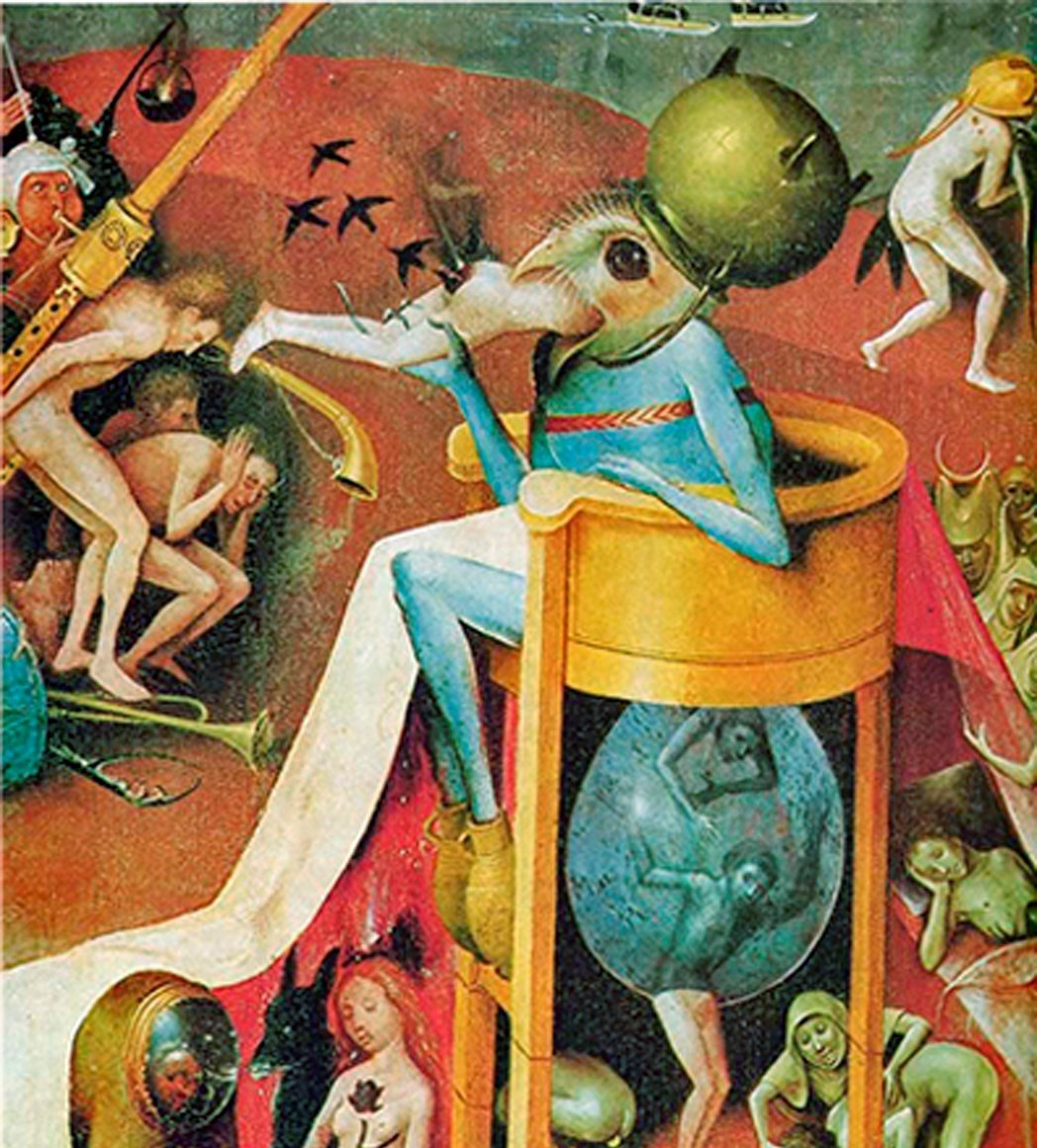
 Torch of Liberty
