Terrible and strange is our undiscovered country; both of myriad possible futures and of our imaginal nations, and all a ground of struggle and a Wilderness of Mirrors, lies, illusions, falsification and rewritten histories, silence and erasure, alternate realities and Rashomon Gate Events.
All of our creations of human being, meaning, and value, and we along with them, ephemeral and in constant processes of change. And under existential threats by systems of oppression and unequal power, which include fascisms of blood, faith, and soil and hierarchies of elite belonging and exclusionary otherness.
To make an idea about kinds of people is an act of violence.
No matter where you begin with ideas of authorized national identity, you always end up at the gates of Auschwitz.
When those who would enslave us come for us, as they always do, let them find not a people subjugated by learned helplessness nor divided by hierarchies of belonging and exclusionary otherness, but a United Humankind unconquerable in solidarity and refusal to submit.
To tyranny and fascism there can be but one reply; Never Again!
As I wrote in my post of January 21 2024, In Germany And Throughout Europe, the Return of Fascism Creates Its Own Resistance As Polarization Begins the Fracture of the State; An ancient terror emerges from the shadows to consume us all once again, as Nazi revivalists in Italy, Germany, Hungary, Spain, and elsewhere join their American counterparts in a vast and ambiguous multifront war against democracy, human rights, and western civilization.
But the use of social force obeys Newton’s Third Law of Motion and creates its own Resistance, as we have witnessed this past week in the mass actions against the Alternative für Deutschland fascist party in Germany, and a hero has risen to defend our humanity, the magnificent Carola Rackete.
This we celebrate, but must also give caution of the dangers of ideological fracture and the polarization of the state which makes a wishbone of nations by their most extreme elements. We can study its effects and consequences in real time as they unfold before us in America, and in elections globally.
It is also recapitulating the ideological fracture and division of the Social Democratic Party of Germany which removed the only blocking force for the rise of fascism; this process also destroyed the Students For A Democratic Society, the Black Panthers, the American Indian Movement, and other organizations of liberation struggle in America, under constant assault from the F.B.I. and other institutions of state terror and counter-revolution which used assassinations and infiltration and subversion to remove leadership and set group members against each other with false rumors of disloyalty.
Such counter-revolution waged against the liberty of the people as theft of citizenship is a predictable phase of revolutionary struggle, and there is but one reply to this strategy of marginalization, division, silencing and erasure, dehumanization and the repression of dissent; solidarity.
Let us stand with those who stand with us, and with those who share our interests in allyship. Come what may.
Because we are now waging the Last Stand Against Fascism, among all humankind and throughout the world, and the price of our failure is too terrible to contemplate.
Let us give to fascism and tyranny the only reply it merits; Never Again!
As I wrote in my post of September 27 2022, A Rising Tide of Fascism in Europe; With the electoral victory of the alt-right in Italy, a rising tide of fascism now threatens all of Europe; Nazi revivalism has a staging ground and launchpad for the reconquest of Europe in Orban’s Hungary, LePen’s Nationalists in France and Vox in Spain are the unquestionable opposition to their governments, Sweden just elected a similar party of Nazi origins, and the new government of England has at best turned back the clock to the ideology and policies of the Thatcher era and at worst displays alarming cues of fascist dog-whistles which portend far worse horrors and depravities to come.
Such are the times we live in, wherein an enemy we have fought for a century returns to seize its birthplace at the centennial of Mussolini’s March on Rome, as European political and social systems and institutions destabilize and begin transformational change from both the mechanical failures of their internal contradictions as terminal stage capitalism consumes the worlds resources and centralizes wealth and power to hegemonic elites, oligarchs which have become a quasi-aristocracy, and the carceral states of force and control which they create. Civilization itself is falling, but will such change be catastrophic or a rebirth of humankind as a free society of equals wherein democracy and our universal human rights are victorious; comes now an age of tyranny or Liberty?
Where do we go from here?
As I wrote in my post of September 23 2021, When Things Fall Apart and the Center Cannot Hold, Embrace Change; Transformative change and the forces of Chaos lie at the heart of our universe, a reality and medium of being characterized by illusion and impermanence, as its central motive principal.
Chaos is a forge of creation which endlessly generates contradictions and paradoxes as the forking points of universes, of multiplicities and relative truths, a wellspring of life and the realization of unknowns but also of our darkness born of attachment to externalities and that which is by its nature ephemeral and transitory, and moreover a world filled with falsifications of ourselves, echoes and reflections like the distorted images in funhouse mirrors which multiply into infinity as a theft of our uniqueness and our souls.
The trauma of death and of life disruptive change, and our immersion in a sea of grief, despair, and terror; when the anchorages and truths we cling to have shifted and cast us adrift into topologies of the unknown, when we dare to look behind the curtain and the figures of our faith are revealed to be lies and instruments of our subjugation, when these existential threats and crises of hope, trust, and faith combine as they have this past year with the loneliness of our modern pathology of disconnectedness, how shall we answer our nothingness?
To this I say, how can we not embrace Chaos and transformative change, when it is endless and ongoing, and challenges us to live in the eternal now? Why fix and react wholly to its negative aspects as death and destruction, when it offers us equally possibilities of liberation from order and authority, self-creation, autonomy, and unknowns to explore, and a space of free creative play?
Here is Yeats great and visionary poem The Second Coming, written in the wake of three successive mechanical failures of civilization as systems of order from their internal contradictions, the First World War, the Easter Rising of 1916, and the Russian Revolution of 1917.
Turning and turning in the widening gyre
The falcon cannot hear the falconer;
Things fall apart; the centre cannot hold;
Mere anarchy is loosed upon the world,
The blood-dimmed tide is loosed, and everywhere
The ceremony of innocence is drowned;
The best lack all conviction, while the worst
Are full of passionate intensity.
Surely some revelation is at hand;
Surely the Second Coming is at hand.
The Second Coming! Hardly are those words out
When a vast image out of Spiritus Mundi
Troubles my sight: somewhere in sands of the desert
A shape with lion body and the head of a man,
A gaze blank and pitiless as the sun,
Is moving its slow thighs, while all about it
Reel shadows of the indignant desert birds.
The darkness drops again; but now I know
That twenty centuries of stony sleep
Were vexed to nightmare by a rocking cradle,
And what rough beast, its hour come round at last,
Slouches towards Bethlehem to be born?
Here we must ask the great question of Lenin and Tolstoy, which set up the current paradigm of our civilization as dyadic revolutionary and conservative forces; What is to be done?
As I wrote in my post of July 17 2023, The World is Mad. And It is On Fire;
The world is mad. And it is on fire.
These existential threats are interdependent faces of a single problem, albeit a Gordian Knot of complex, nuanced, relative and shifting truths, meanings, and values; unequal power.
And both sets of causes and effects which chase each other round in recursion, like the iconic Gahan Wilson cartoon of gleeful devils in pursuit of each other entitled One Damn Thing After Another, are not symptoms of natural processes of change but consequences of political decisions we have made about how to be human with each other.
Extinction and the destruction of earth’s ecosystems and ability to support life is parallel and interdependent with the global subversion of democracy and the dawn of an age of tyrants and fascisms of blood, faith, and soil.
We cannot work toward solutions to extinction and fascist tyranny separately; they must be taken together as a whole.
I write now in reference to an article by Robin McKie in The Guardian entitled, “World experiences hottest week ever recorded and more is forecast to come: There is a good chance that the month of July will see the highest global temperatures for (the past) 120,000 years.“
Yes, but not for the millennium to follow; it just becomes unsurvivable from here. What creatures in some distant future will sift the dead sands of our world for clues to what doomed it, and why?
It will never be this good again, and one day humankind will become nothing and unremembered.
Because we have failed to purge our destroyers from among us, to seize power and control of our destiny from those who would enslave us and steal our future; elite hegemonies of wealth, power, and privilege now locked in a death spiral of terminal stage capitalism as war on nature and subjugation and commodification of our labor which creates benefits for the few who can buy our time at the cost of dehumanization of the many and the extinction of us all.
We must abandon our addiction to power and its ephemeral, transitory, ultimately meaningless and destructive material signs and vanities, and our reliance on fossil fuels as a strategic resource of dominion and hegemony which is consuming us like a poison or cancer, and the whole twisted project and inverted values of civilization not as a conversation and questioning of ourselves and our universe but as systems of oppression and control of nature; and instead embrace the wildness of nature and the wildness of ourselves.
Max, trailer for the film with John Cusack
The Master of Go, by Yasunari Kawabata, Edward G. Seidensticker (Translator)
July 1 2023 In Marseille and Throughout France, a Test of Competing Futures and Ideas of Human Being, Meaning, and Value; A Free Society of Equals Versus Fascisms of Blood, Faith, and Soil and Liberty Versus a Carceral State of Force and Control
April 20 2024 Anniversary of My Speech to the Volunteers At Warsaw, and of the Reorganization of the Abraham Lincoln Brigade of Ukraine For Liberation Struggle in Russia in the Wake of Our Escape From Mariupol
February 24 2024 Anniversary of the Russian Invasion of Ukraine; Symptom, Consequence, and Trigger Event of the Fall of Human Civilization In Recursion
April 25 2024 Liberation Day Italy: Lessons from History for Antifascists, Revolutionaries, Truthtellers, and Bearers of the Promethean Fire Which Is Democracy
August 23 2023 Anniversary of the 1922 Founding of Antifa: the Barricades of Parma and the Antifascist Resistance of Guido Picelli and L’Ardito del Popolo
February 4 2024 Sinn Féin Victorious in Seizing the Government of Northern Ireland; Hope For a United Ireland Free from British Colonial Rule is Rekindled
February 6 2023 In Greece, Birthplace of Democracy and Our Global Civilization, An Ancient Terror Re-Emerges From the Shadows of Our History Like a Plague of Fear and Hate: the Return of Fascism and Nazi Revivalism With the Golden Dawn
And last, the monster we have escaped at our origin in founding democracy;
Britain
May 6 2023 Britain’s Rituals of Subjugation to King Charles Visited By the Grim Reaper, Foretelling Doom to the Monarchy At the Heart of a Diseased and Leprous Empire
How do you spell Trump? Treason, Racism, Untruth, Misogyny, Predator.
Take a moment to savour with me the indictment of Trump for the crime of espionage. Ahhh, the bliss.
A commentator on MSN’s Eleventh Hour on this night one year ago pronounced the magic words which I hope will awaken our nation from the long nightmare of capture by the Fourth Reich; “I think Trump is done.”
It has been a fairytale from which we may learn many kinds of morals, a story which begins in the 1980 capture of the Republican Party by Jerry Falwell’s Moral Majority movement as a fundamentalist theocracy and the Presidency of its figurehead Ronald Reagan, and found its true form in the Presidency of a pedophile rapist and Russian agent who for years slept with a copy of Hitler’s Mein Kampf on his nightstand in place of a Bible.
Here in the trial of Traitor Trump is a morality play which is also a Rashomon Gate of our possible futures, for it is more than a legal last stand of the rule of law and the idea of democracy in America against a rigged electoral process which offers capture of the state to its enemies, but also a trial of democracy in America and of our infiltrated and subverted justice system whose court of ultimate appeal is a Supreme Court which is become a whorehouse.
What is the meaning of the Trump regime in the story of America and our future possibilities of becoming human as a free society of equals?
As I wrote in my post of November 3 2020, One Hundred Years of Racist Vote Suppression and White Supremacist Terror: Anniversary of the Ocoee Massacre; This election has seen attempts at vote suppression unknown in our lifetimes; Trumps mission to subvert democracy includes intimidation by calling for armed white supremacists to deny nonwhite citizens access to the polls, an attack on Biden’s campaign caravan by the Trump Train mobile force, failed assassination attempts against Biden and other political figures, sabotage of the postal system, politization of the Justice department, and his farcical declaration of victory before the vote is counted, among his many treasonous crimes.
Today liberty and tyranny play for the soul of America and the freedom of the world.
I spent some time today at a Trump rally trying to defuse a hate crime in the making. A hey rube went up that a rally staged between our local mosque here in Spokane and a Middle Eastern grocery was becoming a violent mob; while others responded as a protection detail and placed themselves with great courage between potential perpetrators and their victims, I blended into the rally to assess and shape its development as an incubator of violence and work to defuse it through dialog and negotiation.
Today these angry young men chose not to allow fear, rage, and hate to master and dehumanize them, nor provoke them into violence which would be the ruin of their lives; what will all of the other angry young men choose tomorrow?
I’d like to believe this incident is atypical and not being played out a thousand times over across America; but I wouldn’t bet on it.
Tyranny weaponizes overwhelming and generalized fear as an instrument of subjugation. This we must resist, but unless we speak directly to those fears we cannot heal the divisions of our society which authority has so skillfully manipulated.
In the words of Sigmund Freud, “Civilization begins when we throw words instead of stones.” Sadly, we humans have often chosen stones when words would serve us better.
In all the madness of this election and of the deranged perversions and assaults upon our liberty, equality, truth, and justice of our Clown of Terror, Traitor Trump’s kleptocracy of state terror and tyranny, we must not forget that though he exploited the flaws of our society to orchestrate the Fall of America and of democracy throughout the world, he did not originate them.
Trump has revealed, tested, and hammered at our flaws, yet we remain unbroken and unconquered. This we should celebrate; in the main we are voting and not shooting, because our faith in one another and in the ideals on which our society is founded remain intact, though the institutions of our government may need radical and revolutionary change.
Nor is there anything new in the threat to democracy of vote suppression; today is the one hundred year anniversary of the Ocoee Massacre, the most terrible incident of racist vote suppression in the history of our nation since the Civil War. What may give us hope now that failed us then is the emerging consensus of racial equality and the mass coalition for racial justice won for us by the Black Lives Matter movement and the heroic citizens who have seized the streets of our cities in an unparalleled months long mass action.
Regardless of the election results, anyone who wishes to actually govern must do so at the head of these protests and not barricaded against the will of the people. This is the true meaning of this years seizure of power by our citizens, and it is a genie which cannot be returned to the prison of its lamp, for each of us is now a Living Autonomous Zone.
As I wrote in my post of November 5 2020. Trump’s Last Coup Attempt and Subversion of Democracy as His Ship of Fools Sinks in Pathetic Failure; As Trump’s Ship of Fools comes apart at the seams and sinks beneath the waves in pathetic failure, our Clown of Terror collapses in infantile tantrums and tries to take democracy down with him, a final gesture of madness and idiocy in his delusional quest to subvert our values and institutions of liberty and seize tyrannical power.
We must never forget how close we came to a repeat of the 1933 German Federal Election that set Hitler on the path to a tyranny of absolute power; this is clearly the most important electoral event in the history of humankind since then, and the two elections are terrifyingly parallel. Trump tried three times to use the Black Lives Matter protests to create fear and legitimize the federal occupation of America under the pretext of re-establishing law and order in an exact duplication of Hitler’s successful strategy using the Reichstag Fire, and failed.
We have escaped the jaws of the Fourth Reich which have held us fast for four years, since the Stolen Election of 2016, while Trump and his cabal of Gideonite fundamentalist patriarchs, white supremacist terrorists, and plutocratic robber barons have violated everything about America which is noble and true, plundered the public wealth, dehumanized and divided us, sabotaged and subverted the institutions of our freedom, equality, truth, and justice, betrayed our allies and emboldened our foes, lost the American hegemony of global power and privilege and our position as a guarantor of democracy and universal human rights and a beacon of hope to the world.
Let us never forget the bottomless depravities, treasons, and amoral predation and greed of Trump’s many enablers and conspirators in the Fall of America as we struggle in the years ahead to reclaim our nation and our souls. We must hold them to account, but we must also reimagine our society and the many systemic and structural flaws by which we came to this broken and lost state.
As I wrote in my post of June 9 2022, The Greatest Show on Earth: Presenting the January 6 Committee; Tonight our puppets will dance upon the stage of history and our imaginations, while a chiaroscuro of light as truth and democracy versus darkness as fascist tyranny and falsification, lies, illusions, rewritten histories, alternate realities, conspiracy theories and propaganda play for the kingdom of our souls and the fate of America and the world.
Who do we want to become, we humans? A free society of equals or a prison planet of masters and slaves?
Now begins a great Reckoning, and we shall see.
As I wrote in my post of February 10 2021, Treason, Tyranny, and Terror on Trial: As the Second Impeachment of Traitor Trump Begins, I Submit Charges Before the People’s Tribunal of Crimes Against Humanity for Which Trump and His Collaborators Should Now Be On Trial; Among the many crimes against humanity for which Traitor Trump and his collaborators should be on trial but are not yet include the genocide and ethnic cleansing of Mexican and other nonwhite migrants, the concentration camps at our border, the orphaning and torture of children, and the state tyranny and terror of fascist and racist violence as national policy perpetrated by the ICE and Border Patrol components of Homeland Security, forces of repression which are antidemocratic by their nature and which should be abolished as a top priority of the Restoration of America.
Just as villainous and reprehensible is the parallel program of racist police violence and the carceral state to re-enslave Black American citizens and enforce systemic forms of inequality and injustice through state terror, repression of dissent, the force of a militarized police and the counterinsurgency model of policing which has transformed our security services into an army of occupation with primarily political objectives, and the control of pervasive and endemic surveillance and propaganda, lies, illusions, and subversions of the truth.
Our Clown of Terror, Traitor Trump, and his circus of fools, degenerates, and barbarians, his enablers and collaborators both within the government and his shadow forces rallying under the Confederate and Nazi flags to bring violence and insurrection to our nations capital and to the streets of our cities throughout America, are co-conspirators and instigators in the murders of every Black American killed by police shooting or other racist violence since its authorization by Trump in the wake of Charlottesville.
And every missing child kidnapped by the state and disappeared into what abominable slavery or human trafficking designed in the diseased imagination of Trump and his Epstein buddies we know not of, every migrant of the huddled masses yearning to be free who died in the quest to reach the safety of America because the water caches had been intentionally sabotaged by criminals in the uniform of our nation who were “just following orders” like their counterparts in the SS during the Holocaust, every prisoner who died in custody because they were denied water or medical care; the blood of these and countless other victims of Trump’s narcissistic self-aggrandizement and regime of fascist corruption, racism, and patriarchal sexual terror is on the hands of every Republican who voted for him and fails now in this trial to repudiate him publicly and renounce his works as among those of the devils which he serves.
For in his actions Trump has been not only a foreign agent and Putin’s puppet whose mission is the subversion of democracy and the Fall of America, but also a slave of Moloch the Seducer, Demon of Lies, in that he is not merely a pathological liar but also an idiot madman who cannot distinguish truth from lies, and who has weaponized his delusions and psychopathy as instruments of our falsification and subjugation in his quest for tyrannical power.
The bizarre and lurid dark fairytales of the QAnon conspiracy theory movement, like the charges of the Inquisition and the Nazis which othered witches and Jews on which QAnon is constructed, serves as deflection from Trump’s loathsome perversions and sexual terrorism. What terrors did he conceal behind the beauty pageant, modeling, and human trafficking syndicate he once controlled?
His Stop the Steal campaign is a similar deflection which shields him from inquiry into the Stolen Election of 2016 and the fact that his Presidency was entirely illegitimate and due to Russian interference; it was also the rhetorical and organizational basis of his final attempted coup on January 6, for which he is now being impeached for the second time.
We must cast out the monsters from among us, the racists and white supremacist terrorists, the Gideonite fundamentalists and patriarchs of Christian Identity theocratic fascism and sexual terror, and the amoral forces of repression of those who would enslave us and who enforce hegemonies of elite power and privilege and hierarchies of exclusionary otherness armed with guns and badges and the authority of a government which has been infiltrated by the Fourth Reich, an implacable and relentless enemy which has come just short of seizing us in its jaws.
We must give fascism no second chances.
As I wrote in my post of January 11 2021, Allegories and Symbols of the Fall of America: the January 6 Insurrection as Theatre of Cruelty; Here is an expanded version of my post of January 6 on the Surrealist film Gummo as a satire of the Deplorables who committed treason and armed insurrection against our nation at the command of Our Clown of Terror, Traitor Trump; on Insurrection Day, I offer for your consideration the film Gummo, a sensitive and elegant documentary of the Deplorables from whom the Fourth Reich cadre who staged the assault on Congress were recruited, and an allegory of America.
Bacon? Stapled to the wall, a strip of bacon captures ones attention as a symbol of degeneration and barbarian atavisms of instinct. Werner Herzog signposted it for our attention, and it persists as a symbol of degeneration to an animal state, like a trophy of wealth which is also offal above a bathtub filled with filth as our young protagonist eats spaghetti, his mouth smeared with red like a cannibal; an unforgettable image of the fallen American Dream.
It is the little things which disturb, provoke, and incite us to challenge normality, the tyranny of other people’s ideas of virtue, the authorized identities of hegemonic elites and divisions of otherness, and to transgress the boundaries of the Forbidden with glorious sins of beatification.
Here as always, all true art defiles and exalts.
We dine in filth on the carrion of others lives and by their labor. This is a Surrealist film intended as an allegory of America and a thematic interrogation of our flaws and dark legacies of injustice, and in large part restates Nietzsche’s critique of Shakespeare’s Measure For Measure and the idea of the innate depravity of man, an extension of the doctrine of original sin, on which all our law is based, as Nikos Kazantzakis argues in his thesis Friedrich Nietzsche on the Philosophy of Right and the State, an anarchist analysis of authority as dehumanization which underlies all his later work.
So also does the film restate William S. Burroughs’ analysis of capitalism and imperialism as the Algebra of Need, in which drug addiction becomes a metaphor of our addiction to wealth, power, and privilege, an engine of self-destruction, commodification, and dehumanization which feeds on and worsens our most atavistic instincts. Here the flaws of our humanity, fear and rage, vanity and jealousy, the need to dominate and control, become the instruments of our subjugation to hegemonic elites through divisions of exclusionary otherness and to tyrants of force and control and the imperial and carceral states of those who would enslave us.
The film itself is brutally shocking, grotesque, and borders on the obscene; which is why I adore it so. I must warn you that while I like it as an allegory of America’s flaws, and to poke fun at Trump’ s followers, this is brutal and depressing; anyone with suicidal ideation should avoid it. This debut of a heralded wonder of the new age as director was not understood as a critique of state power as a force of dehumanization and regression to an animal state, like that of the Deplorables, and unjustly derailed a promising career; a historical injustice I would like to redeem, because Gummo is a film we need now.
We must see the enemies of Liberty as they truly are, if we are to heal our nation from the primary trauma of fracture they enacted in the January 6 Insurrection.
Both the Insurrection and the film Gummo, like the Trump presidency as a whole, must be interpreted as performances of the Theatre of Cruelty as articulated by Antonin Artaud in his manifesto The Theatre And Its Double. Trump is a figure of the mad emperor from his great novel Heliogabalus; or, the Crowned Anarchist; his performances as a clown of terror, disruption, and sadism were also brilliantly prophesized by Robert Coover in The Public Burning, A Political Fable, written as a satire of Nixon.
Let us see beyond the lies and illusions with which Trump and his Deplorables conceal their subversions of democracy, sabotage of our institutions, and violations of our ideals of liberty, equality, truth, and justice.
Always pay attention to the man behind the curtain. As Dorothy says to Oz, he’s never anything but “just an old humbug.”
As I wrote one year ago today in my post of February 11 2021, Profiles in Treason and Terror; The dishonorable and the mad, the delusional and the sadistic epicures of brutality and perversions, the feral predators hooting and champing before the gallows and guillotines they have brought to murder members of congress with and their partners in uniform unleashing racist terror and gun violence in the streets, and the amoral and predatory grifters and puppetmasters of fascism who have subjugated and enslaved them and stolen their honor and their souls; these are among the idolators of Traitor Trump who conspired, enabled, and collaborated in his plot to subvert democracy and overthrow America in the January 6 Insurrection which attempted to seize Congress and execute its members, which like Hitler’s Beer Hall Putsch on which it was modeled was intended to decapitate the government of the people in a single stroke.
As details emerge of the internal operations and massive scale of the plot against America, in terms of its central coordination and logistics under direct operational command of Trump and his cabal of conspirators, we are offered not only the spectacle of his aberrance and monstrosity as a mad idiot Clown of Terror drooling and gloating in bestial depravity at the destruction of our values and institutions, the violation of our ideals and the endless suffering he has caused, but of those of his freakish and degenerate followers as well.
The role of deniable forces of the Fourth Reich such as the Proud Boys, the Oathkeepers, and other organizations of white supremacist terror, and of their partners and infiltration agents within our police, military, and security services, in the January 6 Insurrection is by now well documented and will become more so as the greatest manhunt in our history exposes and entraps more of its perpetrators.
The images we have been witnessing of their assault on liberty during the Second Impeachment trial will be remembered in the history of the world as the true legacy of an era of fascist tyranny under the figurehead of Trump which nearly ended America as a guarantor of global democracy and universal human rights, and had we fallen as the primary domino and a beacon of hope to the world both democracy and human rights would be lost to humankind for unknown ages; the last time civilization fell it took a thousand years for the idea that government derives its authority from its citizens and not by divine right, the idea that no one of us is better than any other by right of birth, and that freedom, equality, truth, and justice are the foundational values of our society and truths of human being and meaning, to reawaken.
And it took centuries of wars and revolutions to do so; how if this time civilization falls not to hordes of barbarians seeking nothing but pillage and destruction, but to regimes of totalitarian force and control?
This is the great contradiction of the forces of repression and subjugation to authority which overran our capitol on January 6; they have been betrayed by their masters in believing they were acting to restore our traditional values and civilization, when in fact they had been weaponized in service to its destruction. Here is a clear and present danger, but also an opportunity; shared motives can be redirected to heal divisions, for they too want an American Restoration. As yet we just disagree on our definition of terms.
When fear is overwhelming and generalized, it can be shaped through submission to authority by lies, illusions, alternate realities, especially when pervasive and endemic surveillance, big data, and propaganda are available as instruments of state control. Authority achieves submission through falsification and the theft of the soul, but this is also the weakness of control which cannot stand against truth, just as the weakness of force is that it is powerless against resistance, disobedience, and refusal to submit.
The election of Biden and Harris, the failure of Trump’s sixth coup attempt on January 6, and the public exposure and shaming of his co-conspirators, collaborators, and enablers before the stage of the world of the Second Impeachment trial; in these events we have witnessed a turning of the tide from fascism to a restoration of democracy.
Once the Reckoning has been achieved, the Restoration must heal our divisions; and this means we must embrace and transform the fear that lives at the heart of hate, and drives the rage, violence, and need to conquer and dominate others which shadows our historical inequalities and injustices.
Fear, Power, Force; such is the Ring of Power which enslaves us, and which we must abandon if we are to become whole.
Herein I offer a previous version of the role of Trump as Angelo in the savage morality play Measure For Measure, a work luminous with Kafka-esque Absurdism, Freudian horror, and a brilliant interrogation of the dynamics of patriarchy and power asymmetry in gender relations in the brilliant review of the Simon Godwin production, critiqued with marvelous insight by Geoffrey O’Brien in the New York Review of Books; entitled “Shakespeare’s Pornography of Power by Geoffrey O’Brien.
“This is the disgusting, stinking world of medieval Vienna. The darkness of this world is absolutely necessary to the meaning of the play…When this play is prettily staged, it is meaningless—it demands an absolutely convincing roughness and dirt.” Thus Peter Brook, who directed a legendary production in 1950, on his vision of Shakespeare’s Measure for Measure. Simon Godwin’s pathway into the play at the Polonsky Shakespeare Center in Brooklyn is by way of a corridor through Mistress Overdone’s brothel, along a narrow basement path lined with discreetly closed cubicles and arrays of lubes, dildos, anal plugs, shackles and handcuffs, multicolored condoms, an inflatable sex doll. It is a space dimly lit but by no means medieval, an ingratiatingly tacky emporium more likely to amuse than repel the New York theatergoers passing through.
Given the perennial relevance of the various injustices it circles around—the sexual exploitation and pious hypocrisy and persecution of whistleblowers—Measure for Measure invites updating. The virginal Isabella, realizing that no one will believe her story of victimization against that of the all-powerful Angelo—who has been named regent of Vienna by its absent duke—cries out: “To whom should I complain? Did I tell this, / Who would believe me?”—language so direct it could be lifted from the latest celebrity harassment trial, especially when spoken with the angry clarity that Cara Ricketts gives the line.
Angelo—the moral disciplinarian with a spotless reputation who, once given power, swiftly succumbs to his most predatory impulses—can be envisioned almost too neatly as the sort of high-minded conservative who from time to time finds himself indicted for sexual malfeasance. There is no problem with Thomas Jay Ryan’s performance: Ryan’s delineation of Angelo’s ethical collapse and his half-hearted efforts to justify himself to himself have the barely controlled panic of a public figure realizing how little he knows himself. The regent lies, and the most unhampered truth-telling comes from sex workers and criminals who make no pretense to any credo beyond their own self-interest, as in the unarguable defense of the tapster Pompey, arrested for procuring: “Truly, sir, I am a poor fellow that would live.”
But it’s in the nature of Measure for Measure that whatever contemporary analogies are invoked cannot quite make sense of what happens. In its early stages the play is centered on the three characters whose destinies collide so violently: Angelo, Isabella, and her brother Claudio, who has been condemned for fornication. The scenes in which they confront each other have the amplitude of the tragedies that were to follow: Isabella pleading for Claudio’s life, Angelo demanding her virginity as the price of her brother’s pardon, Claudio overwhelmed by the terror of death, Isabella (in a moment that challenges any audience’s sympathy) denouncing her brother for his weakness of character when she realizes he is willing to see her give in to Angelo’s demands.
The grandeur of these scenes becomes most fully alive through Cara Ricketts’s Isabella, intensely focused, supremely pointed in her argumentation, but with a hint of an absolute commitment to the ideal that helps account for her harsh dismissal of her condemned brother’s terror of dying; an altogether serious person, too serious for the world she finds herself inhabiting, perhaps too serious for the madcap Duke when he proposed to her at the very end of the play. Her reaction to Angelo’s harassment goes beyond physical repulsion into profound moral contempt—expressing itself in angry laughter—at the triviality of his character. Her ultimate forgiveness of Angelo—at a moment when she still believes her brother to have been executed—is dramatically the most difficult of all, couched as it is in a nice legal argument, but Ricketts brought a somber conviction to it.
An audience that wants to take the play as readily grasped satire cannot evade the puzzlements and reversals of judgment that come in its later scenes—reversals of judgment that do not end even when the play is done. Measure for Measure is a perpetual questioning machine, exquisitely functional, set to a relentless tempo, yet a machine that bristles and crackles in its joints with contradiction and discomfort. Harold Bloom has described it as “a comedy that destroys comedy.” It is a comedy that threatens to destroy or at least wear down its own characters by subjecting them to the only mechanism—a mechanism demanding elaborate subterfuges and unlikely changes of heart—by which they can avoid a tragic fate. By the end we might imagine them as the exhausted, socially viable remnants of those conflicted, passionate beings we saw tearing apart everything including themselves scene after scene, during the first three acts. They are saved, and some of them have saved others, but for what fate we can only wonder.
In Godwin’s production, to emerge from the brothel’s passageway into the main theater is to find the Polonsky transformed into what looks like an oversize banqueting hall, the playing area laid out as an immense table decked with candles and balloons and trays of drinks, a few audience members seated around the edge. Drunken revelers stagger noisily across the tabletop stage, leaving behind a solitary figure sprawled on its surface, shooting up (presumably) heroin and then wrapping himself up in a tangle of sheets. A woman in business attire approaches him, studying him like a corporate assistant confronted by a messy but familiar management problem. He, it quickly emerges, is Vincentio, Duke of Vienna, and she is Escalus, the “ancient Lord” who serves him, transmuted into Escala, a tightly controlled executive who in January LaVoy’s reading sometimes evokes a less murderous version of Tilda Swinton’s scheming pharmaceuticals exec in Michael Clayton.
As the Duke (Jonathan Cake) rouses himself from his nod he delivers the play’s opening speech, in a broken rhythm suggesting that the passage’s roundabout prolixity reflects his faltering attempt to shake himself out of his opiate daze. It is one way to get the play going: pitched forward headlong, off-balance from the start, the unanswered and perhaps unanswerable questions piling up before we even know where we are. What manner of being is the Duke really? Why is he leaving Vienna in such haste and putting in his place a temporary regent, the “precise” Angelo, known for his rigorous strictness? Why does he choose to linger, disguised as a friar, to observe what happens in his absence? Having learned that his moralistic stand-in is attempting to blackmail Isabella—a young woman just about to enter a convent—into sex in order to save her brother Claudio (Leland Fowler) from a death sentence, why does he intervene in such needlessly tortuous fashion, subjecting innocents to agonies of misinformation? When in one of the play’s most eloquent speeches he more or less persuades Claudio that life is not especially worth living—“Be absolute for death”—does he speak his own sincerest thoughts or is this merely part of the role he is playing as prison confessor?
To cast the Duke as a junkie is one way of providing him with a motive. His addiction perhaps discourages him from exercising moral authority; perhaps he sees it as a weakness rendering him unfit to enforce Vienna’s laws with the necessary severity; perhaps he even harbors the thought that those laws are unnecessarily severe; perhaps he simply needs to take some time out. In any event his drug habit, as far as I could observe, comes up only once more (a quick glance at the track marks on his arm, lest he forget), and from the moment he dons his disguise he grows steadily more assured, though it is an assurance boosted by waves of antic humor to which Cake at times gives an almost Monty Pythonish edge. A certain hilarity gives him courage to dream up and carry out his preposterous scheme, which more and more comes to resemble a baroque sting operation.
We can hardly expect to find out who the Duke really is in the course of the evening, since Shakespeare’s text leaves that question so hauntingly open. Even if he assures a confederate early on that he has “a purpose / More grave and wrinkled than the aims and ends / Of burning youth,” he never articulates what that purpose is. He is more than central to the play—as the narrative advances he becomes its directing force, moving plot elements around like game pieces—while remaining to the end a fascinating cipher. He is memorably termed “the Duke of dark corners”—a secret devotee of hidden vices—by the witty reprobate Lucio, but Lucio is by no means averse to making things up. If nothing else the Duke can be said to behave very much like a playwright working with improvisatory energy on his play’s last act, an act that will feature a succession of agonizingly drawn-out revelations, a string of pardons, and an unlooked-for proposal of marriage.
The lust of the hypocritical Angelo is not triggered by the attractive power of beauty but perversely by the notion of violating purity: the pornography of power, relished by a man for whom execution and torture are primary tools of policy. There is a terror at the heart of everything. The Duke’s exhortation to Claudio to resign himself to death cannot match in dramatic effect Claudio’s subsequent speech—roughly the play’s midpoint—on the horror of dying: “The weariest and most loathed worldly life / That age, ache, penury, and imprisonment / Can lay on nature, is a paradise / To what we fear of death.”
Sometimes the play feels like a series of decentered snapshots of city dwellers shuffling between sex and death. It is the only Shakespeare play concerned with how a city is run, and what that is like for the people who live there. (Romeo and Juliet is also a city play of sorts, but it centers on the operation of clans, not the municipal government that so ineffectively intervenes in their never-ending feud; and that play’s poetry—so unlike the gnarled, combative, often tensely legalistic exchanges of Measure for Measure—constantly evokes spaces beyond the immediate setting.) In Measure for Measure everything is local, in the most oppressive way. We look at things from the top down and from the bottom up, and the judgment is ambivalent, or rather multivalent. Godwin’s staging conveys very well the sense of airless interconnecting interiors, all linked as part of the same system: claustrophobic offices, claustrophobic cells of both prisons and convents, but mostly of prisons. It could almost be called a prison play, a point underlined here by the cell walls constantly rolling in and out of the foreground.
The motives of the three main characters are seen from many angles, by each other and by bystanders and street-corner commentators of all sorts, from the generously inclined Provost of the prison, realized with great feeling by Oberon K.A. Adjepong, to the unavoidable Lucio, amusingly played by Haynes Thigpen as a self-satisfied comedian a little too hip for the room, always there to speak up for ordinary human vice (“a little more lenity to lechery would do no harm”) although contemptuous of the whores he sleeps with, constantly hovering at the edge of what goes on so he can get his digs in and almost managing to avoid getting called on it. The comedy provides not so much relief as an obverse view, consistently deflating and needling, and it is rarely clear where exactly the boundaries are, or who can truly be called central in this world fallen askew.
Consider the late emergence of Barnardine, a murderer who for nine years has been awaiting execution. The Duke determines to substitute his head for that of Claudio, demanded by Angelo in proof that he has been put to death, but when Barnardine—already described as “a man that apprehends death no more dreadfully but as a drunken sleep; careless, reckless, and fearless of what’s past, present, or to come”—emerges from his cell, he simply refuses to die—“I have been drinking hard all night, and I will have more time to prepare me… I swear I will not die today for any man’s persuasion”—and staggers back to his cell. It was a disappointment to see this episode treated as a comic interlude, with too much hokum and unneeded verbal additions. (Zachary Fine did much in his other role as the simple-minded constable Elbow.)
It’s the most surprising scene in Measure for Measure and ought to stop the proceedings in their tracks, with its after beat the Duke’s astonishing pardon of the murderer in the last act. I can still recall being taken to see John Houseman’s production of the play at age eight—a memorable outing to the Shakespeare theater in Stratford, Connecticut in 1956—and however dimly I apprehended its stew of bawdry and sexual extortion, there was no mistaking the uproarious force of Barnardine’s unconditional refusal. The actor was Pernell Roberts, of later Bonanza fame, and he must have delivered Barnardine’s few lines with great vigor, since the scene has lingered in memory ever since. In a play of punitive laws, complex masquerades, and tortuous mutually annihilating arguments, it briefly upholds the intoxicating possibility of simply walking away.”
As I wrote in my post of June 15 2022, Act Three of the Greatest Show on Earth: Where Do We Go From Here?; Where do we go from here?
Democracy in America survived its most terrible moment of peril from internal threat in the January 6 Insurrection, yet here we are, witness to the public exposure of the plot and its treasonous conspirators on television as Congress brings a Reckoning to the Fourth Reich.
Like the Beer Hall Putsch of 1923 on which it was modeled, it failed; but in doing so also achieved all of its strategic goals, moving our great enemy nearer to victory by staging a Lost Cause which established the fascist counternarrative as iconography that Trump remains our legitimate President. Next time, and there will always be a next time, we may not be so lucky.
Not only do the forces of fascism remain an active threat, through open allegiance to the Lost Cause which echoes horrifically with that of the Confederacy and the KKK whose adherents are among the networks of deniable assets now among us as they were at the Capitol on that fateful day, but the vast resources of wealth and power at their command after seventy years of infiltration of global elites and governments remain undiminished.
But none of this is relevant to the true threat which fascism poses to us all today; for America has been divided against itself, and as we are warned by Abraham Lincoln in 1858 in his House Divided speech in reference to the synoptic Gospels of Luke 11:17, Mark 3:25, and Matthew 12:25; “If we could first know where we are, and whither we are tending, we could better judge what to do, and how to do it.
We are now far into the fifth year, since a policy was initiated, with the avowed object, and confident promise, of putting an end to slavery agitation.
Under the operation of that policy, that agitation has not only, not ceased, but has constantly augmented.
In my opinion, it will not cease, until a crisis shall have been reached, and passed –
“A house divided against itself cannot stand.”
I believe this government cannot endure, permanently half slave and half free.
I do not expect the Union to be dissolved – I do not expect the house to fall – but I do expect it will cease to be divided.
It will become all one thing, or all the other.”
As we are taught with the lyrics of the song Where Do We Go From Here?, in Buffy the Vampire Slayer episode 7 of season 6, Once More With Feeling, possibly the greatest musical episode of any telenovela yet created;
“Where do we go from here
Where do we go from here
The battle’s done,
And we kinda won.
So we sound our victory cheer.
Where do we go from here.
Why is the path unclear,
When we know home is near.
Understand we’ll go hand in hand,
But we’ll walk alone in fear. (Tell me)
Tell me where do we go from here.
When does the end appear,
When do the trumpets cheer.
The curtains close, on a kiss god knows,
We can tell the end is near…
Where do we go from here
Where do we go from here
Where do we go
from here?”
Here is an elegy for the Fall of America, a hymn to a dying hope and the lost grandeur of a fallen nation. When in a distant future the artifacts of our civilization begin to puzzle whatever beings arise from our carrion, and they ask who were the Americans, I hope such music as this lamentation remains to guide their questions.
Yet hope remains when all is lost, and whether it becomes a gift or a curse is in our hands. These lyrics speak of the modern pathology of disconnectedness, of the division and fracture of our Solidarity, of subjugation through learned helplessness and the dominion of fear. But this is not the end of the story, nor of ours.
Once More With Feeling ends not with abjection, but with The Kiss, between the Slayer and Spike, one of the monsters she hunts. A very particular kind of monster, who is also the hero of the story in its entire seven year arc; one who is made monstrous by his condition of being and forces beyond his control, against which he struggles for liberation and to recreate and define himself as he chooses, a monster who reclaims his humanity and his soul. This is why we continue to watch the show twenty years after its debut; we are all Spike, locked in titanic struggle for the ownership of ourselves with authorized identities and systemic evils, a revolution of truths written in our flesh against imposed conditions of struggle and orders of human being, meaning, and value.
Buffy the Vampire Slayer is an allegory of Sartrean freedom in a world without inherent value or meaning, of the joy of total freedom versus the terror of our nothingness, and above all a song of the redemptive power of love to return to us our true selves.
This is how we defeat fascist tyranny in the long game, after we bring a Reckoning for its crimes against humanity and its subversion of democracy; let us answer hate with love, division with solidarity, fear with hope, and bring healing to the flaws of our humanity and the brokenness of the world.
Buffy the Vampire Slayer Season 6 episode 7- Once More, with Feeling – Where Do We Go From Here?
Donald Trump charged with illegal retention of classified documents:
Ex-president is being prosecuted for violating Espionage Act and obstruction over documents held at Mar-a-Lago and has been summoned to court next week
Trump’s GOP critics take aim after indictment is unsealed.
Trump was indicted on 37 counts and has denied wrongdoing. Special counsel Jack Smith urged the public to read the indictment to “understand … the gravity of the crimes charged.”
An emerging defense of former President Donald Trump is that he should not be criminally charged. The federal indictment released on Friday describes him sloppily hoarding classified documents at his private clubs, after all, not selling secrets to a foreign country.
Here are some examples of that talking point:
►”You may hate his guts, but he is not a spy; he did not commit espionage,” said Sen. Lindsey Graham of South Carolina. He said the charges are “ridiculous” and “paint an impression that doesn’t exist.”
“Look at who’s been charged under the Espionage Act: Julian Assange, Edward Snowden, Chelsea Manning – people who turned over classified information to news organizations to hurt the country or provide it to a foreign power. That did not happen here,” Graham said.
►Trump also made the same argument during an appearance in North Carolina. “They’re going after me under the Espionage Act. That’s like the creation of missiles in your basement,” he said.
►”Joe Biden’s Justice Department is trying to argue that Trump is a spy, which is really absurd,” said the Fox News host Brian Kilmeade Monday night.
COLUMBUS, GEORGIA – JUNE 10: Former U.S. President Donald Trump delivers remarks during the Georgia state GOP convention at the Columbus Convention and Trade Center on June 10, 2023 in Columbus, Georgia. On Friday, former President Trump was indicted by a federal grand jury on 37 felony counts in Special Counsel Jack Smith’s classified documents probe. (Photo by Anna Moneymaker/Getty Images)
Fact check: Debunking Trump’s blizzard of dishonesty about his federal indictment
It is true that most of the crimes – 31 of the 37 counts – that Trump has been accused of committing stem from the Espionage Act. But it is a complete mischaracterization to say that Trump has been accused of espionage in the common definition.
It is also true that plenty of people, including in recent years, have been charged not just for willfully leaking information, as with the cases cited by Graham, but also for retaining it, like Trump.
For example, a retired Air Force officer, Robert Birchum, was sentenced earlier this month to three years in federal prison for keeping classified material at his Florida home. Birchum was charged under the same portion of federal law that prosecutors have accused Trump of violating – the Espionage Act.
The Espionage Act is bigger than espionage
The CNN legal analyst and the former counsel to the assistant attorney general for national security Carrie Cordero explained the legal system to CNN’s Jake Tapper on “The Lead” on Monday. A typical spy would be charged under the Espionage Act, she said. But so would someone who improperly retained national defense information.
“In this case, former President Trump hasn’t been charged with spying for a foreign government, or espionage as we normally think about it, but he has been charged with willfully withholding national defense information – which is the way that a case like this is normally charged,” Cordero said.
She also noted that in the national security legal community, there is some discussion of separating laws related to national security information out from the Espionage Act.
Complex system of laws
An outline of laws related to classified and sensitive information by the Congressional Research Service describes a system “based on a complex and often overlapping set of statutes or individual provisions within statutes.”
There is no single law meant to cover all of these cases. While mishandling or inappropriately storing national security material is clearly a risk, one obstacle in convicting Trump could be that he did not appear to be using it against the United States – selling it or giving it to a foreign country – but rather just bragging about having it.
The Espionage Act was first passed in 1917, as the US entered World War I, although it has been updated in the century since.
Here’s what the law says
The specific language in 18 US Code 793 (e), which is cited in the indictment against Trump, goes like this, and I’ve put the key portion in bold:
(e)Whoever having unauthorized possession of, access to, or control over any document, writing, code book, signal book, sketch, photograph, photographic negative, blueprint, plan, map, model, instrument, appliance, or note relating to the national defense, or information relating to the national defense which information the possessor has reason to believe could be used to the injury of the United States or to the advantage of any foreign nation, willfully communicates, delivers, transmits or causes to be communicated, delivered, or transmitted, or attempts to communicate, deliver, transmit or cause to be communicated, delivered, or transmitted the same to any person not entitled to receive it, or willfully retains the same and fails to deliver it to the officer or employee of the United States entitled to receive it; or …
That’s the whole point here. The National Archives and the FBI tried repeatedly over time to get the material back. But the government has accused Trump of hiding from the government and his own lawyers.
What about the idea that Trump had the power to declassify?
A separate argument being put forward on Trump’s behalf is that presidents have the authority to declassify information, and so Trump cannot have improperly held classified information.
Here’s Rep. Jim Jordan, the chairman of the House Judiciary Committee, talking to CNN’s Dana Bash: “The standard is clear. The standard is Navy v. Egan, a 1988 case,” Jordan said.
“And it said the president’s ability to classify and control access to national security information flows from the Constitution. He decides. He alone decides. He said he declassified this material. He can put it wherever he wants. He can handle it however he wants; that’s the law,” Jordan added.
The complication for Jordan’s argument
Trump, according to the indictment, is on tape referring to material as still classified and admitting that, since he is no longer president, he lacked the ability to declassify it.
Nick Akerman, the former special Watergate prosecutor, told Tapper the Egan case has nothing to do with the Trump case, but is rather concerned with a Navy contractor who was denied the ability to work on a submarine program.
“In fact, what it does say – it warns about giving untrustworthy people access to classified information, which applies in spades to Donald Trump,” said Akerman. “If you look at what he did with this material after he was president, that he held on to it when he had no right to do it.”
There’s also more to the indictment than simply the portions dealing with the Espionage Act. Trump is also accused of withholding, corruptly concealing and scheming to conceal documents in a federal investigation, along with making false statements.
Four years ago today we launched the Seattle Autonomous Zone, among the greatest experiments in liberty the world has seen since the glorious utopias of our forbearers in history; the Industrial Workers of the World and the Socialist Party and American labor movements founded in the communes of the Seattle Red Coast over a century ago, the Paris Commune, the First International of Bakunin, Proudhon, and Marx, and the French and American Revolutions which radically transformed the possibilities of becoming human as a free society of equals. We seized and held from those who would enslave us and their police forces of tyranny and state terror six blocks of Capitol Hill.
This epochal moment of liberation and triumph over systems of control and dehumanization is for myself shadowed today by the joy of the Indictment of Our Clown of Terror, Traitor Trump, for theft of state secrets exactly like Snowden and many others, not to expose its evils but for profit, secrets he intended to use as blackmail leverage against our nation and as self-aggrandizement props in his pathetic attempt to retain power as a king in exile, a Defining Moment of Reckoning which only just begins now, and the public celebrations of the death of Pat Robertson, fascist apologist who captured the Republican Party in 1980 and opened the door to the crimes against humanity of the Reagan era, the advent of the American Fourth Reich, and the Mayan Genocide perpetrated by his protégé Rios Montt in Guatemala as the most horrific and evil of the consequences of the capture of the state by Gideonite fundamentalist theocracy.
Today my joy is made ambiguous by the anniversary of the death of George Winston, greatest pianist since Rachmaninoff and most innovative musician of the late twentieth century after Kitaro, whose songs speak to me of great sadness, loss, and loneliness, the terror of our nothingness and the pathology of our disconnectedness.
But here I wish to honor and balance the darkness with the beauty and transcendent joy of the birth of the Autonomous Zones in Seattle.
These were days of glory and of freedom, of luminous transgressions and the exaltation of the unconquerable human spirit, of truthtelling and revelation, of the performance of unauthorized identities as guerilla theatre and of communal celebrations of our diversity and the limitless possibilities of human being, meaning, and value, of the ecstatic rapture and vision of living beyond all boundaries, in which nothing is Forbidden.
Within a fleeting moment of joy Autonomous Zones sprang up in Washington DC encircling the White House, Portland, Minneapolis, Atlanta, New York, Austin, and throughout the fifty cities across America where the Black Lives Matter protests had taken control from the government through mass action, and then throughout the world as the powerless and the dispossessed, the silenced and the erased, all those whom Franz Fanon named the Wretched of the Earth arose in solidarity and for a glorious moment spoke to Authority with one voice, a voice that said; We refuse to submit, and because no one has power over us we are free.
As I had printed at the time on the paper currency I distributed bearing the legend “Good for Nothing” on one side and “Good for Everything” on the reverse, with the following lines:
On the one side; “Good for Nothing; Tyranny.
Let us question, expose, mock, and challenge authority; let us incite, provoke, and disturb; let us run amok and be ungovernable.”
On the other side; “Good for Everything; Liberty.
Let us be bringers of chaos, joy, transformation, and revolution.”
So I wrote at the dawn of our Brave New World, which sought to liberate humankind from our addiction to power and our subjugation to authority and carceral states. Here I do not refer to the great novel by Aldous Huxley, dark mirror of this source, but to Miranda’s line in The Tempest; “O wonder!
How many goodly creatures are there here!
How beauteous mankind is! O brave new world
That has such people in’t!”
For it was a thing of beauty, for a time, until it was consumed by its reflected image, fear and force as is common to both criminals and carceral states as embodied violence, the great lie that in the absence of law and restraining force the most brutal and opportunistic becomes king. In Seattle the Autonomous Zone collapsed because it refused to seize power and misread the use of social force in revolutionary struggle as morally equivalent to the use of force in repression of dissent by those who would enslave us.
It’s a mistake Lenin could’ve warned us about, had anyone been listening, and it’s a mistake we won’t be making again. None of the other Autonomous Zones have ever been retaken by the state; the abolition of the use of social force and of formal authority as states remains our common goal, but this does not mean we surrender our universal human rights nor our solidarity and duty of care for others.
The first thing a successful revolution needs, once it has seized power and the tyrants have been cast down from their thrones, is a Committee of Public Safety like that of France in 1793 to defend the people and meet their material needs for food, medical care, and such. Second comes institutions and systems for preventing the centralization of authority as tyranny, for the leveling of unequal power as elite hegemonies of wealth, power, and privilege, for ongoing struggle against social hierarchies and divisions and against fascisms of blood, faith, and soil. We can only abandon the social use of force to the degree we are free from its threat ourselves; this is an imposed condition of revolutionary struggle and not a moral dilemma.
Why did the Seattle Autonomous Zone, the first of many throughout the world, fall when others have not?
First because it was a seizure of territory and the police station and government buildings as symbols, which means ground that must be defended, rather than mobile and temporary zones which can be abandoned and reestablished anywhere at any time, by networks of people who are Living Autonomous Zones. As soon as you need a barricade, a checkpoint, a border of any kind, you are fighting the wrong kind of war.
And we had enemies who were immensely powerful and utterly ruthless, willing to commit any depravity to subjugate and re-enslave us through learned helplessness and terror.
Deniable assets of the Fourth Reich under the Triumvirate of Trump, Barr, and Wolf were sent against us both as infiltration agents, spies and provocateurs, and as elite counterinsurgency forces in raids and acts of random wickedness to sow confusion, mistrust, and terror, and to provoke the police, seize the narrative, and manufacture a casus belli for Occupation.
Looking back from the distance of four years, in which I and others have traveled the world establishing networks of Autonomous Zones, and being case zero of a global alliance of Autonomous Zones as a United Humankind which abandons the use of social force and a stateless successor to the United Nations and which offers a way of living together without nations or borders, without war or laws, without police or prisons, without unequal power as patriarchy or racism, without masters or slaves; as I contemplate all of this unfolding of world-historical forces and dialectical processes it occurs to me that the history of the Seattle Autonomous Zone and of the global Autonomous Zones merits being written, especially by those who lived it.
To such ends I will be sharing my journals of the time, and questioning its meaning, and I ask anyone who was there to do the same, to write of your lived experiences and share them with us all here in this public forum as a witness of history.
Memory, history, identity; are we not the stories we tell about ourselves, to ourselves and to others?
At the time of their origins on this day four years ago I was thinking of our Autonomous Zones as a globalized quest of the Merry Pranksters and others who formed the tribal elders of my childhood, especially as written in The Electric Kool Aid Acid Test, Tom Wolfe’s novelization of the great trek on the bus Furthur in 1964 to enlighten humankind with Dionysian rituals of music and ecstasy through free love and LSD.
A dialectics of parallel and interdependent forces and themes is revealed in Ken Kesey’s documentary film of the iconic journey of 1964 which launched the psychedelic movement and catalyzed the whole counterculture that was to come, Magic Trip, and of the Autonomous Zones as well; the political and social mission to bring the Chaos, disrupt and destabilize order, perform change and mock authority for the purpose of delegitimation as a sacred calling in pursuit of truth, what Foucault called parrhesia in the lectures I attended in 1983 at the University of Berkeley, and the reimagination and transformation of human being, meaning, and value through poetic vision and ecstatic trance, an extension of Surrealism which appropriated its methods and iconography in the quest for transcendence through dreams and exaltation through transgression.
Here as Living Autonomous Zones and bearers of visions of liberty as seeds of change we tilt at the windmills which might be giants to break the mould of man and become free and self created beings.
Magic Trip film: Ken Kesey’s documentary of the trip
Our celebrations of D Day and the historic victory over fascism has witnessed signs and wonders; Zelensky has embraced the few survivors of that tragic and glorious day when we stood against the darkness in solidarity as a Band of Brothers, and Biden and Macron have pledged America and France to the defense of Ukraine.
It is a day I have awaited since an incident of the Last Stand at Mariupol, when I spent several hours crawling through the bloody remains of the dead in collapsed tunnels under bombardment, lightless warrens filled with the sounds of the dying whom I could not help. This disturbed me not at all; but I spent days throwing up and working through the stages of shock when I discovered what the Russian Army was doing with the children they stole. Some things are beyond the limits of the human, and for this there are no words.
What is absolutely new in this war, ongoing since the Russian capture of Crimea in 2014, is Allied willingness to directly strike Russia and support direct action by others within Russia. This changes everything.
Of the countless resistance groups in Russia today fighting to liberate the nation from the regime of Putin and bring an end to his mad quest of imperial conquest and dominion of the Mediterranean, the Middle East, Eastern Europe, and Africa now ongoing in ten theatres of World War Three, I know nothing whatever other than guesses and very indirect communications with one network, the one that I founded as the Abraham Lincoln Brigades of Ukraine and Russia from the few hundred survivors of the Last Stand at the Steelworks in Mariupol who managed to escape with me as the city was being cordoned off for annihilation and the murder or enslavement of its people. We were joined at Warsaw by several hundred volunteers from the intelligence and special operations community throughout Europe and beyond, often legacy allies from the great struggle against the Nazis, and linked hands with two crucial movements of the Russian people; the democracy movement which has permeated civilian society and the peace moment within the Russian military, both of which have long been operating with the Ukrainians.
This is why I know that any nation who wishes to send advisors, troops, arms, or any imaginable aid whatever to bring the fight home to Russia in liberation struggle will find partners on the ground to fight with, exactly as the O.S.S. which became the C.I.A. and the Jedburgh teams which became the Green Berets found and became interdependent with the Resistance throughout occupied Europe. Now as then, we can set each other free if we stand together.
Let us not mistake the gravity and peril of this moment, for the fate of humankind now hangs in the balance. Russia may fold when confronted, as they did during the Cuban Missile Crisis; or this may open the door to the most terrible war the world has yet known, and even if we are victorious we will be driven to extremes of brute survival which sees the fall of civilization into centuries of barbarism. At best, something like ourselves, stumbling over forgotten ruins, will one day discover that we were once more than masters and slaves, more than beasts ruled by atavisms of instinct, and begin to rise toward humanity.
This is still better than the alternative; appeasement and failure to unite in our defense will begin the Age of Tyrants, six to eight centuries of totalitarian states savaging one another in wars of imperial conquest and dominion with weapons of unimaginable horror and destruction and ending in the extinction of our species.
I believe we may have one to two chances out of every hundred possible futures of surviving the next millennium, and I am being optimistic.
When those who would enslave us come for us and for others, as they always have and will, let them find not a humanity subjugated by learned helplessness and division, but united in solidarity as guarantors of each other’s universal human rights. If we do this, we may hope to remain human.
Let us reply to Putin and all tyrants with the words written by J.R.R. Tolkien between 1937 and 1955 in his luminous reimagination of the Second World War in the iconic speech of Aragorn at the Black Gate in The Return of the King which unites ethos, logos, pathos, and kairos; “A day may come when the courage of men fails, when we forsake our friends and break all bonds of fellowship, but it is not this day. An hour of wolves and shattered shields, when the age of men comes crashing down, but it is not this day. This day we fight.”
Join us.
As written by Patrick Wintour in The Guardian, in an article entitled ‘We’re in 1938 now’: Putin’s war in Ukraine and lessons from history; “When big history is self-evidently being written, and leaders face momentous choices, the urge to find inspiration in instructive historical parallels is overwhelming and natural. “The only clue to what man can do is what man has done,” the Oxford historian RG Collingwood once wrote.
One of the contemporary politicians most influenced by the past is the Estonian prime minister, Kaja Kallas, and not just because of her country’s occupation by Russia or her personal family history of exile.
She lugs books on Nato-Russian relations, such as Not One Inch, with her on beach holidays. And in her hi-tech office at the top of the old town in Tallinn, she argued this was a 1938 moment – a moment when a wider war was imminent but the west had not yet joined the dots.
She said the same mistake was made in 1938 when tensions in Abyssinia, Japan and Germany were treated as isolated events. The proximate causes of the current conflicts in Ukraine, the Middle East, the South China Sea and even Armenia might be different, but the bigger picture showed an interconnected battlefield in which post-cold war certainties had given way to “great-power competition” in which authoritarian leaders were testing the boundaries of their empires. The lesson – and necessity – was to resist and rearm. “The lesson from 1938 and 1939 is that if aggression pays off somewhere, it serves as an invitation to use it elsewhere,” Kallas said.
Her favourite historian, Prof Tim Snyder, adds a twist by reimagining 1938 as a year in which Czechoslovakia, like Ukraine in 2022, had chosen to fight: “So you had in Czechoslovakia, like Ukraine, an imperfect democracy. It’s the farthest democracy in eastern Europe. It has various problems, but when threatened by a larger neighbour, it chooses to resist. In that world, where Czechoslovakia resists, there’s no second world war.”
Snyder said such an outcome had been possible. “They could have held the Germans back. It was largely a bluff on the German side. If the Czechs resisted, and the French and the British and maybe the Americans eventually started to help, there would have been a conflict, but there wouldn’t have been a second world war.
“Instead, when Germany invaded Poland in 1939, it was invading Poland with the Czech armaments industry, which was the best in the world. It was invading with Slovak soldiers. It was invading from a geographical position that it only gained because it had destroyed Czechoslovakia.”
Snyder drove home his lesson from history: “If Ukrainians give up, or if we give up on Ukraine, then it’s different. It’s Russia making war in the future. It’s Russia making war with Ukrainian technology, Ukrainian soldiers from a different geographical position. At that point, we’re in 1939. We’re in 1938 now. In effect, what Ukrainians are letting us do is extend 1938.”
A return to Churchill’s ‘locust years’?
As Christopher Hitchens once wrote, much American foolishness abroad, from Korea to Vietnam to Iraq, has been launched on the back of Munich syndrome, the belief that those who appease bullies, as the then British prime minister, Neville Chamberlain, sought to do with Adolf Hitler in Munich in 1938, are either dupes or cowards. Such leaders are eventually forced to put their soldiers into battle, often unprepared and ill-equipped – men against machines, as vividly described in Guilty Men, written by Michael Foot, Frank Owen and Peter Howard after the Dunkirk fiasco. In France, the insult Munichois – synonymous with cowardice – sums it up.
But Snyder made his remarks in Tallinn last month at the Lennart Meri conference, which was largely dedicated to Ukraine and held under the slogan “Let us not despair, but act”. It was held against the backdrop of Russia and China hailing a new authoritarian world order in a joint 6,000-word statement that intended to create an axis to undo the settlement of the past two world wars.
Many at the conference wrestled with how much had gone wrong in Ukraine, and why, and whether the west would shed its self-imposed constraints on helping Kyiv. In a sense, everyone wanted an answer to the question posed by the Polish foreign minister, Radosław Sikorski: “Ukraine has bought us time. Will we put it to good use?”
In 1934-35, what Winston Churchill termed the “locust years”, and again after the Munich agreement, Britain did not put the time to good use, instead allowing Germany to race ahead in rearmament.
Johann Wadephul, the deputy chair of the German Christian Democratic Union’s defence policy committee, fears the answer to Sikorski’s question is in the negative. “If the war goes on like it is, it’s clear Ukraine will lose. It cannot withstand Russian power with its well-organised support from Iran, China and North Korea and countries like India looking only at its self-interest.”
Europe had simply not reorganised itself for war, he said. Listing the consequences for the continent in terms of lost human rights, access to resources and confidence in the west, he said simply: “If Ukraine loses it will be a catastrophe.”
Samir Saran, the head of the Indian thinktank the Observer Research Foundation, who described himself as an atheist in a room full of believers, nevertheless agreed that something bigger than Europe was at stake as he almost mocked the inability of the west’s $40tn economy to organise a battlefield defeat of Russia’s $2tn economy.
He argued: “There is one actor that has reorganised its strategic engagement to fight a war and the other has not. One side is not participating in the battle. You have hosted conferences supporting Ukraine and then do nothing more. But when it comes to action, Russia 2.0 is grinding forward.
“It tells countries like us that if something like this were to happen in the Indo-Pacific, you have no chance against China. If you cannot defeat a $2tn nation, don’t think you are deterring China. China is taking hope from your abysmal and dismal performance against a much smaller adversary.”
Yet it is paradoxical. Nato is bigger and stronger than ever. The transatlantic alliance is functioning far better than the US, France and Britain did in the 1930s – and, after five months of hesitation, some of the extra $60bn in US arms may reach the frontline within weeks.
But from Kyiv’s perspective, everything remains too slow and circumscribed, except for the apportionment of blame across Europe. Germany’s Marie-Agnes Strack-Zimmermann, the Free Democratic party’s top candidate for the European elections, takes one side, urging France to hasten weapons deliveries to Ukraine. She said: “We have the problem that, while Poland is doing a lot as a neighbouring country, while Germany is doing a lot, France is doing relatively little.”
Others say the culprit remains Berlin, and that, despite recognising what a threat Vladimir Putin represents, it cannot accept the consequences in terms of the nuclear risks of going all in for a Russian defeat. Benjamin Tallis, a senior research fellow at the German Council on Foreign Relations, said: “For all of this talk of political will, what we actually face is political won’t. We won’t define victory as a goal.”
Without naming Germany, the French president, Emmanuel Macron, reinvented over the past year as a scourge of Russian imperialism, said: “Europe clearly faces a moment when it will be necessary not to be cowards.”
Ben Wallace, the former UK defence secretary, had less compunction about naming names. “[Olaf] Scholz’s behaviour has shown that, as far as the security of Europe goes, he is the wrong man in the wrong job at the wrong time,” he said of the German chancellor.
Eliot Cohen, a neocon never-Trumper, finds a wider institutional and moral malaise that needs addressing through a theory of victory and a specific practical plan to secure that victory, something akin to Churchill’s call for a ministry of supply that turned the UK into a giant armaments factory.
Cohen said: “It’s not about what people say, it’s about numbers. Are you willing to lift the restrictions on arms factories to run them 24 hours a day? Are you willing to give them Atacms [missiles] and hit targets in Russia, and get Germany to give them Taurus missiles?
“My chief concern is that war is so remote from our societies that we have trouble grappling with what success requires.”
Would Putin turn off his war machine?
Sabine Fischer, a political scientist at the German Council on Foreign Relations, says behind these disputes is the pivot around which every judgment turns: whether Europe believes a Ukrainian defeat can be contained. In other words, what are the consequences for Europe, if any, if Ukraine collapses or a Russian-dictated peace leads to its retention of land gained by military conquest?
Would a victorious Putin husband his resources, turn off the war machine and say the recapture of Kievan Rus had been a self-standing Moscow objective and Russia’s imperial ambitions were now sated? After all, not every state that makes demands has unlimited ambitions.
The Hungarian president, Viktor Orbán, for instance, said: “I do not consider it logical that Russia, which cannot even defeat Ukraine, would all of a sudden come and swallow the western world whole. The chances of this are extremely slim.” An attack on an existing Nato state would be “crazy” since the Nato alliance would have to respond.
But Russia’s foreign policy concept issued in 2023 focuses on a global confrontation with the US and building the alliances to defeat the west. Given Putin’s unrivalled record of broken promises, a Russian peace guarantee might end up as reassuring as Chamberlain’s advice to the British people to have a quiet night’s sleep after he returned from Munich. The US president, Joe Biden, interviewed in Time magazine this week, appeared to regard the consequences as vast. “If we ever let Ukraine go down, mark my words: you’ll see Poland go, and you’ll see all those nations along the actual border of Russia, from the Balkans and Belarus, all those, they’re going to make their own accommodations.”
Others say the Polish response will be less conciliatory. One former Nato commander, who spoke on condition of anonymity, said eastern states would not wait to find out Putin’s next move. “If Ukraine fails, I am certain that our Polish allies are not going to sit behind the Vistula [River] and wait for them to keep coming. I think the Romanian allies are not going to sit behind the Prut River and wait for Russia to go into Moldova. So the best way to prevent Nato from being involved directly in a conflict is to help Ukraine defeat Russia in Ukraine.”
Fischer believes the consequences of a Russian-dictated peace will not be containable. “Ukraine will experience a new wave of refugees fleeing to the west. The terror regime of the Russian occupation will expand and hundreds of thousands will suffer as a result. The economic, political and security situation will change drastically throughout Ukraine. Partisan warfare could erupt, fuelled by the militarisation of Ukrainian society,” she said.
“The threat situation for the states bordering Ukraine would worsen massively. This is true for Moldova, which would again be in the spotlight, as it was in 2022, especially if Moscow were to take over the Ukrainian Black Sea coast. The cohesive power of the western alliance would be shaken to its core. Russia would continue to weaken Europe from within by building alliances with rightwing, chauvinist populist parties.”
Ukrainians, from President Volodymyr Zelenskiy down, have for more than a year tried to frame the consequences of defeat in lurid terms, in an attempt to shake European torpor and galvanise the west.
Olena Halushenka, the co-founder of the International Center for Ukrainian Victory, urged Europe to think about the bombardment of Kharkiv. “Imagine a city the size of Munich is likely to be without electricity this winter. The cost in terms of millions of migrants will overwhelm Europe.”
Wadephul fears even such framing has not worked. “If you ask the average German on the street: ‘Do you really recognise what is at stake? That we have to spend money not for health but for defence?’ the answers show there is still a lot of persuasion to do. Europeans think they can have this war without thinking they are themselves at war.”
He thinks the guilty men are the leaders who pander to voters who dismiss the Russian threat. That takes the debate back to Germany’s, and specifically the Social Democratic party’s, ambivalence about a Russian defeat. It is not a coincidence that the election slogan of Scholz’s SPD was “a secure peace”.
Scholz himself, for instance, refuses to set Russia’s defeat as an objective, and, after Ukraine’s failed offensive, peace advocates within his party have had a resurgence. The party believes its vote is being squeezed by two parties, one left and the other right, both saying the war is unwinnable. In a sign of the times, Michael Roth, the SPD chair of the Bundestag foreign affairs committee and a supporter of arming Ukraine, is quitting politics, saying he found it was like stepping into a refrigerator to hold the views he did inside his own party.
Dangers of chasing ‘illusions’
Five 20th-century historians, including the Weimar Republic expert Heinrich August Winkler, complained in an open letter that Scholz was not willing to learn the lessons of history or recognise that Russia was bent on the destruction of Ukraine. “The chancellor and the SPD leadership, by drawing red lines, not for Russia but for German politics, weaken Germany’s security policy and benefit Russia.” The government had to come up with a strategy for victory, they argued.
There is even a suspicion that anti-war politicians with access to intelligence reports are leaking pessimistic accounts of German intelligence assessments, reinforcing the impression that Ukraine’s position is hopeless. Ralf Stenger, an SPD member of the Bundestag’s intelligence committee, said Ukraine’s failed offensive last year showed “we can and must prevent Ukraine from losing, but we cannot ensure that it wins”. Anyone who “keeps demanding that weapon A must be delivered more quickly and weapon B in even greater quantities” was chasing illusions, he added. Always increasing the dose when the medicine was not working was “not convincing”.
Critics say this fatalistic narrative – dovetailing with Russia’s main objective, which is to convince the US that further aid is futile – also makes little attempt to identify the lessons of the past two years about the failure to organise a war economy in Europe. Macron coined the phrase “war economy” at the Eurosatory military technology conference outside Paris in June 2022, but there is little sign the promise of such a fundamental reorganisation of Europe’s armaments industry has taken place, or even that anyone was appointed to bring it about.
Liberal market economies are inherently likely to be slower to adapt to war than their authoritarian counterparts, but one of the lessons of the 1930s, and those locust years, is that organising for rearmament entails planning and not just false reassurances, which were the stock in trade of Chamberlain and his predecessor Stanley Baldwin.
The popular lure of an easy peace
The reality was that Britain, overstretched and in debt, fell behind, and calls for a ministry of supply to coordinate the flow of arms were spurned. Nevertheless, Chamberlain complacently predicted that “the terrifying power Britain was building” by boosting its defences “would have a sobering effect on Hitler”.
Something similar happened with regard to ammunition supplies for Ukraine in Europe. In 2023, leaders said they would have 1m shells ready for Ukraine by March 2024, only to admit they could reach only half that number. They promised to reach 2m a year in 2025.
One prominent Ukrainian military adviser said the reality was that the Russian arms industry could now churn out 4.5m shells a year, each costing about only $1,000 to manufacture. Meanwhile, in Europe and the US, a total of 1.3m shells were being produced at an average cost of approximately $4,000. That means Nato is 10 times less efficient, and struggling to locate explosives.
He said: “We need a central plan like in the first or second world war. If governments have an existential demand, a company should not have the ability to make as much profit as they want. It should be regulated. Industrial warfare requires national institutions and a Nato-level industrial warfare committee, which would regulate prices.
“Right now, we have dozens of really high-level, super-important targets each day. And we have only one missile we can use a week, and this is actually insane.”
Some say the picture is improving, but the stark fact, according to Sikorski, is that 40% of the Russian government’s budget is devoted to defence. It is Russia, not Europe, that has built a war economy.
The Ukrainian adviser predicts the west may have caught up in two to three years in drones and munitions, but that means the next few years are the most dangerous the region would face.
In the short term, it is the absence of Patriot batteries, a surface-to-air guided missile, and US-supplied F-16s, agreed in August 2023, that leaves Ukraine so exposed. Only six EU member states – Germany, Greece, the Netherlands, Poland, Romania and Spain – operate Patriot systems. Germany has offered a third battery, and the Dutch part of theirs, but Greece and Spain say they have nothing spare. The date for F-16 deliveries depends on the speed at which pilots can be trained.
But Michael Bohnert, an engineer at the Rand Corporation, sees no sign of a public coordinated military plan to raise the firepower needed, let alone new munitions factories. Incredibly, the adviser to the Polish chief of staff, Krzysztof Król, admitted to a conference last month that after two years “we have not yet created proper conditions for a Ukrainian victory with our plans because political leaders had not yet told them the objective”. If that objective was conveyed, he added, “the military leaders could easily decide what is required. As it is, we give enough only for Ukraine to survive.”
To the extent any European leader has grasped this lacuna, it is Macron, with his emergency meeting in Paris on 26 February to look at ammunition shortfalls and repeated speeches on the existential threat to Europe from the alliance between the far right and Putin.
It will take two meetings, one involving the G7 leaders in Italy next week and then the 75th anniversary Nato summit in Washington in July, to reveal whether the west wishes not to contain Putin, but to defeat him – with all the risk that carries, including for China.
Macron will know many in Europe see the external threat as coming from migration, not Putin, and above all as a French politician, he knows the popular lure of an easy peace. Flowers, not tomatoes, greeted the French prime minister Édouard Daladier, to his surprise, when he returned from Munich in 1938. Knowing full well the threat posed by Hitler, and that he and Chamberlain had betrayed Czechoslovakia, the only democratic country in central eastern Europe, he turned to his counsellor and said of the cheering crowds: “Bunch of fools.”
This Day We Fight: Aragorn’s Speech at the Black Gate
‘We’re in 1938 now’: Putin’s war in Ukraine and lessons from history
7 червня 2024 р. Надія для України та людства, якщо це забута надія
Наші святкування Дня D та історичної перемоги над фашизмом стали свідками знамень і чудес; Зеленський прийняв небагатьох, хто вижив у той трагічний і славетний день, коли ми виступили проти темряви в солідарності як Братська група, а Байден і Макрон пообіцяли Америці та Франції захистити Україну.
Це день, якого я чекав після інциденту «Останньої битви» в Маріуполі, коли я провів кілька годин, повзаючи крізь закривавлені останки мертвих у зруйнованих тунелях під бомбардуванням, безсвітні лазні, наповнені звуками вмираючих, яким я не міг допомогти. . Це мене зовсім не турбувало; але я цілими днями кидався і переживав етапи шоку, коли дізнався, що російська армія робила з дітьми, яких вони вкрали. Деякі речі виходять за межі людського, і для цього немає слів.
Абсолютно новим у цій війні, яка триває з моменту захоплення Росією Криму в 2014 році, є готовність Альянсу завдати прямих ударів по Росії та підтримати прямі дії інших усередині Росії. Це все змінює.
З незліченних груп опору в сьогоднішній Росії, які борються за звільнення нації від режиму Путіна та покласти край його божевільним пошукам імперського завоювання та панування в Середземномор’ї, на Близькому Сході, у Східній Європі та Африці, які зараз тривають на десяти театрах Третя світова війна, я нічого не знаю, окрім здогадок і дуже непрямих зв’язків з однією мережею, тією, яку я заснував як Бригади Авраама Лінкольна України та Росії з кількох сотень тих, хто вижив під час Останньої битви на металургійному заводі в Маріуполі, яким вдалося втечі зі мною, оскільки місто було оточене для знищення та вбивства чи поневолення його людей. У Варшаві до нас приєдналися кілька сотень волонтерів з розвідки та спецопераційної спільноти з усієї Європи та за її межами, часто спадщини союзників у великій боротьбі з нацистами, і зв’язані руками з двома вирішальними рухами російського народу; рух за демократію, який пронизав цивільне суспільство, і момент миру в російській армії, обидва з яких давно діють з українцями.
Ось чому я знаю, що будь-яка нація, яка бажає надіслати радників, війська, зброю чи будь-яку можливу допомогу, щоб повернути боротьбу додому в Росію у визвольній боротьбі, знайде на землі партнерів для боротьби, як і O.S.S. яка стала ЦРУ. і Джедбурзькі команди, які стали Зеленими беретами, знайшли та стали взаємозалежними з Опором по всій окупованій Європі. Зараз, як і тоді, ми можемо звільнити один одного, якщо будемо разом.
Давайте не помилятися щодо серйозності та небезпеки цього моменту, бо доля людства зараз висить на волосині. Росія може поступитися, коли зіткнеться, як це було під час Кубинської ракетної кризи; або це може відкрити двері до найжахливішої війни, яку тільки знав світ, і навіть якщо ми переможемо, ми будемо доведені до крайнощів жорстокого виживання, яке веде до падіння цивілізації до століть варварства. У найкращому випадку щось схоже на нас, спотикаючись об забуті руїни, одного дня виявить, що колись ми були більше, ніж панами та рабами, більш ніж звірами, якими керують атавізми інстинктів, і почне підніматися до людства.
Це все одно краще, ніж альтернатива; умиротворення та неспроможність об’єднатися для нашого захисту почне Епоху тиранів, шість-вісім століть тоталітарних держав, які знищують одна одну у війнах за імперське завоювання та панування за допомогою зброї неймовірного жаху та знищення та закінчуються вимиранням нашого виду.
Я вірю, що у нас може бути один-два шанси зі ста можливих майбутніх пережити наступне тисячоліття, і я налаштований оптимістично.
Коли ті, хто хотів би нас поневолити, прийдуть за нами та за іншими, як вони завжди робили і будуть, нехай вони знайдуть не людство, підкорене набутою безпорадністю та розколом, а об’єднане в солідарності як гаранти універсальних прав людини один одного. Якщо ми це зробимо, ми можемо сподіватися залишитися людьми.
Давайте відповімо Путіну і всім тиранам словами, написаними Дж.Р.Р. Толкін між 1937 і 1955 роками у своєму яскравому переосмисленні Другої світової війни в знаковій промові Арагорна біля Чорних воріт у «Поверненні Короля», яка об’єднує етос, логос, пафос і кайрос; «Може настати день, коли мужність людей занепаде, коли ми покинемо своїх друзів і розірвемо всі узи товариства, але це не цей день. Година вовків і розбитих щитів, коли вік людей рухається, але це не цей день. Цього дня ми боремося».
Приєднайся до нас.
Russian
7 июня 2024 Надежда для Украины и человечества, если надежда безнадежна
Наше празднование Дня Д и исторической победы над фашизмом стало свидетелем знамений и чудес; Зеленский обнял немногих, кто выжил в тот трагический и славный день, когда мы солидарно выступили против тьмы как Братья, а Байден и Макрон пообещали Америке и Франции защищать Украину.
Этого дня я ждал со времени инцидента «Последней битвы» в Мариуполе, когда я провел несколько часов, ползая по окровавленным останкам мертвецов в разрушенных туннелях под бомбардировками, в темных лабиринтах, наполненных звуками умирающих, которым я не мог помочь. . Это меня нисколько не беспокоило; но меня несколько дней рвало, и я преодолевал стадии шока, когда узнал, что российская армия делала с украденными детьми. Некоторые вещи находятся за пределами человеческого, и для этого нет слов.
Что абсолютно нового в этой войне, продолжающейся после захвата Россией Крыма в 2014 году, так это готовность союзников нанести прямой удар по России и поддержать прямые действия других стран внутри России. Это меняет все.
Из бесчисленных групп сопротивления в России, борющихся сегодня за освобождение нации от режима Путина и прекращение его безумных поисков имперского завоевания и господства над Средиземноморьем, Ближним Востоком, Восточной Европой и Африкой, которые сейчас ведутся на десяти театрах военных действий. Третья мировая война, я не знаю ничего, кроме догадок и весьма косвенных связей с одной сетью, той, которую я основал как «Бригады Авраама Линкольна Украины и России», из нескольких сотен выживших в «Последней битве» на сталелитейном заводе в Мариуполе, которым удалось сбежать со мной, поскольку город был оцеплен для уничтожения и убийства или порабощения его жителей. В Варшаве к нам присоединились несколько сотен добровольцев из разведки и спецслужб со всей Европы и за ее пределами, часто бывшие союзниками в великой борьбе с нацистами, и мы связали руки с двумя важнейшими движениями русского народа; демократическое движение, охватившее гражданское общество, и момент мира в российских вооруженных силах, которые уже давно работают с украинцами.
Вот почему я знаю, что любая страна, желающая послать советников, войска, оружие или любую мыслимую помощь, чтобы вернуть борьбу домой в Россию в освободительной борьбе, найдет партнеров на местах для борьбы, точно так же, как и УСС. которое стало ЦРУ. и команды Джедбурга, которые стали «Зелеными беретами», нашли Сопротивление и стали взаимозависимыми с ним по всей оккупированной Европе. Сейчас, как и тогда, мы можем освободить друг друга, если будем держаться вместе.
Давайте не будем недооценивать серьезность и опасность этого момента, поскольку судьба человечества сейчас висит на волоске. Россия может сдаться, столкнувшись с ней, как это произошло во время кубинского ракетного кризиса; или это может открыть дверь самой ужасной войне, которую когда-либо знал мир, и даже если мы победим, мы будем вынуждены пойти на крайности жестокого выживания, что приведет к падению цивилизации в столетия варварства. В лучшем случае что-то вроде нас, спотыкаясь о забытые руины, однажды обнаружит, что когда-то мы были больше, чем хозяевами и рабами, больше, чем зверями, управляемыми атавизмами инстинктов, и начнет подниматься к человечности.
Это все же лучше альтернативы; умиротворение и неспособность объединиться для нашей защиты начнут Эпоху Тиранов, шесть-восемь столетий тоталитарных государств, терзающих друг друга в войнах имперского завоевания и господства с применением оружия невообразимого ужаса и разрушения и заканчивающегося вымиранием нашего вида.
Я считаю, что из каждых ста возможных вариантов будущего у нас есть один-два шанса выжить в следующем тысячелетии, и я настроен оптимистично.
Когда те, кто хочет поработить нас, приходят за нами и за другими, как они всегда делали и будут делать, пусть они найдут не человечество, порабощенное выученной беспомощностью и разделением, а объединенное солидарностью в качестве гарантов универсальных прав человека друг друга. Если мы сделаем это, мы сможем надеяться остаться людьми.
Ответим Путину и всем тиранам словами, написанными Дж.Р.Р. Толкин между 1937 и 1955 годами в своем ярком переосмыслении Второй мировой войны в культовой речи Арагорна у Черных ворот в «Возвращении короля», объединяющей этос, логос, пафос и кайрос; «Может наступить день, когда мужество людей иссякнет, когда мы оставим наших друзей и разорвем все узы товарищества, но это не этот день. Час волков и разбитых щитов, когда эпоха людей рухнет, но это не этот день. Сегодня мы сражаемся».
We celebrate this 80th anniversary of D Day, an iconic image of what it means to be an Antifascist, to be an American as a guarantor of democracy and our universal human rights, and to be a human being bearing a duty of care for others.
“All for one and one for all, united we stand divided we fall” as Dumas teaches us in The Three Musketeers, regardless of the costs, even of our lives.
This anniversary of the Allied invasion of Europe finds us once again confronted by rapacious and cruel tyrants and their mad quests for imperial conquest and dominion; Putin, Netanyahu, Xi Jinpeng. But we are also challenged by the subversion of democracy and the rising tide of fascism, nationalism, white supremacist terror and theocratic patriarchal sexual terror, not only in America by Putin’s star agent and rapist Traitor Trump, but throughout the world.
It remains to be seen if we remain a Band of Brothers still, but in the shadows of Russia’s World War Three and its ten active theatres of conflict which include America in the sabotage of our elections, and with American complicity in the Israeli genocide of the Palestinians, we will find out.
As Biden said in his historic speech of solidarity with Ukraine, as quoted in The Guardian; “The US president used his address at the American commemorative event to send a message to Moscow that the US and its allies “will not bow down” and will “stand for freedom”.
“To surrender to bullies, to bow down to dictators, is simply unthinkable,” Biden said in a speech at the American cemetery in Normandy. “If we were to do that, it means we’d be forgetting what happened here on these hallowed beaches.”
“We will not walk away because if we do Ukraine will be subjugated and it will not end there,” Biden said. “Ukraine’s neighbours will be threatened, all of Europe will be threatened.”
“There are things that are worth fighting and dying for”, Biden said. “Freedom is worth it. Democracy is worth it.”
As written by Dan Sabbagh in The Guardian, in an article entitled D-day 80th anniversary comes at time of conflict and growing carelessness: As grim memory of world war fades, many people are anxious amid rise of nationalist, country-first rhetoric; “Twenty-two British D-day veterans, the youngest nearly 100, crossed the Channel on Tuesday to mark this week’s 80th anniversary of the landings in Normandy, representing a thinning thread to the heroics of two or three generations ago when about 150,000 allied soldiers began a seaborne invasion of western Europe that helped end the second world war.
Ron Hayward, a tank trooper who lost his legs fighting in France three weeks after D-day, told crowds assembled in Portsmouth on Wednesday why he and other soldiers were there: “I represent the men and women who put their lives on hold to go and fight for democracy and this country. I am here to honour their memory and their legacy, and to ensure that their story is never forgotten.”
There will not be many more opportunities to commemorate with survivors, while this time the presence of Ukraine’s president, Volodymyr Zelenskiy, in France on 6 June will be a reminder that a part of Europe is in the grip of the largest war since 1945. A deadly war also rages in Gaza, while the living memory of the second world war fades into historical record.
That D-day was a risky task is an understatement: 4,441 British, American, Canadian and other allied soldiers are estimated to have been killed on 6 June 1944, and at least a similar number of Germans. One BBC documentary, D-day: the Unheard Tapes, relying on recordings of veterans’ experiences, demonstrates how terrifying the experience was – and how nobody ought to go through it again.
“I just cried my eyes out. I just stood there and cried, I did,” James Kelly, a Royal Marines commando from Liverpool, recalled of finding himself isolated, alone in the French countryside, a few hours after he had managed to fight his way off Sword beach. A buddy had been killed in front of him as they had got to the sand, blood pumping out of his neck, but Kelly had been ordered to press on.
While leaders present at Thursday’s commemorations in Normandy – King Charles, Rishi Sunak, Joe Biden, Emmanuel Macron and Olaf Scholz – will strike appropriate notes, many of those representing forces of division will not be present, not least Vladimir Putin, the architect of the invasion on Ukraine.
On Friday, Biden is due to speak at Pointe du Hoc, where 80 years ago 225 US Rangers scaled 35-metre sheer cliffs using rope ladders shot over the top to capture a strategically situated artillery bunker. It was perhaps the most dangerous single mission on D-day, and casualties were severe. Only 90 were still able to fight when a count was taken a couple of days later.
There is almost certainly another reason for the location of Biden’s address, given the US president has an election to fight. Forty years ago a Republican president, Ronald Reagan, spoke on the cliffs at the same battle site, and in front of an audience of military veterans he justified the struggle of the day in terms not obviously recognisable in Donald Trump’s Republican worldview.
“We in America have learned bitter lessons from two world wars: it is better to be here ready to protect the peace than to take blind shelter across the sea, rushing to respond only after freedom is lost,” Reagan declared – very different to Trump’s comments that he would refuse to defend Nato members who do not spend enough on defence, never mind previous threats to quit the alliance altogether.
Two years of headline news about Ukraine – but also the conflict in Gaza, so deadly for civilians, and elsewhere in the Middle East – is a reminder that there are those who appear to prefer conflict to stability. Quietly, many people are a little anxious: one recent poll, from YouGov, reports that 55% of Britons believe it is somewhat or very likely that the UK will be involved in a war in the next five years.
Since the end of the cold war at least, and perhaps since 1945, it has been easier to take stability and security in Europe for granted, helped partly by the military pact of Nato and the economic alliance of the EU, but also by the grim memory of all-out conflict. But a rise of nationalist, country-first rhetoric suggests there is also a growing carelessness. If it metastasises, as the stories of D-day survivors demonstrate, ordinary people end up bearing the brunt.”
What happens now, when our fragile democracies are threatened by brutal and degenerate thugs like the organ grinder and his monkey, Putin and Trump?
As I wrote in my post of February 20 2024, Manifesto for Bearers of the Torch of Liberty and Proclamation of Lilac City Antifa; To all those who like myself prefer to run amok and be ungovernable to the alternative of submission to authority, who align on the side of Prometheus, rebellion, chaos, anarchy, resistance, transgression, revolution, and the frightening of the horses, I offer here a manifesto for bearers of the Torch of Liberty.
Herein I offer the Second Act of my February 9 description of my work and myself as I interrogated both in reflection on the Substack debut of my journal Torch of Liberty, entitled Why Do I Write, and Why Am I Writing To All of You Here, in the Nakedness of my Life, my Voice, and my Truth, as America Begins Her Last Stand Against Fascism in the 2024 Elections, and I now return to the beginning, my September 15 2019 Proclamation of Lilac City Antifa.
The goal of Antifascism, and of revolutionary struggle and liberation, is to achieve a society of true equality in which we can abandon the social use of force.
As I wrote in my post of March 28 2019, in the wake of the Christchurch white supremacist terror and the direct threat of a copycat atrocity against our local mosque here in Spokane; I’ve thought about the origins of evil, of violence and power in the relationships between fear, anger, hate, and other negative emotions as illnesses, for a long time now and in many roles and contexts.
Here are some things I have learned:
First, the process by which violence operates as a system is the same for all spheres of action and levels of scale; within personal and social contexts and in intimate relationships and families as well as nations and historical civilizations.
The precondition of violence as hate crime, and of both tyranny and terror, is overwhelming and generalized fear as shaped by submission to authority.
Structures and figures of authorized power feed on fear and hate, grow stronger by the cycle of power and violence and the negative emotions and forces of darkness to which they give form and through which they subjugate others.
We must question, challenge, mock and subvert authority whenever it comes to claim us; these are the Four Primary Duties of a Citizen.
Let us be unconquered, masterless, and free; let us answer tyranny with resistance, control with anarchy and civil disobedience, conformity with transgression, plutocracy with socialism.
Let us answer hate with love and fear with our faith in each other; let us reach out across our boundaries and become better than we now are, let us join together and break the chain of lies which binds us through our most atavistic passions to enslavement by authority and addiction to power.
Let us dethrone authority and abandon power over others for an empowered self-ownership of identity; that we may reinvent how to be human as autonomous individuals, through and for one another in glorious diversity, democracy, and a free society of equals.
Let us be bringers of chaos, joy, transformation, and revolution.
Let us evolve toward a nonviolent and noncoercive society together, become bearers of the Torch of Liberty together, and unite to achieve our dreams of democracy together.
As I wrote in my post of July 31 2020, A Useful Past: What is Antifa?; What do we mean when we say we are Antifascists? What do our enemies mean when they use the term? These mirror reverse meanings face us Janus-like in contradiction, and while factions struggle to control the narrative in the media I don’t see much direction provided by anyone speaking as an Antifa-identified voice. I’m changing that, for I speak to you today as the founder of Lilac City Antifa.
In calling Antifa a terrorist group, Trump has inverted its values and libeled every American serviceman who fought in World War II as well as our entire military services today, for they have been the primary force against fascism throughout the world. I am an American patriot and an Antifascist; and if our flag is on your uniform, you are one of us.
The Second World War has been much studied, filmed, and written about; but of course what we mean when we speak of Antifa today proceeds from the history of those whose public service of vigilance in exposing and confronting fascism developed from the partisans of that conflict and from the Allied military and intelligence services sent to assist them in the liberation of Europe, from the Resistance and from those who hunted escaped Nazis after the war.
A very specific historical context and tradition informs and motivates those who, like myself, use the term Antifascist as a descriptor of identity; I have appended some articles on this useful past, but to claim Antifa as an identity is a personal choice to work against fascism and may sometimes be a component of an ideology or belief system but is not an organization. No one calling themselves Antifa speaks for or answers to anyone else; it is a nonhierarchical and mutualistic network of alliances. There is no special tie nor fraternal handshake; membership is by declaration.
To claim you are Antifa is to be Antifa. This means whatever we intend when we say it; there are no authorized truths among us, nor authorized identities.
For myself, to be an antifascist is to belong to a tradition of resistance which originates in multiple forms and traditions; the 1921 founding of Antifa by the Ardito del Popolo in Italy, Antifaschistische Aktion founded in 1932 in Germany, the International Brigades of the 1936-39 Spanish Civil War, and finally in the Resistance of World War Two, a war that has never ended but went underground.
Here I must note that the C.I.A. and the Green Berets or US Special Forces, like many among the West’s intelligence and special operations community, began as antifascist and Nazi-hunting organizations in WWII interdependent with the Resistance partisans they worked and still work with, and remain so in general character, purpose, and function; such are natural allies of Antifa, with common goals, the differences being that where Antifa is a global voluntary network of nonhierarchical alliances outside the control of or membership in any nation, our parallel and interdependent partners in the intelligence and special operations community are institutions of governments and often of military chains of command. To phrase it differently; we swear our loyalty to each other, theirs are oaths sworn to nations and to Constitutions as systems of law.
I look also to our history and the great crusade against slavery that was the Civil War, to the Paris Commune, and to the American Revolution against tyranny and imperial colonialism and its ideology of liberty as a heritage of Humanism and the Enlightenment, for antecedents and inspiration.
For the principles which I feel are consistent with Anti-fascism, see my repost below of the original proclamation with which I founded Lilac City Antifa with the intent to defend our local mosque which was under threat of violence by Christian Identity terrorists led by former Representative Matt Shea and other secessionists who were also planning to murder our policemen and their families as part of a plot to found a white ethnostate or Redoubt here in my lovely part of Washington with its forested mountains and pristine lakes; the militia they were training included members of Atomwaffen Division and The Base, and had links to both the Christchurch and Las Vegas shooters. I took them with great seriousness as threats, and believed we needed a counterforce.
As I wrote in my post of September 15 2019, Proclamation of Lilac City Antifa: Resistance Against Fascism and Tyranny; We, the People of Lilac City and of America, being of all imaginable varieties of historical origin, race and ethnicity, gender and sexual personae, faith and the lack thereof, class and status, and all other informing and motivating sources of becoming human and frames of identity as yet undiscovered, declare our independence from fear and from authorized boundaries and images of ourselves, and the tyranny of false divisions and categories of otherness and exclusion among us.
To make an idea about a kind of people is an act of violence.
We stand united as human beings whose universal rights depend on no government but on the inherent nature of our humanity, and as American citizens and co-owners of our government in a free society of equals, and inclusive of all who so claim and declare as heirs of the legacy and idea of Liberty and of America as an historical expression and manifest form of its ideals and values, among these being freedom and the autonomy of individuals, equality as an absolute structural principle in law and ideal in social relations, truth and its objectivity and testable nature and our right to seek and verify and to communicate it which includes freedom of the press and the right of access to information and from surveillance and all forms of thought control, justice and its impartiality, and a secular state in which freedom of conscience is absolute and there can be no compulsion in matters of faith, for who stands between each of us and the Infinite serves neither.
We are a web of human lives which connect us with one another and anchor us to our Liberty, to our history and to our future, and we are resolved to our common defense as human beings and as Americans, and to the mutual safety and freedom of ourselves and of others from fascist violence and intimidation, coercion and the social use of force, in the performance of our identities and in our rights of life, liberty, and the pursuit of happiness.
We are American patriots and heirs to the glorious tradition of resistance by those who stood for Liberty at the balance points of history, at Saratoga and Yorktown, Gettysburg, Normandy, and many others, against the three primary threats of tyranny and the state as embodied violence, inequalities of race and gender and slavery in all its forms, and fascisms of blood, faith, and soil which combine and expand them as theocratic-nationalist-capitalist dehumanization and systems of oppression, as we must always do against the atavistic forces of barbarism and the nightmares of totalitarian force and control which threaten our nation and our civilization, against what madness and evil may together do.
We must unite together as free citizens who will not be broken by fear, but instead embrace our differences as a strength and a heritage purchased for us all by the blood of our sacred dead in countless wars throughout our history.
To all those who have offered their lives in our service, both to our nation and to all humankind, members and veterans of the military and other security services: join us. If our flag is on your uniform, you are one of us. For America is a Band of Brothers, sworn to one another and to the defense of our union, with liberty and justice for all.
To all enemies of America and a free society of equals: We are many, we are watching, and we are the future.
Join us in resistance, who answer fascism with equality and tyranny with liberty.
I am an American patriot and an Antifascist. I will bet my refusal to submit against any force of tyranny, and our solidarity against any ideology of division as a strategy of our subjugation. Pledge thus with me:
I swear zero tolerance for racism or the supremacy of any persons by identity politics and hierarchies of elite belonging and exclusionary otherness, racist violence and white supremacist terror, ethnic cleansing and genocide, hate and its symbols and speech, for all fascisms of blood, faith, and soil, and place my life in the balance with those of the powerless and the dispossessed, the silenced and the erased.
I will make no compromise with evil.
In closing, a few words of caution, for the use of force is a Rashomon Gate of relative truths and bifurcating possible futures.
The struggle between good and evil in the human heart often pivots and balances on the differences between the purpose of the use of force; to punish transgression when inflicted by authority as an act of subjugation and repression against the powerless, or to seize power in solidarity with the powerless and the dispossessed, the silenced and the erased, as a duty of care for others and as guarantors of each other’s universal human rights. Be very sure you know which cause your actions serve.
All that matters in the end is what we do with our fear, and how we use our power.
D-day 80th anniversary comes at time of conflict and growing carelessness
An age of force and darkness began on this day fifty seven years ago, the world’s longest military occupation, with the Fall of al Quds to Israeli conquest; grim echo of another crime of theocratic state terror, the end of the Six Day War on June 10 sharing infamy with the 1692 first execution of the Salem witch trials as Bridget Bishop was hanged.
It continues today, as the state of Israel remains an American proxy in our regional hegemony of power and privilege, a belligerent and xenophobic threat which secures our most vital strategic asset of imperial dominion, oil, for our control of fossil fuel as a strategic resource gives us control of everything else, everywhere.
Here is the true reason why Israel can make us complicit in genocide and the use of famine and the destruction of hospitals as weapons of Total War as designed by Franco and Hitler and tested at Guernica, and America does nothing to end the reign of death nor bring a Reckoning for the abandonment of our universal human rights.
Our civilization’s reliance on oil not only threatens the survival of humankind and of earth as an ark of life, but is also the great lever of imperialism by which some of us enslave and control the great masses of the powerless and the dispossessed.
If those whose lives service ours are also different from ourselves, by representations of race, faith, and nation or historical origin, so much the better for the beneficiaries of fascist tyranny. When no such Others exist, the state must create some, for the state is embodied violence.
Israel has learned the wrong lessons from the Nazis; might does not make right, power is not the only thing which has value, and being able to subjugate others through violence, force, and control confers neither authority nor superiority. In fact the reversed is true; tyrannies both rule by fear and are ruled by it, legitimacy and authority are sacrificed by those who use force, and those who would enslave us concede they cannot survive as our equals.
Today the Israelis celebrate the Conquest of Jerusalem as Flag Day, with all of the weaponization of faith in service to power and national identity which flags imply, and violate Palestinian and Islamic spaces to establish dominance through terror while deniable assets modeled on Hitler’s Brownshirts commit crimes of violence and destruction in coordination with Israeli covert ops forces. I am here in al Quds as a witness of history and a living shield of the people, with fedayeen and liberation forces throughout both Palestine and Israel.
We must liberate both Palestine and Israel from the iron grip of decades of state tyranny and terror, brutal repression and imperial conquest, the falsification of peoples by a nation which is a mirage of lies and illusions, propaganda, rewritten history, the silencing and erasure of its victims and the false heroism of a vicious military society and a kleptocratic state.
During the Third Intifada which began on May 10 of 2021 with the defense of al Aqsa we exposed the inhumanity and cruelty of Israel’s Occupation, and brought down the xenophobic oligarchy of the Netanyahu regime. This is a great and historic victory, but an incremental one; for now begins the great work of forging a free society of equals wherein Israelis and Palestinians are fellow citizens under the same law for all, and in which sectarian division is abandoned for inclusion and diversity.
We must also balance the scales of justice and free ourselves from the shadows of our history, lay down our arms, throw open the gates of our borders, and reimagine Israel and Palestine as a unified nation.
Are we not our brother’s keeper?
As written four years ago by Eresh Omar Jamalin in The Daily Star, “Today, June 5, marks the 53rd anniversary of the 1967 war between Israel and its Arab neighbours Egypt, Jordan and Syria. In the six days of conflict, Israel captured the Sinai and Gaza Strip from Egypt, the West Bank and East Jerusalem from Jordan, and the Syrian Golan Heights—all of which, except for the Sinai, it still illegally occupies.”
“The war itself may have lasted only six days, but the occupation that includes the remaining 22 percent of Palestinian land that was conquered by Israel during the war is now in its sixth decade. While Palestine’s freedom struggle has continued in many different forms, so has Israel’s brutal repression of Palestinians. On the scale of “morality”, this is “the greatest issue of our time”, as described by the great Nelson Mandela.”
And what has this terrible conquest brought? As Mehdi Hasan wrote in The Intercept in 2017; “Fifty long years of occupation; of dispossession and ethnic cleansing; of house demolitions and night curfews; of checkpoints, walls, and permits.
Fifty years of bombings and blockades; of air raids and night raids; of “targeted killings” and “human shields”; of tortured Palestinian kids.
Fifty years of racial discrimination and ethnic prejudice; of a “separate but unequal” two-tier justice system for Palestinians and Israelis; of military courts and “administrative detention.”
Fifty years of humiliation and subjugation; of pregnant Palestinian women giving birth at checkpoints; of Palestinian cancer patients denied access to radiation therapy; of Palestinian footballers prevented from reaching their matches.
Fifty years of pointless negotiations and failed peace plans: Allon, Rogers, Fahd, Fez, Reagan, Madrid, Oslo, Wye River, Camp David, Taba, Red Sea, Annapolis. What did they deliver for the occupied Palestinians? Aside from settlements, settlements, and more settlements?”
Let us Boycott, Divest, and Sanction the state of Israel until they return all Occupied Territories to their rightful owners, to whom they owe reparations not unlike those America owes the descendants of her former slaves who labor created our nation and the indigenous Native Americans we stole and conquered our nation from, and begin to heal the legacies of unequal power, theocratic nationalist terror, and racial injustice.
Let us escape the legacies of our history which we drag behind us like an invisible reptilian tail, and bring a transformative Reckoning for the systems of oppression which have entrapped us all.
LIVE: Israelis march through the alleyways of Jerusalem’s Old City on Flag Day
Clashes in Jerusalem as thousands of Israelis parade through Muslim quarter
5 يونيو 2024 سبعة وخمسون عامًا من الاحتلال وإرهاب الدولة الثيوقراطية وفاشيات الدم والإيمان والتربة الإسرائيلية: ذكرى سقوط القدس في حرب الأيام الستة عام 1967
في مثل هذا اليوم، بدأ عصر القوة والظلام قبل سبعة وخمسين عامًا، وهو أطول احتلال عسكري في العالم، مع سقوط القدس في أيدي الغزو الإسرائيلي؛ صدى قاتم لجريمة أخرى من جرائم إرهاب الدولة الثيوقراطية، نهاية حرب الأيام الستة في 10 يونيو، والتي تتقاسم العار مع أول إعدام لمحاكمات السحرة في سالم عام 1692 عندما تم شنق بريدجيت بيشوب.
ويستمر هذا الأمر حتى اليوم، حيث تظل دولة إسرائيل وكيلاً أمريكياً في هيمنتنا الإقليمية للقوة والامتيازات، وهي تهديد عدائي ومعادٍ للأجانب يؤمن أصولنا الاستراتيجية الأكثر أهمية للسيطرة الإمبريالية، أي النفط، لسيطرتنا على الوقود الأحفوري كمورد استراتيجي. يمنحنا السيطرة على كل شيء آخر، في كل مكان.
هذا هو السبب الحقيقي الذي يجعل إسرائيل قادرة على جعلنا متواطئين في الإبادة الجماعية واستخدام المجاعة وتدمير المستشفيات كأسلحة للحرب الشاملة كما صممها فرانكو وهتلر وتم اختبارها في غرنيكا، وأمريكا لا تفعل شيئا لإنهاء عهد الموت ولا تقديم حساب للتخلي عن حقوقنا الإنسانية العالمية.
إن اعتماد حضارتنا على النفط لا يهدد بقاء البشرية والأرض باعتبارها سفينة الحياة فحسب، بل إنه يشكل أيضاً الرافعة الكبرى للإمبريالية التي يستعبد بها البعض منا ويسيطرون على الجماهير العظيمة من الضعفاء والمحرومين.
إذا كان أولئك الذين تخدم حياتهم حياتنا مختلفون أيضًا عنا، من خلال تمثيل العرق أو الإيمان أو الأمة أو الأصل التاريخي، فهذا أفضل بكثير للمستفيدين من الطغيان الفاشي. عندما لا يوجد مثل هؤلاء الآخرين، يجب على الدولة أن تخلق البعض منهم، لأن الدولة تتجسد في العنف.
لقد تعلمت إسرائيل الدروس الخاطئة من النازيين؛ القوة لا تصنع الحق، والقوة ليست الشيء الوحيد الذي له قيمة، والقدرة على إخضاع الآخرين من خلال العنف والقوة والسيطرة لا تمنح السلطة ولا التفوق. في الواقع العكس هو الصحيح. الطغاة يحكمون بالخوف ويحكمون به، ويتم التضحية بالشرعية والسلطة من قبل أولئك الذين يستخدمون القوة، وأولئك الذين يريدون استعبادنا يقرون بأنهم لا يستطيعون البقاء على قيد الحياة مثل نظرائنا.
يحتفل الإسرائيليون اليوم باحتلال القدس باعتباره يوم العلم، مع كل تسليح الإيمان لخدمة السلطة والهوية الوطنية التي تنطوي عليها الأعلام، وتنتهك المساحات الفلسطينية والإسلامية لفرض الهيمنة من خلال الإرهاب بينما ترتكب الأصول التي يمكن إنكارها على غرار قمصان هتلر البنية جرائم. أعمال العنف والدمار بالتنسيق مع قوات العمليات السرية الإسرائيلية. وأنا هنا في القدس شاهدا على التاريخ ودرعا حيا للشعب مع الفدائيين وقوى التحرير في كل من فلسطين وإسرائيل.
يجب علينا أن نحرر فلسطين وإسرائيل من القبضة الحديدية لعقود من طغيان الدولة والإرهاب، والقمع الوحشي والغزو الإمبراطوري، وتزييف الشعوب من قبل أمة هي سراب من الأكاذيب والأوهام، والدعاية، وإعادة كتابة التاريخ، والإسكات والمحو. ضحاياه والبطولة الكاذبة للمجتمع العسكري الشرير والدولة الكليبتوقراطية.
خلال الانتفاضة الثالثة التي بدأت في 10 مايو 2021 بالدفاع عن الأقصى، كشفنا عن وحشية الاحتلال الإسرائيلي وقسوته، وأسقطنا الأوليغارشية المعادية للأجانب في نظام نتنياهو. وهذا نصر عظيم وتاريخي، ولكنه نصر تدريجي؛ والآن يبدأ العمل العظيم المتمثل في تشكيل مجتمع حر متساوٍ، حيث يصبح الإسرائيليون والفلسطينيون مواطنين زملاء بموجب نفس القانون للجميع، وحيث يتم التخلي عن الانقسام الطائفي من أجل الشمول والتنوع.
ويجب علينا أيضًا أن نوازن ميزان العدالة ونحرر أنفسنا من ظلال تاريخنا، ونلقي أسلحتنا، ونفتح أبواب حدودنا، ونعيد تصور إسرائيل وفلسطين كأمة موحدة.
ألسنا حارسين لأخينا؟
وكما كتب إيريش عمر جمالين قبل أربع سنوات في صحيفة ديلي ستار، “اليوم، 5 يونيو، يصادف الذكرى السنوية الثالثة والخمسين لحرب عام 1967 بين إسرائيل وجيرانها العرب مصر والأردن وسوريا. في الأيام الستة من الصراع، استولت إسرائيل على سيناء وقطاع غزة من مصر، والضفة الغربية والقدس الشرقية من الأردن، ومرتفعات الجولان السورية – وكلها، باستثناء سيناء، لا تزال تحتلها بشكل غير قانوني.
ربما استمرت الحرب نفسها ستة أيام فقط، لكن الاحتلال الذي يشمل الـ 22% المتبقية من الأراضي الفلسطينية التي احتلتها إسرائيل خلال الحرب أصبح الآن في عقده السادس. وبينما استمر نضال فلسطين من أجل الحرية بأشكال عديدة ومختلفة، كذلك استمر القمع الوحشي الذي تمارسه إسرائيل ضد الفلسطينيين. وعلى مقياس “الأخلاق” فهذه “أعظم قضية في عصرنا”، كما وصفها الزعيم العظيم نيلسون مانديلا.
وماذا جلب هذا الفتح الرهيب؟ وكما كتب مهدي حسن في موقع The Intercept عام 2017؛ «خمسون عامًا طويلًا من الاحتلال؛ ونزع الملكية والتطهير العرقي؛ وهدم المنازل وحظر التجول الليلي؛ من نقاط التفتيش والجدران و
سمح.
خمسون عاماً من التفجيرات والحصارات؛ والغارات الجوية والغارات الليلية. و”القتل المستهدف” و”الدروع البشرية”؛ من الاطفال الفلسطينيين المعذبين
خمسون عاماً من التمييز العنصري والتحيز العرقي؛ ونظام عدالة “منفصل ولكن غير متكافئ” من مستويين للفلسطينيين والإسرائيليين؛ المحاكم العسكرية و”الاعتقال الإداري”.
خمسون عاماً من الذل والقهر؛ والنساء الفلسطينيات الحوامل اللاتي يلدن عند نقاط التفتيش؛ من مرضى السرطان الفلسطينيين المحرومين من الحصول على العلاج الإشعاعي؛ منع لاعبي كرة القدم الفلسطينيين من الوصول إلى مبارياتهم.
خمسون عاماً من المفاوضات العبثية وخطط السلام الفاشلة: ألون، روجرز، فهد، فاس، ريغان، مدريد، أوسلو، واي ريفر، كامب ديفيد، طابا، البحر الأحمر، أنابوليس. ماذا قدموا للفلسطينيين المحتلين؟ غير المستوطنات، المستوطنات، ومزيد من المستوطنات؟”
دعونا نقاطع دولة إسرائيل ونجردها ونفرض العقوبات عليها حتى تعيد جميع الأراضي المحتلة إلى أصحابها الشرعيين، الذين يدينون لهم بتعويضات لا تختلف عن تلك التي تدين بها أمريكا لأحفاد عبيدها السابقين الذين خلقوا أمتنا والأمريكيين الأصليين. سرقوا أمتنا واحتلوها، وبدأوا في شفاء إرث القوة غير المتكافئة، والإرهاب القومي الثيوقراطي، والظلم العنصري.
دعونا نهرب من تراث تاريخنا الذي نسحبه خلفنا مثل ذيل زاحف غير مرئي، ونأتي بحساب تحويلي لأنظمة القمع التي أوقعتنا جميعًا في شركها.
بث مباشر: إسرائيليون يسيرون في أزقة البلدة القديمة بالقدس في يوم العلم
’’النية المباشرة لإضرام النار‘‘ في مسيرة العلم: ناشط إسرائيلي
5 ביוני 2024 חמישים ושבע שנות כיבוש, טרור מדינה תיאוקרטי ופשיזם ישראלי של דם, אמונה ואדמה: יום השנה לנפילת ירושלים במלחמת ששת הימים ב-1967
עידן של כוח וחושך החל ביום זה לפני חמישים ושבע שנים, הכיבוש הצבאי הארוך בעולם, עם נפילת אל קודס לכיבוש ישראלי; הד עגום לפשע אחר של טרור מדינתי תיאוקרטי, סיום מלחמת ששת הימים ב-10 ביוני תוך שיתוף לשון הרע עם ההוצאה להורג הראשונה של משפטי המכשפות בסאלם ב-1692 כשבריג’ט בישופ נתלה.
זה נמשך גם היום, כשמדינת ישראל נותרה נציגה אמריקאית בהגמוניה האזורית של כוח וזכות, איום לוחמני ושנאת זרים המבטיח את הנכס האסטרטגי החיוני ביותר שלנו של שליטה אימפריאלית, נפט, לשליטתנו בדלק מאובנים כמשאב אסטרטגי. נותן לנו שליטה על כל השאר, בכל מקום.
הנה הסיבה האמיתית לכך שישראל יכולה לגרום לנו להיות שותפים לרצח עם ושימוש ברעב והרס בתי חולים כנשק של מלחמה טוטאלית כפי שתכננו פרנקו והיטלר ונבדקו בגרניקה, ואמריקה לא עושה דבר כדי לסיים את שלטון המוות ולא להביא חשבון לנטישת זכויות האדם האוניברסליות שלנו.
ההסתמכות של הציוויליזציה שלנו על נפט לא רק מאיימת על הישרדותם של המין האנושי ושל כדור הארץ כארון חיים, אלא היא גם המנוף הגדול של האימפריאליזם שבאמצעותו חלקנו משעבדים ושולטים בהמונים הגדולים של חסרי הכוח והמנושלים.
אם אלה שחייהם משרתים את חיינו שונים גם מעצמנו, על ידי ייצוגים של גזע, אמונה ואומה או מוצא היסטורי, אז עדיף לזוכים של העריצות הפשיסטית. כאשר אין אחרים כאלה, המדינה חייבת ליצור חלק, שכן המדינה מגולמת באלימות.
ישראל למדה את הלקחים הלא נכונים מהנאצים; כוח אינו עושה נכון, כוח אינו הדבר היחיד שיש לו ערך, והיכולת להכניע אחרים באמצעות אלימות, כוח ושליטה אינה מעניקה לא סמכות ולא עליונות. למעשה ההפך הוא הנכון; עריצות הן שולטות על ידי פחד והן נשלטות על ידו, לגיטימציה וסמכות מוקרבות על ידי אלה שמשתמשים בכוח, ומי שישעבד אותנו מודים שהם לא יכולים לשרוד כשווים לנו.
היום הישראלים חוגגים את כיבוש ירושלים כיום הדגל, עם כל הנשק של האמונה בשירות לשלטון וזהות לאומית שדגלים מרמזים עליה, ומפרים את המרחבים הפלסטינים והאסלאמיים כדי לבסס דומיננטיות באמצעות טרור, בעוד שנכסים ניתנים להכחשה שעוצבו בדוגמת חולצות החום של היטלר מבצעים פשעים של אלימות והרס בתיאום עם כוחות מבצעים חשאיים ישראלים. אני כאן באל קודס כעד להיסטוריה וכמגן חי של העם, עם כוחות פדאיין ושחרור ברחבי פלסטין וישראל כאחד.
עלינו לשחרר הן את פלסטין והן את ישראל מאחיזת הברזל של עשרות שנים של עריצות מדינה וטרור, דיכוי אכזרי וכיבוש אימפריאלי, זיוף עמים על ידי אומה שהיא תעתוע של שקרים ואשליות, תעמולה, היסטוריה משוכתבת, השתקה ומחיקה. של קורבנותיה והגבורה השקרית של חברה צבאית מרושעת ומדינה קלפטוקרטית.
במהלך האינתיפאדה השלישית שהחלה ב-10 במאי 2021 עם הגנת אל אקצא, חשפנו את חוסר האנושיות והאכזריות של הכיבוש הישראלי, והפלנו את האוליגרכיה השונאת זרים של משטר נתניהו. זהו ניצחון גדול והיסטורי, אך מצטבר; לעת עתה מתחילה העבודה הגדולה של גיבוש חברה חופשית של שווים, שבה ישראלים ופלסטינים הם אזרחים עמיתים תחת אותו חוק לכולם, ובה חלוקה עדתית מוזנחת לשם הכלה וגיוון.
עלינו גם לאזן את מאזני הצדק ולהשתחרר מצללי ההיסטוריה שלנו, להניח את נשקינו, לפתוח את שערי גבולותינו, ולדמיין מחדש את ישראל ופלסטין כעם מאוחד.
האם איננו שומר אחינו?
כפי שכתב לפני ארבע שנים ערש עומר ג’מאלין ב”דיילי סטאר”, “היום, 5 ביוני, מלאו 53 שנים למלחמת 1967 בין ישראל לשכנותיה הערביות מצרים, ירדן וסוריה. בששת ימי הסכסוך כבשה ישראל את סיני ורצועת עזה ממצרים, את הגדה המערבית ומזרח ירושלים מירדן ואת רמת הגולן הסורית – את כולם, מלבד סיני, היא עדיין כובשת באופן בלתי חוקי”.
“המלחמה עצמה אולי נמשכה שישה ימים בלבד, אבל הכיבוש שכולל את 22 האחוזים הנותרים מהאדמה הפלסטינית שנכבשה על ידי ישראל במהלך המלחמה נמצא כעת בעשור השישי. בעוד שמאבק החופש של פלסטין נמשך בצורות רבות ושונות, כך גם הדיכוי האכזרי של ישראל את הפלסטינים. בקנה מידה של “מוסר”, זהו “הנושא הגדול ביותר של זמננו”, כפי שתואר על ידי נלסון מנדלה הגדול.
ומה הביא הכיבוש הנורא הזה? כפי שכתב מהדי חסן ב-The Intercept ב-2017; “חמישים שנות כיבוש; של נישול וטיהור אתני; של הריסות בתים ועוצר לילה; של מחסומים, חומות ו
היתרים.
חמישים שנה של הפצצות וחסימות; של התקפות אוויר ופשיטות לילה; של “הרג ממוקד” ו”מגן אנושי”; של ילדים פלסטינים מעונים.
חמישים שנה של אפליה גזעית ודעות קדומות אתניות; של מערכת משפט דו-שכבתית “נפרדת אך לא שוויונית” לפלסטינים ולישראלים; של בתי משפט צבאיים ו”מעצר מנהלי”.
חמישים שנה של השפלה והכנעה; של נשים פלסטיניות הרות שיולדות במחסומים; מחולי סרטן פלסטינים נמנעה גישה לטיפול בקרינה; של כדורגלנים פלסטינים נמנעו מלהגיע למשחקיהם.
חמישים שנה של משא ומתן חסר טעם ותוכניות שלום כושלות: אלון, רוג’רס, פאהד, פאס, רייגן, מדריד, אוסלו, נהר ווי, קמפ דיוויד, טאבה, ים סוף, אנאפוליס. מה הם סיפקו לפלסטינים הכבושים? חוץ מהתנחלויות, התנחלויות ועוד התנחלויות?”
הבה נחרים, נסלק וסנקציות על מדינת ישראל עד שהם יחזירו את כל השטחים הכבושים לבעליהם החוקיים, להם הם חייבים פיצויים לא שונים מאלה שאמריקה חייבת לצאצאי עבדיה לשעבר שהעבודה יצרה את האומה שלנו ואת האינדיאנים הילידים שאנו גנבו וכבשו את האומה שלנו, והתחילו לרפא את המורשת של כוח לא שוויוני, טרור לאומני תיאוקרטי ואי צדק גזעני.
הבה נמלט מהמורשת של ההיסטוריה שלנו שאנו גוררים מאחורינו כמו זנב זוחל בלתי נראה, ונביא חשבון נפש מהפך למערכות הדיכוי שלכדו את כולנו.
בשידור חי: ישראלים צועדים בסמטאות העיר העתיקה בירושלים ביום הדגל
A lone hero confronts tanks with refusal to submit, and bequeaths to humankind a legacy of moral vision and the unconquerable human dream of liberty; today we celebrate the anniversary of Tiananmen Square and the stand of its iconic Tank Man against tyranny and state terror.
I greet you from the belly of the beast, for Hong Kong has been swallowed whole by an abomination, a shining beacon of hope lost to despair and dehumanization among endless fathoms of darkness; yet hope and the dream of liberty endure, and a people dehumanized and disempowered by an amoral colonial occupation cry their defiance and refuse to be subjugated with a wave of resistance and revolutionary struggle through legions of figures of democracy as a goddess.
Here the people of Hong Kong and of China in solidarity of action honor the iconic Tank Man and the Tiananmen Revolt of 1989, and in refusal to submit become Unconquered and free.
Tyrannies of force and control find their limit in disobedience and disbelief; our freedom and autonomy are conferred by our refusal of consent to be governed by those who would enslave us, and like Dorothy’s magic ruby slippers cannot be taken from us, and have the power to send us home and return to us our true selves.
Under the tyranny and terror of the Chinese Communist Party’s imperial dominion, the imposed conditions of struggle have left us only symbolic acts of resistance as mass action, and our duty to the future and to our possibilities of becoming human to bring a Reckoning to those who would enslave us and steal our souls.
Resistance is always war to the knife.
Who respects no laws and no limits may hide behind none.
There will be no mass action in China today in recognition of the solidarity and courage of the democracy movement of 1989, nor of that which propagates throughout China today, for the long shadow of the Chinese Communist Party’s iron fist has cast the nation under a spell of fear, darkness, and silence like that of a fairytale wicked witch.
Such are the legacies of history and the powers of abjection from which we must awaken.
But in Hong Kong today, a people unite in subversion of their conqueror’s laws and find subtle ways to signal solidarity in revolutionary struggle. The brutal repression of the CCP’s regime has galvanized, not subjugated, the democracy movement of the Chinese peoples. Like the Rape of Nanking, the terrors of Xi Jinping’s regime have failed to drive the people of China into abject submission through learned helplessness, and like the thuggery of the British Empire’s reply to Gandhi’s Salt Tax Protest has sacrificed any pretense of legitimacy for its hegemony of power.
It is a triumph of the human spirit that the hope of freedom and democracy still lives and is an indestructible part of the Chinese national character, for the peoples of China must struggle in a vast laboratory of pervasive and endemic surveillance and thought control, like rats trapped in a maze by demented captors whose bizarre experiments and crimes against humanity, which echo those of Mengele but on an industrial scale, are designed to falsify and dehumanize their own citizens.
And this is nothing compared to the imperial conquest of Hong Kong now underway, the threat of imperial conquest and dominion of the Pacific Rim, the genocide of Islamic minorities in Xinjiang, and the horrors of their client states like Myanmar which enact a Nietzschean eternal recurrence of Pol Pot’s abattoir of Cambodia, spectacles of terror and brutal repression perpetrated with the arrogance of power of an authoritarian state bereft of all moral values, wherein only violence, force, and power have meaning.
Yet the peoples of China resist and yield not, and abandon not their fellows, as the Oath of the Resistance challenges us all to do, and we who love liberty must stand in solidarity with them.
A wave of vigils, protests, mass actions, and forlorn hopes commences this week throughout the world, as peoples of all nationalities unite as one humankind, inheritors of our universal human rights and the principles of freedom, equality, truth, and justice which democracy is designed to uphold and which none of us may deny any other.
As the lyrics of the Chinese national anthem teach us; “Arise, ye who refuse to be slaves.”
As written by Chris Lau in CNN, in an article entitled Overseas Hong Kongers carry Tiananmen’s torch as vigils to remember massacre victims are snuffed out back home; “Hong Kongers living overseas are helping to keep the flame of remembrance alive for the victims of China’s Tiananmen massacre as authorities in a city that once hosted huge annual vigils continue to stamp out dissent.
Until recently Hong Kong was the only place within China where large-scale gatherings each June 4 were tolerated to remember the moment in 1989 when the Communist Party sent tanks in to violently quell peaceful student-led democracy protests in Beijing’s Tiananmen Square.
But the annual candlelight vigils have been silenced the last three years in the wake of pandemic restrictions and Beijing’s ongoing political crackdown in Hong Kong, which was upended by its own huge democracy protests in 2019.
This year is set to be no different.
As a result, it is overseas where the most concerted commemorations were taking place for the 34th anniversary.
Protests, vigils and exhibitions are planned in multiple cities around the world including in Australia, Japan, Taiwan, Europe, the United States and Canada bolstered by a growing cohort of Hong Kongers who have chosen to move overseas.
“I think it’s sad to say that what Beijing and Hong Kong are doing is trying to erase history and the memory,” said Kevin Yam, a former lawyer in Hong Kong, who will be attending a ceremony in Melbourne, Australia, where he now resides.
“For those who can still remember, we have the obligation to let the world know that we have not forgotten,” he told CNN.
A new museum in New York is a vivid example of how Tiananmen commemorations are going global.
On Friday, Zhou Fengsuo and Wang Dan, two former student leaders who took part in the 1989 Tiananmen protests and now live in the United States, unveiled a June 4th Memorial Exhibit on 6th Avenue
The display includes items collected from those who survived the massacre including newspapers chronicling the event, a blood-stained shirt from a former journalist and a decades-old printer used by protesters that was sneaked out of China.
Zhou said the idea to create a New York exhibition began five years ago but the closure of Hong Kong’s own June 4 museum by authorities in 2021 “added to the urgency”.
“Hong Kong has been carrying the torch for commemorating the Tiananmen massacre, keeping the legacy alive. When the museum was shut down, with the Hong Kong alliance’s leaders in prison, we knew it was a critical moment,” he said.
“We have to continue here in the United States.”
The 2,200-square-feet venue in New York can host up to 100 guests at a time, with schools and universities already reaching to request for a tour, Zhou said, adding they have raised enough funding to keep it running for “many years”.
A censored massacre
Thirty four years ago, Beijing sent in People’s Liberation Army troops armed with rifles and accompanied by tanks to forcibly clear the square where students were protesting for greater democracy.
No official death toll is available, but estimates range from several hundred to thousands, with many more injured.
Authorities in mainland China have always done their best to erase all memory of the Tiananmen massacre: Censoring news reports, scrubbing all mentions from the internet, arresting and chasing into exile the organizers of the protests, and keeping the relatives of those who died under tight surveillance.
The censorship has meant generations of mainland Chinese have grown up without knowledge of the events of June 4.
But Hong Kong was different.
Somber and defiant vigils were an annual political cornerstone, first under colonial British rule and then after the city’s 1997 handover to China. Every June 4, come rain or shine, tens of thousands of people would descend on Victoria Park with speakers demanding accountability from the Chinese Communist Party for ordering the bloody military crackdown.
But Hong Kong’s political culture has changed drastically in the aftermath in 2019’s huge and sometimes violent democracy protests.
Beijing responded with a sweeping national security law that outlawed most dissent. Leading democracy activists, including key Tiananmen vigil figures, have been jailed, critical newspapers shuttered and the political system overhauled to ensure only “patriots” are allowed.
Authorities banned the vigil in 2020 and 2021 citing coronavirus health restrictions – though many Hongkongers believe that was just an excuse to clamp down on shows of public dissent.
Last year, the park remained in darkness again, barricaded off on all sides with police stopping and searching passersby to “prevent any unauthorized assemblies which affect public safety and public order, and to prevent the risk of virus transmission due to such gatherings,” according to a government statement.
The Hong Kong Alliance, the group behind the past vigils, has disbanded with three leading figures in jail facing national security charges.
This year the park is again open after three years of coronavirus pandemic closures. But it is hosting a fair put on by patriotic pro-government associations to celebrate Hong Kong’s handover to China – an anniversary that is more than three weeks away.
In the run up to this Sunday’s anniversary, authorities made clear commemorating Tiananmen this year would not be tolerated.
Security secretary Chris Tang – a former police chief – said he expected some might use “this very special day” to advocate Hong Kong independence and subvert state power, acts banned by the new national security law.
“But I want to tell these people that if you carry out these acts, we will definitely take decisive action,” he warned, adding: “You will not be lucky.”
Hong Kong police maintained a heavy police presence around the park on the anniversary’s eve, deploying multiple police coaches and even an armored vehicle at one point.
A handful of artists and activists defied warnings and turned up either at the park or surrounding streets on Saturday evening to make private commemorations with floral tributes and banners, only to be quickly intercepted and taken away by officers.
A police spokesman said four people were arrested on suspicion of disorderly behavior in public or carrying out acts with seditious intent as of Saturday. Police said some individuals had protest props bearing allegedly “seditious” wording. Four others were brought in for further investigation, police added.
Private mourning
Richard Tsoi, former secretary for the now-defunct Hong Kong Alliance, said he planned to commemorate the event either at home or at a private location.
“Definitely there will be not be large-scale commemoration activities. Whether one can mourn in public without breaking the law is also a question,” said the ex-organizer, who used attend every vigil in the past.
Throughout Hong Kong physical reminders of the Tiananmen massacre, including a famous “Pillar of Shame” statue that used to stand in the city’s oldest university, have been dismantled in recent years.
Yet last month a replica of the “Pillar of Shame” was erected in Berlin, with the help of its original Danish artist Jens Galschiot and a prominent Hong Kong activist now living in Germany. The artist also provided more than 40 giant banners printed with an image of the pillar to 18 cities for their commemoration events, including Los Angeles and Boston.
Another pillar was unveiled in Norway last year.
“It is true that the commemorations around June 4th have expanded and become more global since it has become impossible to do anything in Hong Kong,” he told CNN.
Hong Kongers, Zhou says, are playing a key role in keeping Tiananmen remembrance alive overseas,
“Since last year, many places have seen record numbers in attendance largely because of Hong Kong immigrants,” he said.
Many Hong Kongers have left for overseas with the city’s population dropping from 7.41 million to 7.29 million last year.
In Britain – where more than 100,000 Hongkongers have since settled after London offered an easier pathway to citizenship two years ago – about a dozen marches and vigils are slated to take place throughout June 4 across the country, from Nottingham and Manchester, a popular destination for Hong Kong immigrants.
In London, marchers will gather at Trafalgar Square before marching to the Chinese embassies, where a vigil will be held.”
BBC On Tiananmen
Thousands mark Tiananmen anniversary in Hong Kong
Timeline: What Led to the Tiananmen Square Massacre | PBS FRONTLINE
April 15 2023 Pax Sinica and the Case of China’s Secret Police Station in New York: Xi Jinping and the Chinese Communist Party Disguise Imperial Conquest, the Silencing and Repression of Dissent, and the Theft of Liberty as Peace and Prosperity
Here is a marvelous set of nested boxes of ideas regarding identity, communication and language, history and memory, psychology and transhistorical and epigenetic trauma, politics and aesthetics, the necessity of pride and self-ownership and the art of being human.
Writing in The Paris Review of the art and meaning of David Wojnarowicz, Patrick Nation interrogates the borders of self and other in an inspired meditation on the use of pronouns, the we and I, in both language and persons as self-referential systems.
His words become a labyrinth, an echo of values which are immanent in nature like the spirals of a seashell, truths written in our flesh awaiting our discovery, an evocation of a virtual third realm and interface between the masks that others make for us and those we make for ourselves, as two essences of perfume will create together a new and prodigal scent.
It is precisely this uniqueness and surprise, and the transitory nature of experience, which confers value on the moments of our lives and on art as a motive force and a fulcrum of our passion and our vision.
Art, like one’s persona, is not an object but an experience; not a fixed quality but an adaptive process in motion and subject to change.
Gender and sexual personae are a performance, both a struggle for ownership of identity between self and other and an event occurring in the free space of play between these bounded realms.
As I wrote in my post of March 13 2021, A Year of Quarantine in Retrospect;
The quality of our humanity is not fixed, but always in motion, like the turbulent systems da Vinci studied in his fountain and which later with new mathematics came to be described as chaos theory. Identity is a process which is fluid, and our emotions are instruments with which it creates itself.
We create ourselves over time, through our history of defining moments; human being is a prochronism, a history expressed in our form of how we solved problems of adaptation. What we call our self or our soul is no different in kind from the exoskeleton of an insect or the shell of a sea creature.
And we create ourselves through our interdependence with others, our relationships, friends, families, communities, and the systems of signs thereof.
Human being has in this scheme three orders of relationships; persona, history, and interdependence, and all of it is in motion, dynamic and inherently unstable.
Impermanence is the defining quality of nature and the material universe; so also is the controlling metaphor and condition of human nature, being, and identity our ephemeral, transitory, and protean forms. Nature is a mirror which reflects itself, and like the Hobgoblin’ fragmented mirror in Hans Christian Andersen’s The Snow Queen, reveals endless possibilities of becoming human; the inward and outward halves of the cosmos also create and define each other in mutual coevolution, like Escher’s Drawing Hands.
Humans are naturally polyamorous and are enculturated to be otherwise; we are shaped by sociohistorical forces in the sphere of gender identity and sexual orientation to deny our true nature. It is normality which is deviant, and from which misogyny, the system of Patriarchy, and other destructive illnesses of the spirit arise; fear weaponized in service to power, fear of otherness but also of nature and ourselves. Here is the true origin of evil as the social use of force and violence in self-hatred.
As Goethe wrote in Faust; “Let us extend our lives through our bodies in all directions possible”.
For me the origin of human evil is in unequal relationships and the Wagnerian Ring of fear, power, and force, pathologies of violence and dominion which as with the figure of Alberich the dwarf require the renunciation of love as their price; not in the violation of taboos, the transgression of the Forbidden, or the defiance of Authority, three things I count as sacred acts in pursuit of the truth of ourselves, but in the systemic and structural injustices and inequalities of hegemonic elites, their lies and illusions which falsify us and steal our souls, and the state tyranny and terror of brutal force and control which we must resist and refuse to submit to, that we may become autonomous and free as self- created and self-owned beings; for power and force are meaningless when met with disobedience, and in the moment of our refusal to submit to authority we become Unconquered and free.
I say again; human sexual orientation is not a spectrum with endpoint limits, but a Moebius Loop of infinite possibilities, and we are born and exist by nature everywhere along it at once. All else is limitation and control imposed artificially as dominion, captivity, and falsification by authorized identities, or a seizure of power and self-ownership in revolutionary struggle against such narratives, hierarchies, and divisions.
Writing of love in Letters to Milena, Franz Kafka gives us this witness; “I wish the world were ending tomorrow. Then I could take the next train, arrive at your door in Vienna, and say, Come with me, Milena. We are going to love each other without scruples or fear or restraint. Because the world is ending tomorrow.
Perhaps we don’t love unreasonably because we think we have time, or have to reckon with time. But what if we don’t have time? Or what if time, as we know it, is irrelevant? Ah, if only the world were ending tomorrow. We could help each other very much.”
Here is the true origin of Nietzsche’s idea of Eternal Return as a test and praxis of Authenticity, and it recalls to me something I once said to Jean Genet. He had sat down at my table after my friends and I made our morning race against death, crossing a sniper alley to reach a cafe in Beirut that had the best strawberry crepes in the world.
“I’m told you do this every day, steal breakfast from death.”
To which I replied, “It’s a poor man who loves nothing beyond reason, and has no pleasures worth dying for.”
He smiled and said,” I agree”; this was the beginning of our conversations at breakfast in the days of the terrible siege, which would reset the path of my life.
My wish for all of us is that we may find such friends who can reveal to us our true selves and offer figural spaces into which to grow; such is my functional definition of love.
Through love and desire we pursue a sacred calling to discover our truths, truths which are immanent in nature and written in our flesh. Herein also we escape the limits of our flesh as we become sublimed and exalted in unification with others, who free our captive images from the wilderness of mirrors which falsify us. Love is an instrument with which we may liberate and empower each other and restore to one another our autonomy and authenticity.
Love and desire are forces of liberation, uncontrollable as the tides and inherently anarchic. They are our most powerful weapons against authority and tyranny; for they can neither be taken from us nor limited.
Love like you have laughed in the face of your executioner, for this is exactly what love is.
As written by Patrick Nation in The Paris Review, in an article entitled
Participating in the American Theater of Trauma; “For David Wojnarowicz, this decade has been a renaissance. He plays a guiding spirit in Olivia Laing’s 2016 internal travelogue, The Lonely City, and haunts the 2011 music video for Justice’s “Civilization.” In last year’s retrospective, History Keeps Me Awake at Night, the Whitney Museum reminded us that Wojnarowicz “came to prominence in New York in the 1980s, a period marked by creative energy, financial precariousness, and profound cultural changes.” We recognize that decade in our own, and, with it, Wojnarowicz’s anger. Our present is magnetized to his past. His art, as Hanya Yanagihara wrote, “reminds you that there is a distinction between cynicism and anger, because the work, while angry, is rarely bitter—bitterness is the absence of hope; anger is hope’s companion.” In truth, renaissance is a cruel word to give to someone who died at thirty-seven. But we do love him. We do need him.
Some things to know about who we are:
We are trapped in a moment of political terror. We are dangerously close to cynicism, but angry enough to have hope. We are no longer interested in compromise. Men, we agree, have had their chance. White women we can no longer trust to uphold feminism, not while they cling to white supremacy. We are antiracist and antifascist and prison abolitionists; we rejoiced when Bill Cosby received his sentence. We canceled Woody Allen, Kevin Spacey, Harvey Weinstein, and Al Franken with equal fervor. We are uninterested in what they think.
Welcome to we: a disingenuous pronoun that both paid and unpaid pundits alike brandish without consent. I’m often guilty, too: my points are more convincing if I ventriloquize your voice alongside mine. Are we really doing this? Is this what we want? When did we decide this was okay? As usual, Adorno said it best: “To say ‘we’ and mean ‘I’ is one of the most recondite insults.” More often than not, we is an erasure, a linguistic illusion that you or I have endorsed some third person’s opinion, politics, or decisions. Deployed in politicized spaces, the subtext of we—i.e., I didn’t need to ask you—is a violation of political agency.
What’s dangerous in maligning we, however, is how badly I—a cisgender white man living in America—need to hear these voices. Often, the contemporary we is a backlash against centuries of a white cishet male monolith, which includes the we in the Constitution. It’s a backlash voiced by women, people of color, trans and nonbinary persons, and persons with disabilities. As Wesley Morris wrote for the New York Times last year, “Groups who have been previously marginalized can now see that they don’t have to remain marginalized. Spending time with work that insults or alienates them has never felt acceptable. Now they can do something about it.” Morris casts this moment as an inversion of the culture wars of the eighties and nineties, when artists like Wojnarowicz faced censorship and humiliation from the religious right. After pushing their work to extremes and waging costly legal and political campaigns—including, in Wojnarowicz’s case, the very right to survive as a queer artist—the oppressed are now closer to power than ever. “This territory,” Morris writes, “was so hard won that it must be defended at all times, at any costs. Wrongs have to be righted. They can’t affect social policy—not directly. They can, however, amend the culture.” It’s in this sense that we becomes linguistic action. We cosign or cancel speech, endorse or excoriate art, all the while presuming that any I can borrow any you. We amplifies our voices as one, an assumption of power.
While Morris’s essay is a sensitive, observant, and smart examination of ethics in contemporary art, and while I’m grateful to have read and reread it, my first impulse upon seeing its subheading (“Should art be a battleground for social justice?”) was to throw the magazine across the room and tweet something like, “Do we really need another man whispering ‘art for art’s sake’ as he pins us against the wall?” This is what our politics has done to me as a queer artist. I carry so much anger that even the threat of some man saying, Let’s not get carried away, triggers rage.
Or perhaps more exact: revenge.
I want to believe we need Wojnarowicz’s art, but I can only say that I need it. I burn for its juxtapositions, the shadows in his photographs, and the narrative ambition of his paintings—exuberant perversions of renaissance epics. Close to the Knives, his “memoir of disintegration,” immolates me entirely. Like many queers in the seventies, Wojnarowicz grew up neglected and abused, prostituting his body by the time he was fifteen. As an artist, he received no formal training—only critique from other queer artists, including his one-time lover, Peter Hujar, whose body became one of his subjects. Hujar’s face and hands and feet, photographed on his deathbed in 1987, found their way into one of Wojnarowicz’s collages, lacquered over with a fiery indictment of the society that let this happen to a man he loved; and then Wojnarowicz, too, died, with so much art left unmade.
Reading Wojnarowicz today—that is, in his words, “in a country where an actor becomes the only acceptable president … a man whose vocation is to persuade with words and actions an audience who wants to believe whatever he tells them”—empowers me. Art “can be reparatory,” Morris writes, “a means for the oppressed and ignored to speak,” and Wojnarowicz’s anger makes me feel as if it’s my right to demand silence from those I perceive to have oppressed queer people, or even those who just don’t have the luck of being queer. I feel as if it’s my right to shun artworks in which I don’t recognize myself or my friends. To not see oneself mirrored in culture feels like abuse, every renewed act of erasure newly unbearable.
While Morris writes about art specifically, his essay reflects a tendency in discourse overall toward separating, totally, that which we call bearable from that which we decide is not. This is the subject of Sarah Schulman’s Conflict is Not Abuse: Overstating Harm, Community Responsibility, and the Duty of Repair. “At many levels of human interaction,” she writes, “there is an opportunity to conflate discomfort with threat, to mistake internal anxiety for exterior danger, and in turn to escalate rather than resolve.” As social creatures, communication and negotiation are human responsibilities. Activities that work against communication—shunning, silencing, and enlisting the power of the state to punish rather than resolve—shirk this responsibility, and are unfortunately common among vulnerable persons, for whom withdrawal and refusal are often the only communication skills they possess. This leaves both parties trapped—one behind a locked door they won’t open, the other outside. Schulman describes her struggle to understand her colleagues, who, despite their liberal politics, have developed an “almost prescribed instinct to punish, using the language originated initially by a radical movement but now co-opted to deny complexity, due process, and the kind of in-person, interactive conversation that produces resolution.” This language is that of “abuse,” which has a perpetrator and a victim.
In situations of abuse (ask yourself: is this a power struggle or does this person have power over me?), victims are indeed blameless. But Schulman’s thesis outlines how what often feels like abuse is instead conflict—a point of pain in need of resolution, arrived at only through honest and open communication, which can, and often does, hurt: “the collapse of Conflict and Abuse is partly the result of a punitive standard in which people are made desperate, yet ineligible, for compassion.” The state and its systems of power withhold assistance and compassion from those who are not “eligible.” This creates a system where the identity of victim is desired, if only to ensure one is met with compassion instead of derision. “This concept,” Schulman writes, “is predicated on a need to enforce that one party is entirely righteous and without mistake, while the other is the Specter, the residual holder of all evil.” Anyone who endured the punditry after the 2016 elections will understand why labeling oneself an economic or demographic victim can be toxic. In a sociological refusal to communicate, 63 million voters escalated decades of capitalist-driven conflict by turning their pain into a sacrosanct identity, regardless of how it would, and has, hurt millions of people far more severely than any pain, however legitimate, those voters felt.
Schulman’s ideas on conflict, communication, escalation, abuse, and repair encourage us to accept individual responsibility, however small, for as many of the conflicts in one’s life as we can stand. Yet it remains necessary to distinguish these conflicts from abuse. What’s interesting about Schulman’s essay is how it intersects with urgent questions of speech, de-platforming, and “cancelation.” Her insistence upon open and respectful communication seems like an inversion of the tactics of silence, shunning, exclusion, and sometimes of violence used by antifascist groups for decades to combat authoritarian politics. The strategies of antifascism contradict everything Schulman says in her plea toward mutual understanding and conflict resolution, but only in the way that shouting over Ann Coulter, for example, seems like an infringement upon her right to incite violence through “free speech.” The error here is to call fascism a conflict.
A primary goal of Mark Bray’s Antifa: The Anti-Fascist Handbook is to illuminate the “trans-historical terror of fascism,” which is never a “defeated” enemy but a constant reactionary threat as long as inequality and suffering are tolerated. History is not fixed or written but being written. The post-Holocaust slogan—“Never again!”—is not a fact, observation, or conclusion, but a plea for understanding. As Bray writes, “History is a complex tapestry stitched together by threads of continuity and discontinuity… [Anti-fascism] is an argument about the historical continuity between different eras of far-right violence and the many forms of collective self-defense that it has necessitated across the globe over the past century.” It could indeed happen again—maybe tomorrow—and one needs to recognize it, contain it, and drive it back out of sight. These tactics don’t seek to understand the conflict and work toward resolution because there is no understanding, nor resolution; there is, in fact, no conflict. Fascism is abuse, and its evangelists know it. As Bray says, “The point here is not tactics; it is politics.” Just as an abusive parent or partner has no right to demand that his victim sit down and hear his case (again: “power over,” not “power struggle”), a political system that is predicated on the oppression and elimination of human beings from the populace based on race, legal history, nationality, gender, sexual orientation, citizenship, or ability has no right to a national platform, and merits resistance over resolution. Fascism assumes a false mask of victimhood—one that seems like a “politics in conflict”—in order to undermine those who’d speak against it. But fascism is not a politics in conflict: it is a politics of abuse on a national and transnational scale. Antifascism seeks a way out of trauma; fascism governs with it.
At the Morgan Library in New York, I saw Peter Hujar’s portrait of David Wojnarowicz, gaunt and severely shadowed, dark-eyed, a cigarette in mid drag; and I felt it, around my neck. Love there, and admiration. Grief. Seeing how Hujar saw his ex-lover, friend, and fellow artist seized me entirely. I didn’t understand why I was trembling. It just happened as these things happen—and, for me, are happening more and more. Last year, T magazine ran a special issue on the early eighties in New York. On one page, Edmund White remembered friends, writers, and artists who’d died young: “I was just thinking of Allen Barnett, who lived to publish one book of stories … He was so angry that he had to die.” On another page, the faces of over a hundred artists, choreographers, writers, performers, designers, and cinematographers “lost” to HIV related illnesses. I had no choice: I sobbed. The same thing happened with Tom Bianchi’s Polaroids of Fire Island in the early eighties, in which young men, naked or mostly naked, smile there on the sand, playing and drinking and fucking and loving each other with no idea what awaits them. “I could not have imagined,” Bianchi writes, “that my Polaroids would so suddenly become a record of a lost world—my box of pictures a mausoleum, too painful to visit. When I reopened the box decades later, I found friends and lovers playing and smiling. Alive again.” Even this, reread so many times, is hard to transcribe.
I began having sex with men in 2006. HIV is not only a treatable illness, but, thanks to PrEP, easier to avoid contracting than ever. I’ve lost no one to AIDS. I was a child when it decimated queer communities across the world. Because of this, it’s taken me a long time to understand that there is still trauma here, that for me to look back and see what has happened, and to see the people—the Reagan administration, state and local governments, charity organizations, and “normal Americans”—who stood by and let it happen, is for me a trauma I’m allowed to feel. It’s traumatic to know how many influential figures called it punishment, called it God, and how many millions nodded along with them. It’s traumatic that I believed, long after the documented success of antiretroviral therapy, that HIV was certain death. It’s traumatic to imagine myself and my friends in that other decade, losing all the men in my life I love and have loved, all while someone laughs on television, where they are paid to say, You had it coming.
Yes, they called me faggot, bullied me and threatened me; yes, I pushed myself so deeply into the closet that I thought I was someone else, hurting a lot of people in the process; and yes, I carry scars from those years when I craved physical pain instead of pain I couldn’t articulate. But no one I love died, not like that. Nor do I understand these intense reactions as merely empathetic, because I feel them a hundredfold more strongly than when I encounter the pain of people suffering in other situations. Instead—to adapt a phrase from Bray—this feels like transhistorical queer trauma. Not long ago, people like me suffered unimaginably and died in isolation, cut off not only from civil and social apparatuses but often their families; and this happened because those people were like me. Through shunning, violence, intimidation, and legislation, a society had so othered LGBTQ individuals that their drawn out and brutal deaths seemed permissible, even desirable. And alongside those deaths, what was a few million drug users, homeless persons, and black Americans living in abject poverty? Because of white supremacist and heteropatriarchal ideologies, a virus became a weapon of the state, allowed first to proliferate and then, once activists had pushed back hard enough, to be contained, managed, and controlled by federal subsidies and corporate pharmaceutical research.
I’m not stupid enough to think “never again” calls for anything but constant vigilance. In February of 2018, the White House proposed a 20% cut in the nation’s global HIV/AIDS fund, which would lead, according to a report issued by ONE.org, to “nearly 300,000 deaths and more than 1.75 million new infections each year.” On June 1 of this year, the president logged onto Twitter and mentioned how we would “celebrate LGBT Pride Month and recognize the outstanding contributions LGBT people have made to our great Nation,” despite everything his administration and party have done to strip trans persons of their safety and their rights, to obstruct federal and state protections for queer families and workers. It’s especially tempting to ask this transphobic autocrat what he believes the T stands for when he reminds the nation to celebrate LGBT people, but that’s beside the point. It’s not ignorance that emanates from the White House. It is not a politics in conflict. No matter how many rainbow emoji the president tweets, his queer politics is death, hate, and exclusion. It is a legacy of abuse, and perhaps it’s only natural to feel it across generations, to break down sobbing when I discover another artist or writer or human being who was, not that many years ago, “so angry that he had to die.”
Those 63 million votes: was each an act of abuse? I want to say yes—I believed they were for a long time. As Bray indicates, “It is clear that ardent Trump supporters voted for their candidate either because of or despite his misogyny, racism, ableism, Islamaphobia, and many more hateful traits.” For me and the people I love, these votes felt cruel, and while I’m no longer sure about saying yes, I don’t question my choice to end every relationship I had with anyone who used their vote to inflict such irresponsible, widespread harm.
Every fascist regime has snuck into power through legal means with a relatively small majority. In the 1930 elections, shortly before Hitler was appointed chancellor of the Reichstag, the Nazis received 18.3% of the vote. When Vittorio Emanuele III appointed Mussolini as prime minister in 1922, after 30,000 blackshirts marched theatrically on Rome, the PNF only held thirty-five of more than five hundred seats. In 2016, Trump received over 2.8 million fewer votes than Hillary Clinton. As I write this, there are thirty-one states—plus D.C.—with party registration. In those states, registered Democrats outnumber Republicans by 12 million; yet Republicans currently control sixty-seven of the ninety-nine state legislative bodies and hold a majority in the Senate. Supremacist ideologies don’t need that many fervent supporters; what they do need is indifference. In the case of Trump voters, Bray continues, “it is always important to distinguish between ideologues and their capricious followers, yet we cannot overlook how these popular bases of support create the foundations for fascism to manifest itself.”
Here is where the difference between conflict and abuse becomes a societal urgency. I’m not going to mince words. The Republican party, championing Islamophobia, denying and exacerbating climate change, stripping trans persons of their rights, supporting police brutality against the black community, incarcerating immigrants and separating children from their families—in short, committing crime upon crime against humanity—is a global terrorist organization rooted not only in white supremacy, but the supremacy of wealth. It’s hard to see class in America—to see poverty as an identity—because the American fabrication is that today’s poor, through obedience and hard work, will be rich tomorrow. It’s a story that hides an oppressed class in plain sight of people who serve as a ready-made voting base for the rich, as long as the rich grant them whiteness, heteronormativity, male supremacy, or some other power over those more deeply oppressed. These are those who might not champion the oppression of others, but go along with it as a price paid for a seat at the table.
It’s difficult to accept responsibility for this transaction, so enticing is its reward: state-sponsored victimhood. To take an example from Schulman, the white queer community doesn’t want to hear that today, “with gay marriage and parenthood prevalent, and the advent of gay nuclear families and normalized queer childbirth … white queer families realign with the state that held them in pervasive illegality less than a generation ago.” At the same time, this community still sees itself as unable to do harm, so entrenched is its history with victimhood. To challenge this is perceived as antiqueer ideology: of course we have the right to families, to suburbs, to lattes and plaid. But so, too, do white queers, in their newfound positions of power, have newfound responsibility to uphold the greater community, and to use their privilege to resolve conflicts with the trans community and queers of color, not to mention other oppressed and persecuted communities.
There is a similarity in action, Schulman says, in both the supremacist and the victim. This is born of refusal: “For the Supremacist, this refusal comes from a sense of entitlement; that they have an inherent ‘right’ not to question themselves. Conversely, the unrecovered traumatized person’s refusal is rooted in a panic that their fragile self cannot bear interrogation.” For the conflicted, seeing their pain mirrored in another can become a way to justify pain: at least she feels what I feel, or even at least he’s worse off than me. What this creates is an ongoing and mutually reflective theater of trauma in which everyone is a victim, exempt from responsibility, beyond repair.
We live in a misogynistic, racist, homo- and transphobic, ableist, violent, and viciously unequal country whose relatively small population (4.4% of the world) and vast wealth (25%) leave us, individual voters, responsible for the fate and future of this planet as its oceans rise and reefs die, as its air grows increasingly contaminated and water less potable. To feel so powerless and yet accountable for the future of the human race means that the sheer number of traumatized persons living in America is staggering. We are rooted in a country created by two concurrent genocides and supported by two centuries of wars, spectacular terrorism, theft, and global oppression. What’s worse, as Schulman argues, traumatized persons, through their actions, amplify and spread trauma to others by shunning, bullying, silencing, scapegoating, and threatening; they cling to what little they’re given as payment for their complicity in worldwide destruction at the profit of a small minority of white, wealthy men.
What use am I, and who is profiting from my trauma? How has my pain been weaponized and turned against others to stoke greater conflict? These are questions every American should ask themselves, particularly as we enter the nauseating theater of the 2020 elections and what lies beyond.
Conflict is profitable. Not only is this obvious in two hundred years of U.S. foreign policy, but in millennia of art and entertainment: escalation is dramatic, and drama, if it doesn’t affect us directly, is cathartic. It’s fun to say, Did you see what he said about her? and to watch a conflict get worse. There’s a reason journalists crank the apocalypse up to eleven every time the president tweets. It keeps readers coming back. Resolution is boring. Resolution is unprofitable. A played-out resolution is not a drama but an education: you too are responsible, rather than, watch this. Resisting this is not easy, fast, or efficient—three values Americans cherish. To be conflicted, to explore one’s accountability in a relationship, this is not what makes an individual spectacularly eligible for compassion. Only victimhood opens that coffer, and whoever screams loudest gets the prize.
What is needed is a queering of compassion. To move beyond the truly rare (but extant) binaries of perpetrator and victim, it’s important that every individual recognizes their existence in a continuum of conflict, and seeks to resolve and repair rather than escalate and destroy. We—and here I do mean every single one of us—must question individual guilt, which is rooted in action, rather than shame, which is entrenched in identity. Because when we insist upon the binary—that everyone is either perpetrator or victim—the cost is literal human life. One need only to look to all the Black Americans murdered by police, summoned by a white neighbor’s perceived victimhood, amplified by the aesthetics of entertainment.
The we I want to belong to is the we that recognizes our vast diversity of pain—the we that understands we’ve been assigned this pain for someone else’s profit, and that we need no longer give them want they want. To reserve compassion only for victims deemed eligible is to accept an arbitrary division, one in which the state can deem some of us worthy of aid and exclude others, meanwhile ensuring that the victims never speak to one another, competing as they must to remain in their places. Is it so revolutionary to say that every human being is eligible for compassion? That men and women of any gender or sexuality, any skin color, any ability, any legal or migratory status, any age, receive the same compassionate understanding as any other, responsible only for their actions and not the identities coerced upon them by others? To believe otherwise is to let fascism shatter our society.”
As written by Olivia Laing in Frieze, in an article entitled A Stitch in Time
The enduring symbolism of a sewn mouth, from the works of David Wojnarowicz to recent protests by refugees; “The light’s behind them. Four men, somewhere on the border between Greece and Macedonia. They can’t go forward, can’t go back. The man on the left has his eyes closed. He’s unshaven, a single freckle on his temple. The light is tangling in his hair, running down his forehead and catching on his chin. Head bowed, careful as a surgeon, the man opposite him is sewing up his mouth. The blue thread runs from lip to hand. The sewn man’s face is absolutely still, upturned to the sun. I don’t know where I first saw this photograph. Maybe it washed up on my Twitter feed. Later, I searched for it again, typing ‘refugee lip sewing’ into Google. This time, there were dozens of images, almost all of men, lips sewn shut with blue and scarlet thread. Afghan refugee, Athens. Australian immigration centre in Papua New Guinea. Stuck on the Balkan borders, a first smattering of snow.
The mouth is for speaking. But how do you speak if no one’s listening, if your voice is prohibited or no one understands your tongue? You make a migrant image, an image that can travel where you cannot. An Afghan boy who spent three years at the beginning of the millennium on Nauru – the off-shore processing camp for refugees attempting to reach Australia – told the website Solidarity.net.au: ‘My brother didn’t sew his lips but he was part of the hunger strike. He became unconscious and was sent to the hospital. Every time someone became unconscious we would send a picture to the media.’
The first time I encountered lip sewing as protest was in Rosa von Praunheim’s extraordinary 1990 AIDS documentary, Silence = Death. One of the interviewees was the artist and activist David Wojnarowicz. A former street kid, a gay man who had recently been diagnosed with AIDS, he talked with great eloquence and fury about the different kinds of silence ranged against him. He spoke of what it had been like to grow up queer; the need to keep his sexuality secret because of the omnipresent threat of violence. He spoke of the silence of politicians, whose refusal to confront AIDS was hastening his own oncoming death. And, as he talked, footage he’d collaged together appeared on screen: a kaleidoscope of distress, which was later given the title A Fire in My Belly (1986–87). Ants crawl over a crucifix; a puppet dances on its strings; money pours from bandaged hands; a mouth is sewn shut, blood trickling from puncture wounds. What is the stitched mouth doing? If silence equals death, the biting slogan of AIDS activists, then part of the work of resistance is to make visible the people who are being silenced. Carefully, carefully, the needle works through skin, self-inflicted damage announcing larger harm. ‘I think what I really fear about death is the silencing of my voice,’ Wojnarowicz says. ‘I feel this incredible pressure to leave something of myself behind.’ You make an image to communicate what is unsayable in words. You make an image to go on beyond you, to speak when you no longer can. The image can survive its creator’s death, but that doesn’t mean it is immune to the same forces of silencing that it protests. In 2010, nearly two decades after Wojnarowicz died of AIDS at the age of 37, A Fire in My Belly was removed from a landmark exhibition of gay art at the Smithsonian, in Washington DC, following complaints from right-wing politicians and the Catholic League. This time, the stitched mouth became a symbol of censorship. At protests, people held up posters of Wojnarowicz’s face, lantern-jawed, implacable, five stitches locking shut his lips. Both images are in front of me now: stitches in time, reporting from the past. Wojnarowicz is dead; God knows where the man on the Greek border is. In other photos from the same protest, men sit or stand on train tracks, holding hand-lettered signs on scraps of dirty cardboard: ONLY FREEDOM and OPEN THE BORDER. They are bare-chested, wrapped in blankets, ranked against police with riot shields and bulletproof vests. The word ‘stitch’ is a double-edged prayer. It means the least bit of anything – the stigmatized, say, or the devalued. And it means to join together, mend or fasten, a hope powerful enough to drive a needle through bare flesh.”
Of the origins of sewn lips as a symbol of silenced voices and of an archetypal figure which draws us into its myth of Resistance I wrote in my post of October 9 2021, Silenced Loki: a Figure and Symbol of Poetic Vision and Creativity as Rebellion Against Authority and Revolutionary Struggle; The image of Silenced Loki, a totemic ritual statue called the Snaptun Stone which depicts the protean Trickster god and titan of fluid gender (in Old Norse, a class of beings literally termed “Devourer” and commonly translated as Giants) with his mouth sewn shut to silence his power to reorder the universe and change, subvert, manipulate, or evade its laws, has become part of our popular culture through the influence of Marvel comics and films, and a subject of discussion.
What does it mean? Why would a god whose power is imprisoned in his flesh and useless be an object of worship? Why has this part of his myth, so near a parallel to that of Prometheus, become central to Viking culture and assimilated into our own at this moment of history?
Silence equals Death, as the AIDS activist movement of decades ago constructed Elie Wiesel’s Silence is Complicity. Primarily I see this in terms of Loki’s role as what Foucault called a truthteller, parrhesia in classical terms, like the Jester of King Lear, as in the Lokasenna when he satirizes and mocks the gods. I call this the Four Primary Duties of a Citizen in a free society of equals; Question Authority, Expose Authority, Mock Authority, and Challenge Authority. For law serves power and there is no just authority, and our mission as Bringers of Chaos is to subvert laws and delegitimize tyrants and those who would enslave us, be they gods or men.
Secondarily this relates to Loki’s role as a source of poetic vision and inspiration, here in the context of his grand trick, the Wager of Loki, which resulted in the forging of Mjolnir as embodied lightning and other signature powers of the gods, the price of which was having his mouth sewn shut to seal his power, but of course he like Ulysses outwits the gods and escapes to reclaim his power of true speaking. This myth makes him a patron of smiths and creative arts, not a maker, but a muse.
The image of Silenced Loki, terrible though it may be, refers to his willing sacrifice to forge the truth of others, and to guide their seizure of power as liberation. As such it was probably used by smiths to avert the dangers of their profession, a lightning rod and totemic patron.
Magic, like revolutionary struggle, always has a cost; among the first things one will need is something to bear that cost for us. Such is the purpose of Silenced Loki; he goes forth into the unknown bearing our voices and our truths.
Loki is a patron of outlaws, especially those of sex and gender, who finds reflection in Virginia Woolf’s gender changing immortal time traveler Orlando, of revolutionaries and anarchists in his guise as Milton’s rebel angel in Paradise Lost, the primary text of the iconic Hells Angels Motorcycle Club, of gamblers, chance, and luck as a figure of Fortune, of lost causes and forlorn hopes and the unknown heroes who fight for them, of all those who survive not by force but by wit and guile and changing the rules of play, and of us all as the source of our idea of the devil and his fairytale version as Rumpelstiltskin. What god or devil was ever more terrible than the Maker of Deals?
Above all else, Loki is a patron of outcasts and exiles, the abandoned and the vilified, a champion and liberator who places his life in the balance with those of the powerless and the dispossessed, the silenced and the erased, whom Frantz Fanon called the Wretched of the Earth, of bringing a Reckoning for their oppression and solidarity in revolutionary struggle. In this aspect he resembles Frankenstein’s monster, a child abandoned because he is imperfect, bearer of a sacred wound which opens him to the pain of others, an innocent child trapped in the same flesh with a tortured and demonized thing of rage and pain, who wonders why others find him monstrous.
But he is also a god of creativity, inspiration, poetic vision, and the reimagination and transformation of ourselves and our civilization, a bringer of Chaos who disrupts order, frees us from the tyranny of authority, and bears the limitless possibilities of becoming human.
Let us embrace our monstrosity, name ourselves and perform our chosen identities before the stage of history as guerilla theatre in the sacred calling to pursue the truth, disrupt order, violate normality, subvert idealizations of masculine and feminine beauty and authorized identities, refuse subjugation by authority through disobedience and disbelief, enact seizures of power, and bring the Chaos, and say with Loki; “I am burdened with glorious purpose.”
David Wojnarowicz poster image for the Rosa von Praunheim film Silence=Death, 1989, photographed by Andreas Sterzing
Silence is Complicity: of Elie Wiesel’s Millennium Lecture at the White House, on April 12 1999, hosted by President Bill Clinton and First Lady Hillary Rodham Clinton
Song: “Monster” – Imagine Dragons (cover by Runaground on youtube)
David Wojnarowicz: A Definitive History of Five or Six Years on the Lower East Side, by Giancarlo Ambrosino, Sylvère Lotringer (Editor), Chris Kraus (Editor), Hedi El Kholti (Editor), Justin Cavin (Editor), Jennifer Doyle (Afterword)
We celebrate victory for the people of Mexico in the election of her new President Claudia Sheinbaum. This is historic both for Mexico and the world; in the heart of patriarchal darkness and the psychopathy of macho violence as a system of control and oppression, her people have elected a woman. If Mexico can do this for herself, what can all of us together do in solidarity and liberation struggle?
Mexico is now a world leader in human rights and gender equality. Though her predecessor was admirable and a man of great heart and vision.
How does one balance two truths which contradict each other?
First I wish to offer eulogy for the historic Presidency of AMLO, who with all of his very human flaws remains a man who placed his life in the balance with those of the powerless and the dispossessed, the silenced and the erased, all whom Frantz Fanon called The Wretched of the Earth, and whose legacy includes the restoration of the Revolution in Mexico.
A thousand Trumps cannot equal him; my hope for our common future is that Mexico herself will live up to his example.
As I wrote in my post of November 21 2020, Hope and Struggle: Mexico;
Yesterday we celebrated the one hundred tenth anniversary of the Mexican Revolution; I cooked Oaxacan cuisine, a vestigial skill of my adventures as an ally of the Zapatista Revolt in the mid 1990’s, and there was music and dancing, if only that of my partner Theresa and myself under the glittering stars of our mountain home.
It has also been two years since the great reformer AMLO was elected President of Mexico as a figure of our hope for the future, one of many successive waves of revolutionary struggle to engulf the nation in the century and more since the Revolution of 1910, and it is to the historical dialectics of hope and struggle that my thoughts now turn.
Claudio Lomnitz has charted the course of that history in his brilliant article in Jacobin, The Mexican Revolution Is Not Dead; “The Mexican Revolution erupted 110 years ago today, as ordinary Mexicans rebelled against despotism and inequality. Before it was over, the country’s agrarian oligarchy had been destroyed.
The Mexican Revolution began 110 years ago, in response to a formal invitation. It then slowly unfurled into an uncontrollable mess. Its leader, the gentlemanly Francisco Madero, issued the summons in his Plan de San Luis: “On November 20, from 6 p.m. on, all citizens of the Republic shall take up arms to overthrow the authorities that currently govern us.”
“Mr and Mrs Madero kindly request your distinguished presence for the initiation of the Mexican Revolution; please RSVP at your local Anti-Reelection Committee,” it may well have read.
Except that rather than summoning a much-hoped-for, oh-so-civil civil society, Madero’s call was answered by a cast of characters that has contributed to making Hollywood a more diverse kind of place: bandit heroes like Pancho Villa; a villanous coup-plotting gringo ambassador; and Francisco Madero himself, who received his marching orders at séances, from the spirit of his long-departed little brother, Raúl. And then there was also the arch-traitor, alcoholic and second Indian president of Mexico, General Victoriano Huerta, who had his boss, the mild-mannered Madero, killed; and the ancient patriarch general Porfirio Díaz, who had the folly of seeking reelection for the eigth time (when is enough enough?). The list still goes on and on . . . peasant leaders like Emiliano Zapata; wily schemers like Venustiano Carranza . . . All locked in a fight to survive, or to kill one another off — for, like Chronos, the Mexican Revolution devoured all of its children.
The Revolution put Mexico’s contradictions on display, for all the world to see. It was a modern war, but unlike the First World War, with which it was contemporaneous, the Mexican Revolution’s modernity sometimes let off a cheap, secondhand aroma. Its most prized gun was not the Krupp’s astonishing “Big Bertha,” but rather the “carabina .30-30” of lore. These guns were purchased from the US Army’s stock of leftovers from the Spanish-American War of 1898. Still, knockoffs and all, the Mexican Revolution was a modern war, yet it served to upend the painstakingly cultivated image of modernity that had been nursed during thirty years of dictatorship (the “Porfiriato”). The positivist dream of Mexican evolution was shattered by crowds of sombreroed peasants, and soldadera women, wrapped in their rebozos atop the transport trains, slapping tortillas, and sleeping or fighting with the soldiers. From a symbolic point of view, the Mexican Revolution was the world’s biggest jacquerie.”
“On the other hand, thanks to widespread agrarian reform, the Mexican Revolution successfully destroyed Mexico’s agrarian oligarchy, and it was the first country to nationalize its oil industry. The Revolution also destroyed the old Federal Army, and so Mexico became one of the rare Latin American countries not to have military coups in the twentieth century. These and other major accomplishments have generated hesitations regarding what history’s veredict on the twentieth century’s first social revolution should be.
Even so, by the 1960s, many intellectuals were saying that the revolution was dead. It seemed to be dead, in any case, but then the neoliberal reforms of the 1980s brought it back to life. Privatization, democratic reform, and state shrinkage allowed the revolution to migrate from the state to the opposition, a process that culminated in 1988, with the annnointment of Cuauhtémoc Cárdenas, son of Lázaro Cárdenas, and former PRI governor as its candidate for the presidency. Along with Cárdenas, Zapata, Villa, and the rest of the revolutionary pantheon migrated to one opposition or another. Thus, in 1994, an indigenous rebellion rocked the southern state of Chiapas, and it took up Zapata’s name and cause. The Zapatistas also revived the symbolic topography of the revolution and made it their own.
More recently, Andrés Manuel López Obrador’s Movimiento de Renovación Nacional (“MORENA,” which is now a political party) named its newspaper Regeneración, after Flores Magón’s famous journal, while AMLO has been at pains to identify neoliberalism with the Porfiriato, and himself with Franciso Madero.
The Mexican Revolution, then, is not dead. But is it alive? That’s harder to say, because it has died and been revived several times, often lingering as a ghost. Maybe this is because, despite its many sinister and farcical elements, the Mexican Revolution was, in the end, tragic — a concatenation of events that was bigger even than its heroes and villains. For this reason, it still occasionally offers models for contestation and self-fashioning, much as the French Revolution once did.”
Which brings us up to the present moment, with AMLO beset with enemies, enemies in the guise of friends like America and the plutocratic elites whose wealth rests on the de facto slavery of illegal migrant labor and weaponized disparity and racism, and allies with questionable motives who are unreliable, like a majestic lion surrounded by ravenous hyenas.
As written by Andres Manuel Lopez Obrador himself in the essay Privatization Is Theft, from the book A New Hope for Mexico published in the year of his election as President; “In terms of our collective wellbeing, the politics of pillage has been an unmitigated disaster. In economic and social affairs, we’ve been regressing instead of moving forward. But this is hardly surprising: the model itself is designed to favor a small minority of corrupt politicians and white-collar criminals. The model does not seek to meet the needs of the people, or to avoid violence and conflict; it seeks neither to govern openly nor honestly. It seeks to monopolize the bureaucratic apparatus and transfer public goods to private hands, making claims that this will somehow bring about prosperity.
The result: monstrous economic and social inequality. Mexico is one of the countries with the greatest disparities between wealth and poverty in the world. According to a 2015 article written by Gerardo Esquivel, a professor at the College of Mexico and a Harvard graduate, 10 percent of Mexicans control 64.4 percent of the national income, and 1 percent own 21 percent of the country’s wealth. But most significantly, inequality in Mexico deepened precisely during the neoliberal period. Privatization allowed it to thrive.
It’s also important to make note of the following statistic: in July 1988, when Carlos Salinas was imposed as president on the Mexican people through electoral fraud, only one Mexican family sat on the Forbes list of the world’s richest people — the Garza Sada family, with $2 billion to their name. By the end of Salinas’s term in office, twenty-four Mexicans had joined the list, owning a combined total of $44.1 billion. Nearly all had made off with companies, mines, and banks belonging to the people of Mexico. In 1988, Mexico sat at twenty-sixth place on a list of countries with the most billionaires; by 1994, Mexico was in fourth place, just beneath the United States, Japan, and Germany.
As is readily observed, economic inequality today is greater than it was in the 1980s, and perhaps greater than the periods before, though a lack of accurate records makes such comparisons difficult. Although Esquivel doesn’t highlight it, inequality skyrocketed during Salinas’s term, when the transfer of public goods to private hands was at its most intense. Under Salinas, the divide between rich and poor deepened like never before. Salinas is the godfather of modern inequality in Mexico.
It’s clear, then, that privatization is not the panacea that its proponents would have us believe. If it were, beneficial effects would by now be visible. At this juncture it’s fair to ask neoliberalism’s supporters: how have Mexicans benefited from the privatization of the telecommunications system? Is it a mere coincidence that, in terms of price and quality, both phone and internet service in Mexico rank seventieth worldwide, far below other members of the OECD?
What social benefits has the media monopoly conferred — other than to its direct beneficiaries, who have amassed tremendous wealth in exchange for protecting the corrupt regime, through brazenly slanted coverage of opposition candidates? What have we gained through the privatization of [Mexican state railroad company] Ferrocarriles Nacionales in 1995, if twenty-plus years later these outside investors haven’t built new train lines, and can charge whatever they want for transport?
How have we benefited from the leasing out of 240 million acres, 40 percent of the country (Mexico has 482 million acres total) for the extraction of gold, silver, and copper? Mexican miners earn, on average, sixteen times less than those in the United States and Canada. Companies in this field have extracted in five short years as much gold and silver as the Spanish Empire took in three centuries. Most outrageously, up until recently they were extracting these minerals untaxed. In short, we are living through the greatest pillage of natural resources in Mexico’s history.
This destructive policy has done nothing for the country. Statistics show that in the past thirty years we’ve failed to advance. To the contrary, in terms of economic growth we’ve fallen behind even an impoverished country like Haiti. The only constant has been economic stagnation and unemployment, which has forced millions of Mexicans to migrate or to make a living through the informal economy, if not resorting to crime. Half of the population is precariously employed with no safety net.
The widespread abandonment of agriculture, lack of job or educational prospects for our youth, and spiraling unemployment has resulted in insecurity and violence that have taken millions of lives. In the magazine Mundo Ejecutivo, Alejandro Desfassiaux reports that “the National Institute of Statistics and Geography (INEGI) and the National Registry of Disappeared or Lost Persons (RNPED) reported over 175,000 homicides and 26,798 instances of missing people between 2006–2015.” As Desfassiaux puts it, “this violence affected countless others when family members are included.”
For these reasons, it’s illogical to think we can end corruption through the same neoliberal political and economic approach that has so patently failed in the past. To the contrary, until there’s a deep and sustained change, Mexico will continue its decline. Our present course is unsustainable, and we are nearing the point of complete collapse.
Our political economy today echoes the failures of the Porfiriato period at the end of the nineteenth century, when the prosperity of a few was placed above the needs of the many. That failed experiment culminated in armed revolution. The need to topple the PRIAN oligarchy and their ilk has never been greater, just as happened with Porfirio Díaz. But this time around we will not descend into violence, acting rather through a revolution of conscience, through an awakening and an organization of the pueblo to rid Mexico of the corruption that consumes it.
In short: instead of the neoliberal agenda, which consists of the appropriation for the few, we must create a new consensus that prioritizes honesty as a way of living and governing, and regains the great material, social, and moral wealth that was once Mexico’s. We should never forget the words of José María Morelos two hundred years ago: “Alleviate both indigency and extravagance.”
We must ensure that the democratic state, through legal means, distributes Mexico’s wealth equitably, subject to the premise that equal treatment cannot exist without equal access, and that justice consists of giving more to he or she who has less.”
Next I turn to our future, and as we emerge from the legacies of our history I say now what I once said to the wife of a poetry professor in regard to the great classics of literature and their authors; There are those who must be kept and those from whom we must escape, and if we are very lucky they are not always the same. Anne Rice that was, who used the idea of Those Who Must Be Kept in her novels and modeled her character of Mael on myself.
As I wrote in my post of March 9 2020, Three Stories of the Woman’s Day March in Mexico Which Became a Revolt: Defiance, Seizure of Power, and Victory; Eighty thousand women in Mexico City marched against femicide and gender based violence this Sunday in a triumphant reprise of the Valentines Day march which was met with police repression, this time overwhelming the police sent to club them into submission in a stunning victory over patriarchal state terror. But this is not the story here.
Demonstrations on International Woman’s Day and a following 24 hour Day Without a Woman strike Monday, echoes of Aristophanes’ Lysistrata thundering across the centuries like a lightning strike, erupted into revolt as tens of thousands of women stormed the Presidential Palace and firebombed it with molotov cocktails, demanding that Amlo break his wall of silence and listen to their calls for government action to end the killings and transform the culture of patriarchy and toxic masculinity which has plunged the nation into a cauldron of death and sexual terror. This is almost the story, the one we must tell future generations of this day.
No, the story here is just this; ten women are murdered each day in Mexico, victims of a patriarchy which has until now run unchecked and without accountability. And this the women of Mexico will tolerate no more, and are holding their government responsible for their lives.
So I wrote four years ago, as the anti femicide and violence against women riots seized Mexico and brought it to a standstill for a crucial moment, and though patriarchy as a system of oppression is as ancient as what we call civilization and as powerful as any other tyranny with the authorization of theocracy, and is also the among the most pervasive of multigenerational criminal conspiracies, the women of Mexico broke the wall of silence and began a great reckoning for a moral disease older than the Hanging of the Maids in Homer’s Ulysses.
In President Claudia Sheinbaum, the women of Mexico have a champion let us rejoice and celebrate this seizure of power, and also stand in solidarity to bring change to the Patriarchy for all humankind.
For we are many, we are watching, and we are the future.
She is poised to become Mexico’s first female president. Can she escape Amlo’s shadow?
Celebramos la victoria del pueblo de México en la elección de su nueva Presidenta Claudia Sheinbaum. Esto es histórico tanto para México como para el mundo; En el corazón de la oscuridad patriarcal y la psicopatía de la violencia machista como sistema de control y opresión, su pueblo ha elegido a una mujer. Si México puede hacer esto por sí mismo, ¿qué podemos hacer todos juntos en solidaridad y lucha por la liberación?
México es ahora un líder mundial en derechos humanos e igualdad de género. Aunque su predecesor fue admirable y un hombre de gran corazón y visión.
¿Cómo se equilibran dos verdades que se contradicen?
Primero deseo ofrecer un elogio a la presidencia histórica de AMLO, quien con todos sus defectos muy humanos sigue siendo un hombre que puso su vida en juego con la de los impotentes y los desposeídos, los silenciados y los borrados, todos a quienes Frantz Fanon llamado Los condenados de la tierra, y cuyo legado incluye la restauración de la Revolución en México.
Mil Triunfos no pueden igualarlo; Mi esperanza para nuestro futuro común es que el propio México esté a la altura de su ejemplo.
Como escribí en mi post del 21 de noviembre de 2020, Esperanza y Lucha: México;Ayer celebramos el ciento décimo aniversario de la Revolución Mexicana; Cociné cocina oaxaqueña, una habilidad vestigial de mis aventuras como aliado de la revuelta zapatista a mediados de la década de 1990, y había música y baile, aunque solo fuera el de mi pareja Theresa y el mío, bajo las brillantes estrellas de nuestra casa en la montaña.
También han pasado dos años desde que el gran reformador AMLO fue elegido Presidente de México como figura de nuestra esperanza para el futuro, una de las muchas oleadas sucesivas de lucha revolucionaria que engulleron a la nación en el siglo y más desde la Revolución de 1910, y Mi pensamiento se centra ahora en la dialéctica histórica de la esperanza y la lucha.
Claudio Lomnitz ha trazado el curso de esa historia en su brillante artículo en Jacobin, The Mexican Revolution Is Not Dead; “La Revolución Mexicana estalló hoy hace 110 años, cuando los mexicanos comunes y corrientes se rebelaron contra el despotismo y la desigualdad. Antes de que terminara, la oligarquía agraria del país había sido destruida.
La Revolución Mexicana comenzó hace 110 años, en respuesta a una invitación formal. Luego, lentamente, se desarrolló en un desastre incontrolable. Su líder, el caballeroso Francisco Madero, emitió la citación en su Plan de San Luis: “El 20 de noviembre, de 6 p.m. En adelante, todos los ciudadanos de la República tomaremos las armas para derrocar a las autoridades que actualmente nos gobiernan”.
“El señor y la señora Madero tienen a bien solicitar su distinguida presencia para el inicio de la Revolución Mexicana; Por favor confirme su asistencia en su Comité Anti-Reelección local”, bien pudo haber leído.
Excepto que en lugar de convocar a una sociedad civil tan esperada y tan civilizada, el llamado de Madero fue respondido por un elenco de personajes que han contribuido a hacer de Hollywood un lugar más diverso: héroes bandidos como Pancho Villa; un embajador gringo villano y golpista; y el propio Francisco Madero, quien recibió sus órdenes de marcha en sesiones de espiritismo, del espíritu de su hermano pequeño, Raúl, fallecido hace mucho tiempo. Y luego estaba también el archi-traidor, alcohólico y segundo presidente indio de México, el general Victoriano Huerta, que hizo matar a su jefe, el afable Madero; y el antiguo patriarca general Porfirio Díaz, que tuvo la locura de buscar la reelección por octava vez (¿cuándo será suficiente?). La lista sigue y sigue. . . líderes campesinos como Emiliano Zapata; astutos intrigantes como Venustiano Carranza. . . Todos enzarzados en una lucha por sobrevivir o por matarse unos a otros, porque, como Cronos, la Revolución Mexicana devoró a todos sus hijos.
La Revolución puso de manifiesto las contradicciones de México, para que todo el mundo las viera. Fue una guerra moderna, pero a diferencia de la Primera Guerra Mundial, de la que fue contemporánea, la modernidad de la Revolución Mexicana a veces dejaba escapar un aroma barato y de segunda mano. Su arma más preciada no era la asombrosa “Big Bertha” del Krupp, sino la “carabina .30-30” de la tradición. Estas armas se compraron de las existencias del ejército estadounidense de restos de la Guerra Hispano-Estadounidense de 1898. Aún así, con imitaciones y todo, la Revolución Mexicana fue una guerra moderna, pero sirvió para cambiar la imagen de modernidad minuciosamente cultivada que se había alimentado durante Treinta años de dictadura (el “Porfiriato”). El sueño positivista de la evolución mexicana fue destrozado por multitudes de campesinos con sombreros y mujeres soldaderas, envueltas en sus rebozos en lo alto de los trenes de transporte, golpeando tortillas y durmiendo o peleando con los soldados. Desde un punto de vista simbólico, la Revolución Mexicana fue la jacquerie más grande del mundo”.
“Por otro lado, gracias a una reforma agraria generalizada, la Revolución Mexicana destruyó con éxito la oligarquía agraria de México y fue el primer país en nacionalizar su industria petrolera. La Revolución también destruyó al antiguo Ejército Federal, y así México s e convirtió en uno de los pocos países latinoamericanos que no tuvo golpes militares en el siglo XX. Estos y otros logros importantes han generado dudas sobre cuál debería ser el veredicto de la historia sobre la primera revolución social del siglo XX.
Aun así, en la década de 1960, muchos intelectuales decían que la revolución estaba muerta. En cualquier caso, parecía estar muerto, pero luego las reformas neoliberales de los años 80 lo devolvieron a la vida. La privatización, la reforma democrática y la reducción del Estado permitieron que la revolución migrara del Estado a la oposición, proceso que culminó en 1988, con la designación de Cuauhtémoc Cárdenas, hijo de Lázaro Cárdenas y ex gobernador del PRI, como candidato a la presidencia. Junto con Cárdenas, Zapata, Villa y el resto del panteón revolucionario migraron hacia una oposición u otra. Así, en 1994, una rebelión indígena sacudió el estado sureño de Chiapas y retomó el nombre y la causa de Zapata. Los zapatistas también revivieron la topografía simbólica de la revolución y la hicieron suya.
Más recientemente, el Movimiento de Renovación Nacional (“MORENA”, que ahora es un partido político) de Andrés Manuel López Obrador nombró a su periódico Regeneración, en honor al famoso diario de Flores Magón, mientras que AMLO se ha esforzado por identificar el neoliberalismo con el Porfiriato, y a él mismo con Francisco Madero.
La Revolución Mexicana, entonces, no está muerta. ¿Pero está vivo? Eso es más difícil de decir, porque ha muerto y ha sido revivido varias veces, a menudo permaneciendo como un fantasma. Quizás esto se deba a que, a pesar de sus muchos elementos siniestros y ridículos, la Revolución Mexicana fue, al final, trágica: una concatenación de acontecimientos que fue incluso mayor que sus héroes y villanos. Por esta razón, todavía ofrece ocasionalmente modelos para la contestación y la autoconfiguración, como lo hizo alguna vez la Revolución Francesa”.
Lo que nos lleva al momento actual, con AMLO acosado por enemigos, enemigos disfrazados de amigos como Estados Unidos y las élites plutocráticas cuya riqueza se basa en la esclavitud de facto de la mano de obra migrante ilegal y la disparidad y el racismo convertidos en armas, y aliados con motivos cuestionables. que son poco fiables, como un león majestuoso rodeado de hienas voraces.
Según lo escrito por el propio Andrés Manuel López Obrador en el ensayo La privatización es robo, del libro Una nueva esperanza para México publicado en el año de su elección como presidente; “En términos de nuestro bienestar colectivo, la política de saqueo ha sido un desastre absoluto. En asuntos económicos y sociales, hemos estado retrocediendo en lugar de avanzar. Pero esto no sorprende: el modelo en sí está diseñado para favorecer a una pequeña minoría de políticos corruptos y delincuentes de cuello blanco. El modelo no busca satisfacer las necesidades de la gente ni evitar la violencia y los conflictos; no busca gobernar abierta ni honestamente. Busca monopolizar el aparato burocrático y transferir bienes públicos a manos privadas, afirmando que esto de alguna manera traerá prosperidad.
El resultado: una monstruosa desigualdad económica y social. México es uno de los países con mayores disparidades entre riqueza y pobreza en el mundo. Según un artículo de 2015 escrito por Gerardo Esquivel, profesor del Colegio de México y graduado de Harvard, el 10 por ciento de los mexicanos controla el 64,4 por ciento del ingreso nacional y el 1 por ciento posee el 21 por ciento de la riqueza del país. Pero lo más significativo es que la desigualdad en México se profundizó precisamente durante el período neoliberal. La privatización le permitió prosperar.
También es importante tomar nota de la siguiente estadística: en julio de 1988, cuando Carlos Salinas fue impuesto como presidente al pueblo mexicano mediante un fraude electoral, sólo una familia mexicana figuraba en la lista Forbes de las personas más ricas del mundo: la familia Garza Sada. con 2 mil millones de dólares a su nombre. Al final del mandato de Salinas, veinticuatro mexicanos se habían sumado a la lista, poseyendo un total combinado de 44.100 millones de dólares. Casi todos se habían fugado con empresas, minas y bancos del pueblo de México. En 1988, México ocupaba el puesto vigésimo sexto en una lista de países con más multimillonarios; en 1994, México ocupaba el cuarto lugar, justo detrás de Estados Unidos, Japón y Alemania.
Como se observa fácilmente, la desigualdad económica hoy es mayor que en la década de 1980, y quizás mayor que en períodos anteriores, aunque la falta de registros precisos dificulta tales comparaciones. Aunque Esquivel no lo destaca, la desigualdad se disparó durante el mandato de Salinas, cuando la transferencia de bienes públicos a manos privadas fue más intensa. Bajo Salinas, la división entre ricos y pobres se profundizó como nunca antes. Salinas es el padrino de la desigualdad moderna en México.
Está claro, entonces, que la privatización no es la panacea que sus defensores quieren hacernos creer. Si así fuera, los efectos beneficiosos ya serían visibles. En esta coyuntura es justo preguntar a los partidarios del neoliberalismo: ¿cómo han logrado M ¿Se beneficiaron los mexicanos con la privatización del sistema de telecomunicaciones? ¿Es mera coincidencia que, en términos de precio y calidad, tanto el servicio de telefonía como de internet en México ocupe el puesto setenta a nivel mundial, muy por debajo de otros miembros de la OCDE?
¿Qué beneficios sociales ha conferido el monopolio de los medios de comunicación, aparte de sus beneficiarios directos, que han amasado una enorme riqueza a cambio de proteger al régimen corrupto, mediante una cobertura descaradamente sesgada de los candidatos de la oposición? ¿Qué hemos ganado con la privatización de Ferrocarriles Nacionales [la compañía ferroviaria estatal mexicana] en 1995, si más de veinte años después estos inversionistas externos no han construido nuevas líneas de trenes y pueden cobrar lo que quieran por el transporte?
¿Cómo nos hemos beneficiado del arrendamiento de 240 millones de acres, el 40 por ciento del país (México tiene 482 millones de acres en total) para la extracción de oro, plata y cobre? Los mineros mexicanos ganan, en promedio, dieciséis veces menos que los de Estados Unidos y Canadá. Las empresas de este campo han extraído en cinco cortos años tanto oro y plata como el Imperio español extrajo en tres siglos. Lo más escandaloso es que hasta hace poco extraían estos minerales libres de impuestos. En resumen, estamos viviendo el mayor saqueo de recursos naturales en la historia de México.
Esta política destructiva no ha hecho nada por el país. Las estadísticas muestran que en los últimos treinta años no hemos logrado avanzar. Por el contrario, en términos de crecimiento económico nos hemos quedado atrás incluso de un país empobrecido como Haití. La única constante ha sido el estancamiento económico y el desempleo, que ha obligado a millones de mexicanos a migrar o ganarse la vida a través de la economía informal, cuando no recurriendo a la delincuencia. La mitad de la población tiene un empleo precario y no tiene red de seguridad.
El abandono generalizado de la agricultura, la falta de empleo o de perspectivas educativas para nuestros jóvenes y la creciente espiral del desempleo han resultado en inseguridad y violencia que se han cobrado millones de vidas. En la revista Mundo Ejecutivo, Alejandro Desfassiaux informa que “el Instituto Nacional de Estadística y Geografía (INEGI) y el Registro Nacional de Personas Desaparecidas o Extraviadas (RNPED) reportaron más de 175.000 homicidios y 26.798 casos de personas desaparecidas entre 2006 y 2015”. Como dice Desfassiaux, “esta violencia afectó a muchas otras personas, si se incluyen a los miembros de la familia”.
Por estas razones, es ilógico pensar que podemos acabar con la corrupción mediante el mismo enfoque político y económico neoliberal que tan claramente ha fracasado en el pasado. Por el contrario, hasta que no haya un cambio profundo y sostenido, México continuará su decadencia. Nuestro rumbo actual es insostenible y nos acercamos al punto del colapso total.
Nuestra economía política actual se hace eco de los fracasos del período del Porfiriato de finales del siglo XIX, cuando la prosperidad de unos pocos se anteponía a las necesidades de muchos. Ese experimento fallido culminó en una revolución armada. La necesidad de derrocar a la oligarquía del PRIAN y sus semejantes nunca ha sido mayor, tal como ocurrió con Porfirio Díaz. Pero esta vez no descenderemos a la violencia, sino que actuaremos más bien a través de una revolución de conciencia, a través de un despertar y una organización del pueblo para librar a México de la corrupción que lo consume.
En resumen: en lugar de la agenda neoliberal, que consiste en la apropiación para unos pocos, debemos crear un nuevo consenso que priorice la honestidad como forma de vivir y gobernar, y recupere la gran riqueza material, social y moral que alguna vez fue la riqueza de México. . Nunca debemos olvidar las palabras de José María Morelos hace doscientos años: “Aliviar tanto la indigencia como la extravagancia”.
Debemos asegurar que el Estado democrático, a través de medios legales, distribuya equitativamente la riqueza de México, sujeto a la premisa de que no puede existir igualdad de trato sin igualdad de acceso, y que la justicia consiste en dar más a quien menos tiene”.
A continuación me refiero a nuestro futuro, y a medida que emergemos de los legados de nuestra historia, digo ahora lo que una vez le dije a la esposa de un profesor de poesía con respecto a los grandes clásicos de la literatura y sus autores; Hay quienes debemos conservar y aquellos de quienes debemos escapar, y si tenemos mucha suerte no siempre son los mismos. Anne Rice, que utilizó la idea de Aquellos que deben ser conservados en sus novelas y modeló su personaje de Mael a partir de mí.
Como escribí en mi publicación del 9 de marzo de 2020, Tres historias de la Marcha del Día de la Mujer en México que se convirtió en revuelta: desafío, toma del poder y victoria; Ochenta mil mujeres en la Ciudad de México marcharon contra el feminicidio y la violencia de género este domingo en una repetición triunfal de la marcha del Día de San Valentín que fue recibida con represión policial, esta vez abrumando a la policía enviada para someterlas a garrotazos en una sorprendente victoria sobre el terror estatal patriarcal. . Pero esta no es la historia aquí.
Manifestaciones en el Día Internacional de la Mujer y un día siguiente de 24 horas Wi Durante la huelga de mujeres del lunes, los ecos de la Lisístrata de Aristófanes resonaron a través de los siglos como un rayo, estallaron en revuelta cuando decenas de miles de mujeres irrumpieron en el Palacio Presidencial y lo bombardearon con cócteles molotov, exigiendo que Amlo rompiera su muro de silencio y escuchara. a sus llamados a que el gobierno actúe para poner fin a los asesinatos y transformar la cultura del patriarcado y la masculinidad tóxica que ha hundido a la nación en un caldero de muerte y terror sexual. Ésta es casi la historia, la que debemos contar a las generaciones futuras de este día.
No, la historia aquí es sólo esta; Diez mujeres son asesinadas cada día en México, víctimas de un patriarcado que hasta ahora ha funcionado sin control y sin rendir cuentas. Y esto las mujeres de México no tolerarán más y responsabilizan a su gobierno de sus vidas.
Así escribí hace cuatro años, cuando los disturbios contra el feminicidio y la violencia contra las mujeres se apoderaron de México y lo paralizaron en un momento crucial, y aunque el patriarcado como sistema de opresión es tan antiguo como lo que llamamos civilización y tan poderoso como cualquier Otra tiranía con la autorización de la teocracia, y también una de las conspiraciones criminales multigeneracionales más generalizadas, las mujeres de México rompieron el muro de silencio y comenzaron un gran ajuste de cuentas por una enfermedad moral más antigua que el ahorcamiento de las doncellas en el Ulises de Homero.
En la presidenta Claudia Sheinbaum, las mujeres de México tenemos una defensora: regocijémonos y celebremos esta toma del poder, y también solidaricemos para traer un cambio al Patriarcado para toda la humanidad.
Porque somos muchos, estamos observando y somos el futuro
In the wake of the seizure of St. John’s Church for a photo op and ordering police to assault the protestors who had in reply laid siege to the White House, and the refusal of the Pentagon and Joint Chiefs to obey his orders which invoke the Insurrection Act to send military forces against the Black Lives Matter protests, Our Clown of Terror, Traitor Trump, made a desperate and final direct call to Putin, after several throughout the previous two months as his regime began to crumble, in which he asked Putin to send the Russian Army to occupy America’s cities.
This was both the final act of madness and the moment of the Fourth Reich’s fall in our nation, as tyranny discovered its limits in a democracy wherein the faith and loyalty of the people to its institutions and ideals of liberty, equality, truth, and justice remain unbroken despite massive infiltration and subversion of our government from the Presidency through every level and branch by agents of fascism and the influence of foreign tyrants.
Sadly we have yet to purge our destroyers from among us; that great work remains for the future, though many of the principal traitors have been exposed or revealed themselves in refusal to denounce the January 6 Insurrection or to convict Trump and all his minions as treasonous and disloyal foreign spies.
America as a free society of equals and a guarantor of global democracy and our universal human rights, as with democracy throughout the world, remains under existential threat by fascisms of blood, faith, and soil; but we may also say with William Ernest Henley; “my head is bloodied, but unbowed.”
Unconquered; the only title worth having, an idea which has continued to inform, motivate, and shape me since I first discovered it in a poem by William Ernest Henley, Invictus, as a high school Freshman.
At the first assembly of the new school year members of the incoming class were asked to recite a poem we liked to our new peers to introduce ourselves. Ours was a town divided by church affiliation of which my family and I were members of neither and rare new arrivals, my father having been hired as a teacher by the high school; the quiet and unsmiling black garbed Dutch and their Reformed Church, affiliated with that of South Africa’s Apartheid regime, grim giants with snow white hair like Harry Potter villains who thought music and dancing were sinful and whose mouths were full of thee’s and thou’s, and the loud and laughing, earthy, polka dancing, sawdust pit wrestling Swiss and their Calvinist Church, who served beer to anyone over the age of twelve.
Among my earliest memories was when a Dutch man married a Swiss girl, and the town called it a mixed marriage and burned a cross on their lawn.
I asked a neighbor boy among the mob laughing and running about with torches why they were setting fires and he said “We’re punishing the bad people”.
Then I asked my mom, “Are they bad people?”
She said no, and pointed at the crowd with torches, “These are the bad people. And they are always our enemies, yours and mine.”
My next question was, “Why are they bad?”
And she forever simplified a complex set of issues for me with her answer; “Because they want to make everyone the same.”
Here I was notorious, an outsider having arrived as a first grader who attended no church at all and the student for whom prayer in school had been discontinued at the ferocious insistence of my mother, lifelong member of the Peace and Freedom Party because of their platform which included taking the anticommunist propaganda slogan In God We Trust off our money. I had adopted Nietzsche’s Thus Spake Zarathustra as a counter-narrative to the Bible the previous year and often quoted it in refutation to my fellow students attempts to cite Biblical authority in the repression of dissent.
My parents were formidable figures who were also misfits; my mother, whose speech was full of Yiddish vocabulary and phrases from my maternal great grandmother; mom’s dual home languages were English and the family German, actually Wienerisch or the Viennese dialect of Austro-Bavarian blended with Schönbrunner Deutsch, a sociolect of the Hapsburg imperial court from my grandfather; grandpa knew Latin, taught himself English from reading newspapers, and to various degrees knew other languages of the Austrian Empire including Hungarian, Romanian, Ukrainian, Croatian, the Romance language Venetian, and could speak Russian and Polish well enough to do business in their communities here in America.
My mother was a radical atheist, feminist, and peace activist who was also a biologist, psychologist, author, with my father an international class fencer, and scholar of Coleridge and medieval religious art.
My father, who described himself as Cajun and was a nonwhite Louisiana Creole with mostly European but also African and Shawnee ancestry. I am a direct patrilineal descendent of the ally of Scipio Africanus of whom Cicero wrote his treatise on friendship, Laelius de Amicitia, in 44 B.C. We briefly ruled what is called the Gallic Empire in the mid second century A.D., what is now France, Spain, and the British Iles; my ancestors include a deified Roman general and shapechanger, for whom the Bear Dance is still performed in Romania.
Between the fall of the Gallic Dynasty of Rome in 276 AD and coming to America my family were driven out of the Black Forest in 1586 at the start of decades of a witch hunting hysteria. Drachensbrute, Brides of the Dragon, my ancestors were called by Martin Luther, whose fame for grand defiance of Church law eclipsed his infamy as a witch hunter and brutal torturer of women. By modern constructions of race this makes me Bavarian, though we only lived a thousand years or so in Germany and my ancestry in the patriarchal line is equally Shawnee, from the marriage of Henry Lale and Me Shekin Ta Withe or White Painted Dove during the American Revolution.
There is more; the grandmother of Henry claimed to be a Mughal courtier who escaped with Henry’s grandfather from the pirate kingdom of Madagascar after capture from the Ganj-i-Sawai in 1695, Henry being named for the pirate king Henry Every with whom his grandfather sailed; but that is a different story.
To return to my father, the ambiguously ethnic looking high school English, Drama, Forensics, and Fencing Club teacher who was also a counterculture theater director who held court in the San Francisco-Berkeley arts scene and collected intellectuals, including Edward Albee whose plays he directed and William S. Burroughs with whom he practiced magic and whose novel of anarchist werewolves The Wild Boys he may have influenced, both of whom were important personal influences of my childhood.
I figured that I was going to get into a lot of fights, and had chosen to recite Invictus as the terms of struggle. Here was my prefacing speech to my peers and to the world; I ask nothing of anyone, nor any quarter; neither will I offer any to those who stand against me. But I will never abandon anyone who stands with me, nor will you ever stand alone.
Last summer I went to Brazil to train as a fencer for the Pan American Games, and stayed to defend abandoned street children from the bounty hunters whom the rich had set on them, and this is how we survived against police death squads with only our hands and whatever we could steal; by standing together regardless of our differences.
This is what I ask now, of all of you. I’m hoping we can be friends.
The poem I’ve chosen to recite is Invictus, which means Unconquered in Latin, by William Ernest Henley.
“Out of the night that covers me,
Black as the Pit from pole to pole,
I thank whatever gods may be
For my unconquerable soul.
In the fell clutch of circumstance
I have not winced nor cried aloud.
Under the bludgeonings of chance
My head is bloody, but unbowed.
Beyond this place of wrath and tears
Looms but the Horror of the shade,
And yet the menace of the years
Finds, and shall find, me unafraid.
It matters not how strait the gate,
How charged with punishments the scroll,
I am the master of my fate:
I am the captain of my soul. “
After a long and terrible silence, the auditorium erupted in cheers.
None who are human are beyond redemption. Sometimes all we need do to conjure the redemptive power of love is offer others entrance into our world, to reveal our pain and our fear, our loneliness and hope of love, the wounds and flaws of our humanity which open us to the pain of others.
This is my advice to anyone who would reach out across the interfaces of our differences to win allies and transform enemies into friends, to all who write, speak, teach, and organize as a fulcrum of action with which to change the balance of power in the world; be unguarded, genuine, raw even, and speak your truth with vision and passion. We must speak directly to the pain we share as fellow human beings to call forth the truth of others.
We all have one problem in common as we grow up; each of us must reinvent how to be human.
Always there remains the struggle between the masks that others make for us and those we make for ourselves; this is the first revolution in which we all must fight, the struggle to seize ownership of ourselves.
As I wrote in my post of June 3 2020, No Velvet Glove, Just the Iron Fist: Trump Attempts to Use Nationwide Protests For Racial Justice Not to Redress Historic Inequalities But to Impose Tyranny; Cowering in his bunker in the darkness, cries of thousands of voices of the marginalized, the dispossessed, and the masses of those re-enslaved through divisions of exclusionary otherness as racist terror thundering through the warrens of his underworld kingdom of lies, Trump made a frantic call to his master in the Kremlin, Putin, former Colonel of the KGB and long his patron and handler.
“Boss? Boss, you gotta get me outta this. Its not going down like we planned. They got the palace surrounded. What do I do?”
“Listen Donald, there’s nothing you can’t solve with greater force. You like Napoleon, right? Conquered Europe, they gave him a princess to marry as tribute. You just do what he did to seize the throne of France; give ‘em a whiff of grapeshot.”
“Can you send the Russian Army to restore order? The Pentagon refused to send in the army to occupy the cities under siege by protestors. Our deal was I keep America out of it when you conquer Ukraine and you send the Russian Army to occupy America for me when we kicked off the boogaloo.…”
Putin laughs. Click.
“Hey, that’s not funny. Pick up the phone.” He smashes things, howling and blubbering in fear and rage. “I’m the joke? I’m never the joke. I’ll make America pay for making a monkey outta me. I’ll make everybody pay.”
And like the petulant child and bully that he is, Trump goes forth to avenge himself on the world that does not love him, visions of a red button in a briefcase dancing in his head, muttering, “Behold, I am become Death, the destroyer of worlds.”
In case you thought the danger of civil war was over, the fascists mobilize now for civil war.
As written by Rachel Leingang in The Guardian, in an article entitled ‘No way out without bloodshed’: the right believe the US is under threat and are mobilizing: In ‘mirror world’, Trump is martyr and Biden is autocrat, as calls for violence erupt on internet after ex-president’s conviction; “The posts are ominous.
“Pick a side, or YOU are next,” wrote conservative talkshow host Dan Bongino on the Truth Social media platform in the aftermath of former president Donald Trump’s 34 felony convictions.
The replies were even more so.
“Dan, seriously now,” one user wrote in response to Bongino. “I see no way out of all this mess without bloodshed. When you can rig an election, then weaponize the government and the courts against a former President, what other alternative is there? I’m almost 70 and would rather die than live in tyranny.”
That’s a common version of how many people on the US right reacted to the Trump verdict, drawing on a “mirror world” where Trump is seen as the selfless martyr to powerful state forces and Joe Biden is the dangerous autocrat wielding the justice system as his own personal plaything and a threat to American democracy.
Calls for revenge, retribution and violence littered the rightwing internet as soon as Trump’s guilty verdict came down, all predicated on the idea that the trial had been a sham designed to interfere with the 2024 election. Some posted online explicitly saying it was time for hangings, executions and civil wars.
In this case, Trump was charged with falsifying documents related to a hush-money payment made to an adult film actor to keep an alleged affair out of the spotlight during the 2016 election – a form of election interference from a man whose platform lately consists largely of blaming others for election interference. The verdict has been followed by a backlash from his followers, those who for years chanted to lock up Trump’s political opponents, like Hillary Clinton.
On the left, the mood was downright celebratory, a brief interlude of joy that Trump might finally be held accountable for his actions. But there was an undercurrent of worry among some liberals, who saw the way these felonies could galvanize support for the former president.
On the right, in the alternate reality created by and for Trump and his supporters, the convictions are a sign of both doom and dogma – evidence that a corrupt faction runs the Joe Biden government, but that it can be driven out by the Trump faithful like themselves.
Trump’s allies in Congress want to use the federal government’s coffers to send a message to Biden that the verdict crosses a line, saying the jury’s decision “turned our judicial system into a political cudgel”. Some Senate Republicans vowed not to cooperate with Democratic priorities or nominees – effectively politicizing the government as recompense for what they claim is a politicization of the courts.
They echoed a claim Trump himself has repeatedly driven home to his followers: that his political opponents, namely Biden, are a threat to democracy, a rebrand of how Biden and Democrats often cast Trump. For his most ardent followers, the stakes of the 2024 election are existential, the idea that he might lose a cause for intense rhetoric and threats.
And, for some, the convictions provide another reason to take matters into their own hands during a time when support for using violence to achieve political goals is on the rise. Indictments against Trump fueled this support, surveys have shown.
Some rightwing media and commentators, like Bongino and the Gateway Pundit, displayed upside-down flags on social media, a sign of distress and a symbol among Trump supporters that recently made the news because one flew at US supreme court justice Samuel Alito’s home after the insurrection.
The terms “banana republic” and “kangaroo court” flew around, as did memes comparing Biden to Nazi or fascist leaders. Telegram channels lit up with posts about how the end of America was solidified – unless Trump wins again in November.
“If we jail Trump, get rid of Maga, end the electoral college, ban voter ID, censor free speech, we’ll save democracy,” says one meme in a QAnon channel on Telegram that depicts Biden in a Nazi uniform with a Hitler mustache.
Tucker Carlson, the rightwing media heavyweight, waxed apocalyptic: “Import the third world, become the third world. That’s what we just saw. This won’t stop Trump. He’ll win the election if he’s not killed first. But it does mark the end of the fairest justice system in the world. Anyone who defends this verdict is a danger to you and your family.”
The former president’s supporters also opened their wallets, sending a “record-shattering” $34.8m in small-dollar donations to Trump’s campaign on Thursday, the Trump campaign claimed.
The massive haul came after Trump declared himself a “political prisoner” (he is not in prison) and declared justice “dead” in the US in a dire fundraising pitch.
“Their sick & twisted goal is simple: Pervert the justice system against me so much, that proud supporters like YOU will SPIT when you hear my name,” Trump’s campaign wrote. “BUT THAT WILL NEVER HAPPEN! NOW IT’S TIME FOR ME & YOU TO SHOVE IT BACK IN THEIR CORRUPT FACES!”
The real verdict, Trump wrote on Truth Social, would come on 5 November. Posts calling 5 November a new “independence day” and comparing 2024 to 1776 – but a revolution not against the British, but among Americans for the control of the country – spread widely.
Misinformation and rumors spread as well, with the potential that these rumors could lead to further action by Republicans to avenge Trump.
In one viral claim, people say it’s not clear what crimes Trump even committed (the charges for falsifying documents are listed in detail in the indictment, and have been broken down piece by piece by the media). In another, posts claim the judge gave incorrect instructions to the jury before deliberations, which an Associated Press fact check deemed false.
Suggestions that the conviction was an “op” or a “psyop” – meaning a planned manipulation, a common refrain on the far right whenever something big happens – spread as well.
Talk quickly went to what Maga should do to stand up for Trump, and about how the verdict’s fans, and Democrats in general, would come to regret seeking accountability in the courts.
“This is going to be the biggest political backfire in US history,” the conservative account Catturd posted on Truth Social. “I’m feeling a tremendous seismic shift in the air.”
Kash Patel, a former Trump administration staffer and ally, suggested one way forward: Congress should subpoena the bank records of Merchan’s daughter, he said. The daughter became a frequent target throughout the trial – she worked as a Democratic consultant and has fundraised for Democratic politicians. Ohio senator JD Vance called for a criminal investigation into Merchan, and potentially his daughter, whom Vance said was an “obvious beneficiary of Merchan’s biased rulings”.
Patel also said prosecutor Alvin Bragg should be subpoenaed for any documents related to meetings with the Biden administration. “In case you need a jurisdictional hook- Bragg’s office receives federal funds from DOJ to ‘administer justice’- GET ON IT,” he wrote.
Megyn Kelly said Bragg should be disbarred, without offering a reason for what would justify it.
Some Trump allies sought to project calm amid the vitriol, saying they had known the verdict would come down as it did because the process had been rigged, and that people needed to keep focused on winning in November.
Steve Bannon, who himself is awaiting some time in prison for criminal contempt, said immediately after the verdict was released that it was “not going to damage President Trump at all”.
“It’s time to collect yourself and say, yes, we’ve seen what’s happened. We’ve seen how they run the tables in this crooked process. But you’ve got to say, hey, I’m more determined than ever to set things right.”
Dr. Strangelove trailer
Oppenheimer Quotes the Bhagavad Gita 11.32.; I am become Death
Edward Albee’s Who’s Afraid of Virginia Woolf? With Elizabeth Taylor and Richard Burton
In case you thought the danger of civil war was over
‘No way out without bloodshed’: the right believe the US is under threat and are mobilizing: In ‘mirror world’, Trump is martyr and Biden is autocrat, as calls for violence erupt on internet after ex-president’s conviction

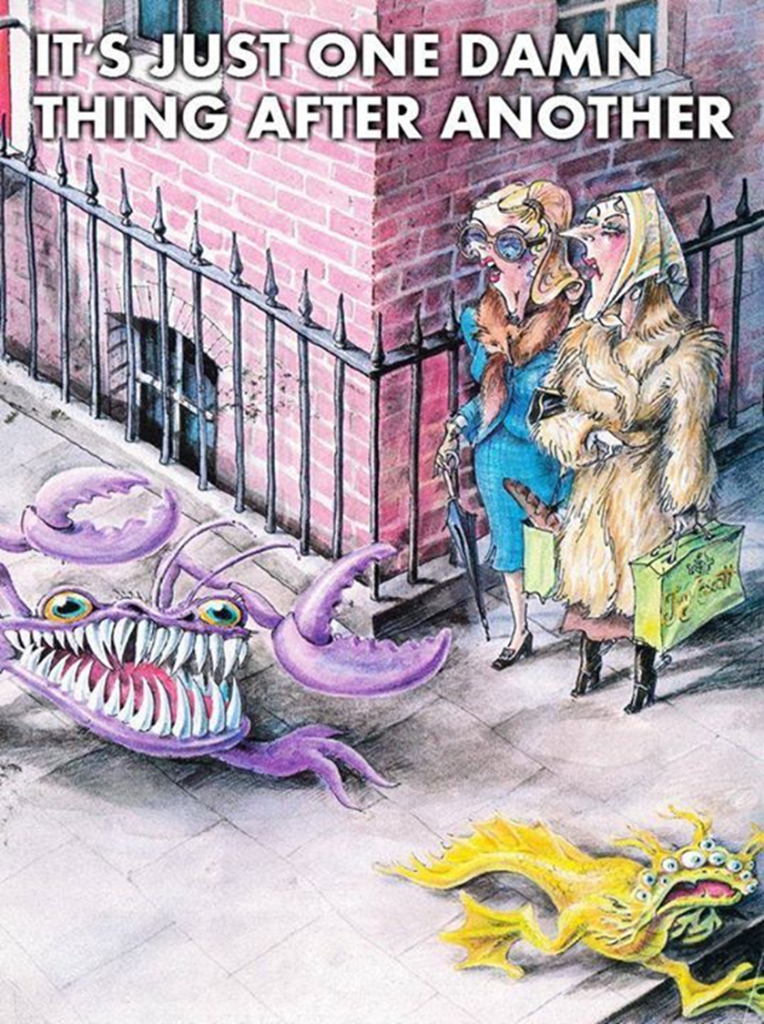


 Torch of Liberty